

Informatics: build your own digital assistant Lesson 65 of 72
Training a simple classifier
You teach a younger friend to sort cards: “read” goes with books; “geometry” with maths.
Where we are on the map
Lesson 65 of 72. AI and project release block (63–72). The assistant keeps its earlier reminder rules and local database; the new feature only suggests a task category and can abstain.
Situation and question
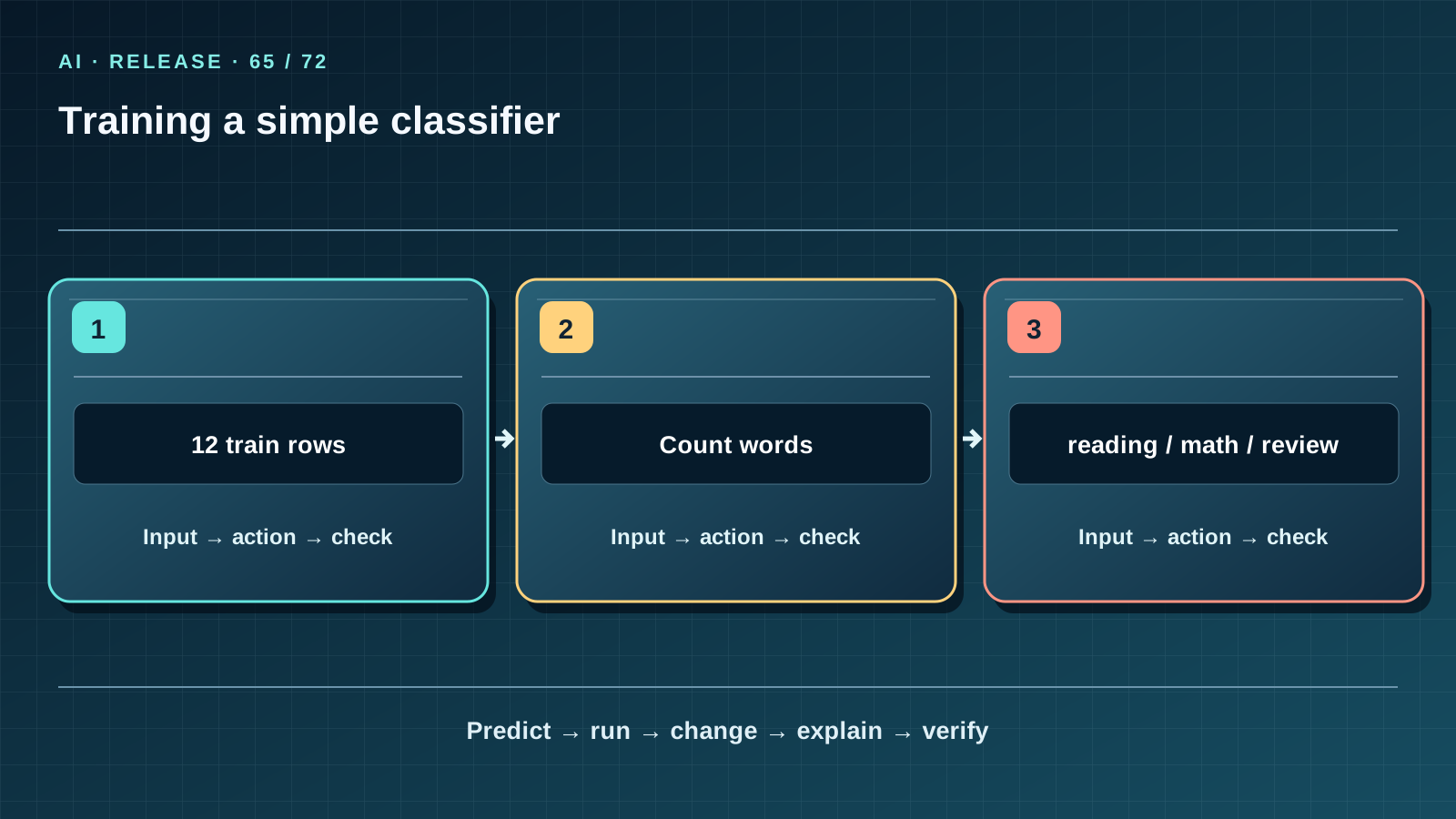
You teach a younger friend to sort cards: “read” goes with books; “geometry” with maths. Our code performs a very simple version by counting words in labelled teaching cards.
New words without gaps
Training here means counting word occurrences by train labels, not understanding a subject. Tokenisation extracts words from a title. A word weight counts how many training examples of one category contain it. A category score sums these weights for a new title. A tie, including no known words, returns review.
The lesson’s support signal
Read the three cells left to right, then cover the third. State the input and action in each cell; predict how the path ends and which observable fact checks it. Compare the drawing with a project file or worked example. If a number on the map cannot be derived from the data, correct the map rather than changing data for a pretty picture.
Work through it step by step
In step-07, run python3 classifier.py "Кітап оқу": expect suggestion: reading. For Геометрия есебі, expect math. Open classifier.py: train reads only split=train; suggest sums counters. For unfamiliar “Task without examples”, both scores are zero and the answer is review. Change one fictional training row and predict which score will move.
Predict and check
Write the expected output before running code. Execute it in step-06 or step-07, compare every character and explain each line. Then change one safe fictional input and repeat “predict — run — change — explain — verify.” Do not turn an observation on a tiny dataset into a promise about real people.
from classifier import read_examples, train, suggest
model = train(read_examples("labelled_tasks.csv"))
print(suggest("Кітап оқу", model), suggest("Геометрия есебі", model), suggest("unknown", model))
Expected output
reading math review
Catch the error
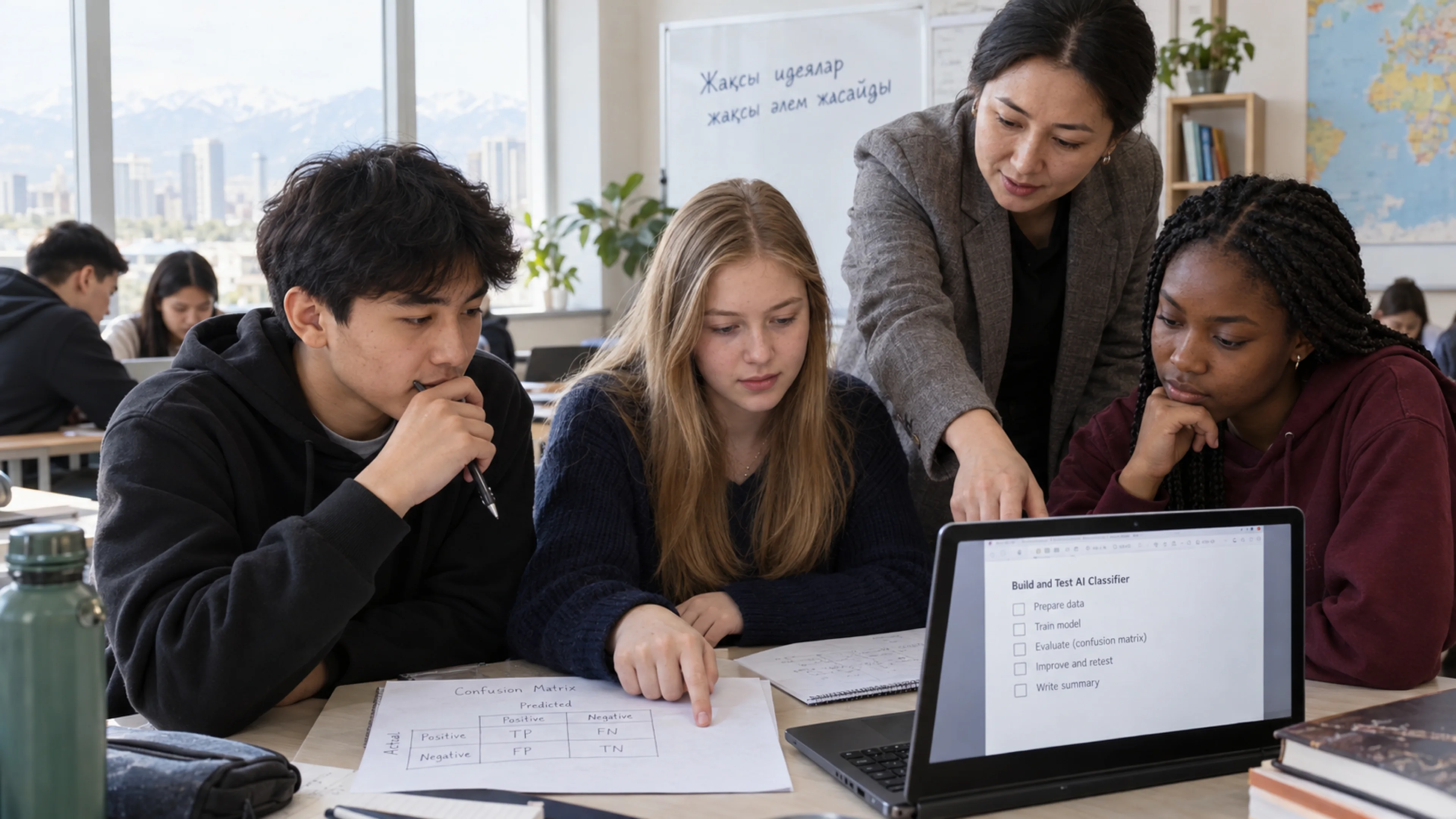
This is a toy classifier, not a large language model. It does not understand inflections, negation or context. Moving a convenient test row into training before evaluation breaks the evaluation.
Project change
Release 2.1 preserves the DB, report, reminders and backup. labelled_tasks.csv contains fictional examples only. classifier.py suggests math, reading or review but writes no decision to the database. Check each model output against held-out examples and let a person reconsider it.
Task and evidence
Compute scores by hand for titles with one familiar word. Show a tie. Then run tests and explain any discrepancy.
Transfer to a new setting
A mail sorter knows “bill” but encounters “billing”. Why might the word-splitting rule change its answer?
Return after 1, 7, and 30 days
After 1 day redraw the map from memory and name one boundary of the idea. After 7 days explain it to a friend without reading the lesson and answer 7 of 10 block questions; analyse mistakes with concrete inputs. After 30 days open a fresh project copy, reproduce the check and transfer the idea to a new case. Keep a record of input, expected output and actual output.
Primary reference to check
Next lesson
If you have found a mistake or a typo in this article, tell us about it
Comments (0)
Log in to leave a comment →
No comments yet. Be the first.