


Informatics: build your own digital assistant Lesson 71 of 72
Release 2.1: tests, instructions, and product handoff
A classmate downloads the project and asks “What runs first? What if the DB exists? When can I trust a model suggestion?” A release answers with runnable instructions and checks.
Where we are on the map
Lesson 71 of 72. AI and project release block (63–72). The assistant keeps its earlier reminder rules and local database; the new feature only suggests a task category and can abstain.
Situation and question
A classmate downloads the project and asks “What runs first? What if the DB exists? When can I trust a model suggestion?” A release answers with runnable instructions and checks.
New words without gaps
Version 2.1 is a fixed set of files and behaviour. A regression test checks that a new feature did not break an older rule. Documentation lists inputs, commands, results and limits. Product handoff means another person can reproduce the path without the author present.
The lesson’s support signal
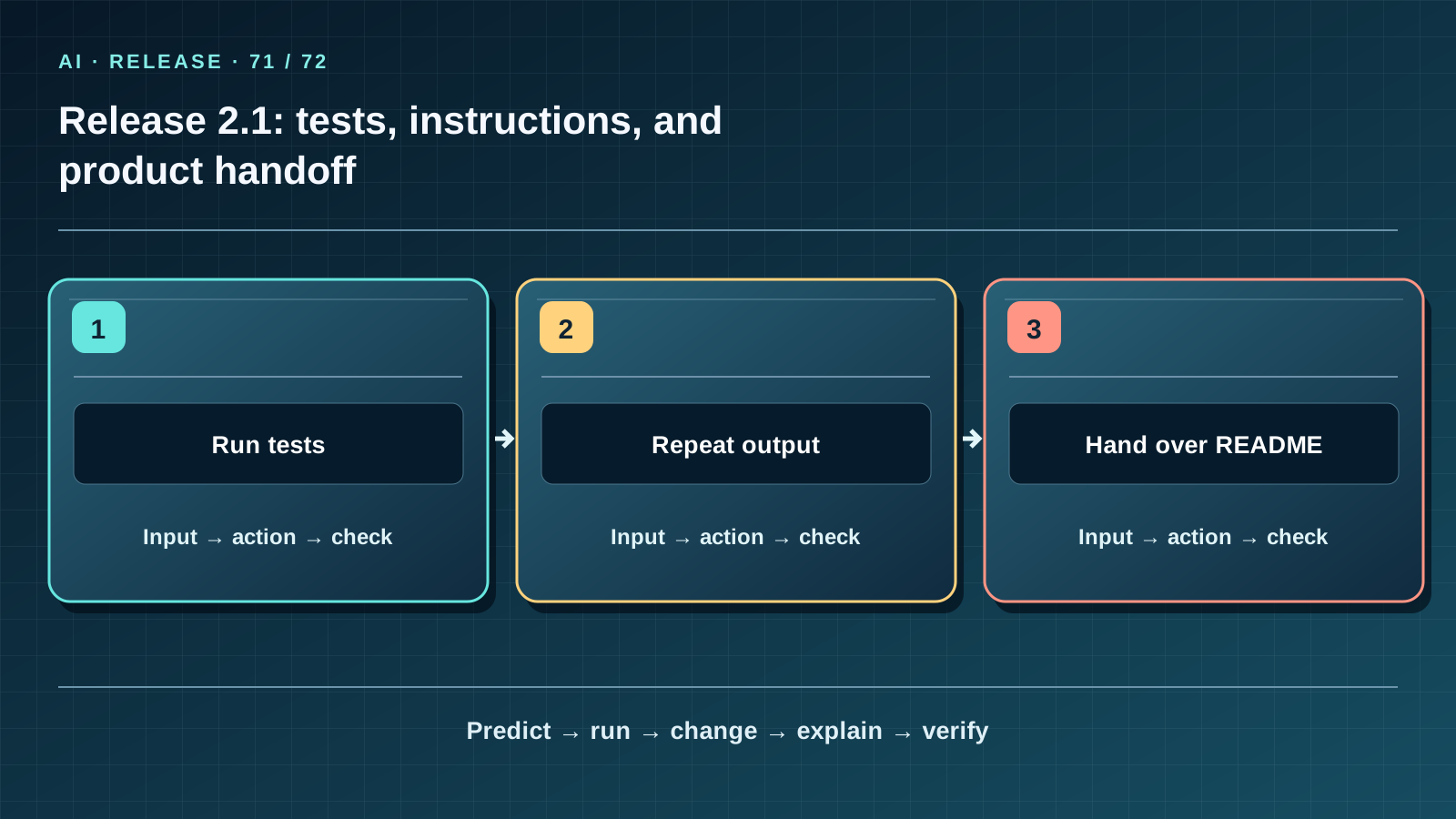
Read the three cells left to right, then cover the third. State the input and action in each cell; predict how the path ends and which observable fact checks it. Compare the drawing with a project file or worked example. If a number on the map cannot be derived from the data, correct the map rather than changing data for a pretty picture.
Work through it step by step
In step-07, run the tests: they cover earlier reminders and SQLite, backup and recovery, and the separate classifier. Create the DB only with init; run the 45/0/25 report; check classifier.py "Кітап оқу" and an unfamiliar phrase. Set the 4/4 held-out score beside a clear warning that the sample is tiny. Open the README for your language and give it to a classmate.
Predict and check
Write the expected output before running code. Execute it in step-06 or step-07, compare every character and explain each line. Then change one safe fictional input and repeat “predict — run — change — explain — verify.” Do not turn an observation on a tiny dataset into a promise about real people.
from classifier import read_examples, train, evaluate
rows = read_examples("labelled_tasks.csv")
print(len(rows), sum(evaluate(rows, train(rows)).values()))
Expected output
16 4
Catch the error
Passing tests do not prove the absence of all defects. Four correct predictions do not establish performance on real learners. The web server remains local and educational; the backup remains unencrypted.
Project change
Release 2.1 preserves the DB, report, reminders and backup. labelled_tasks.csv contains fictional examples only. classifier.py suggests math, reading or review but writes no decision to the database. Check each model output against held-out examples and let a person reconsider it.
Task and evidence
Write a short handoff protocol: commands, exact output, backup location, security limits and a way to report an error. Ask another learner to follow it without spoken hints.
Transfer to a new setting
A club wants to roll the app out across a school. Which tests and decisions are needed beyond our local classroom version?
Return after 1, 7, and 30 days
After 1 day redraw the map from memory and name one boundary of the idea. After 7 days explain it to a friend without reading the lesson and answer 7 of 10 block questions; analyse mistakes with concrete inputs. After 30 days open a fresh project copy, reproduce the check and transfer the idea to a new case. Keep a record of input, expected output and actual output.
Primary reference to check
Next lesson
Project defence: demonstrate a solution, an error, and a limitation
If you have found a mistake or a typo in this article, tell us about it
Comments (0)
Log in to leave a comment →
No comments yet. Be the first.