


Informatics: build your own digital assistant Lesson 13 of 18
How a computer distinguishes Ә, Я, and A
Find out how one file can preserve Kazakh Ә, Russian Я, and Latin A, and why a character is not necessarily one byte.
This text was translated with AI.
Where we are on the map
The previous block showed how to find files and separate a program from its data. Now we ask how data can carry meaning that another person and another program will read in the same way. State your first guess, test it with numbers, and record what you had to revise.
Everyday analogy and exact model
You send a friend the task name “Әлем.” If they see strange marks, the bytes may have been read using a different encoding from the one used to save them. Think of an address: one apartment number can take different amounts of space when written down.
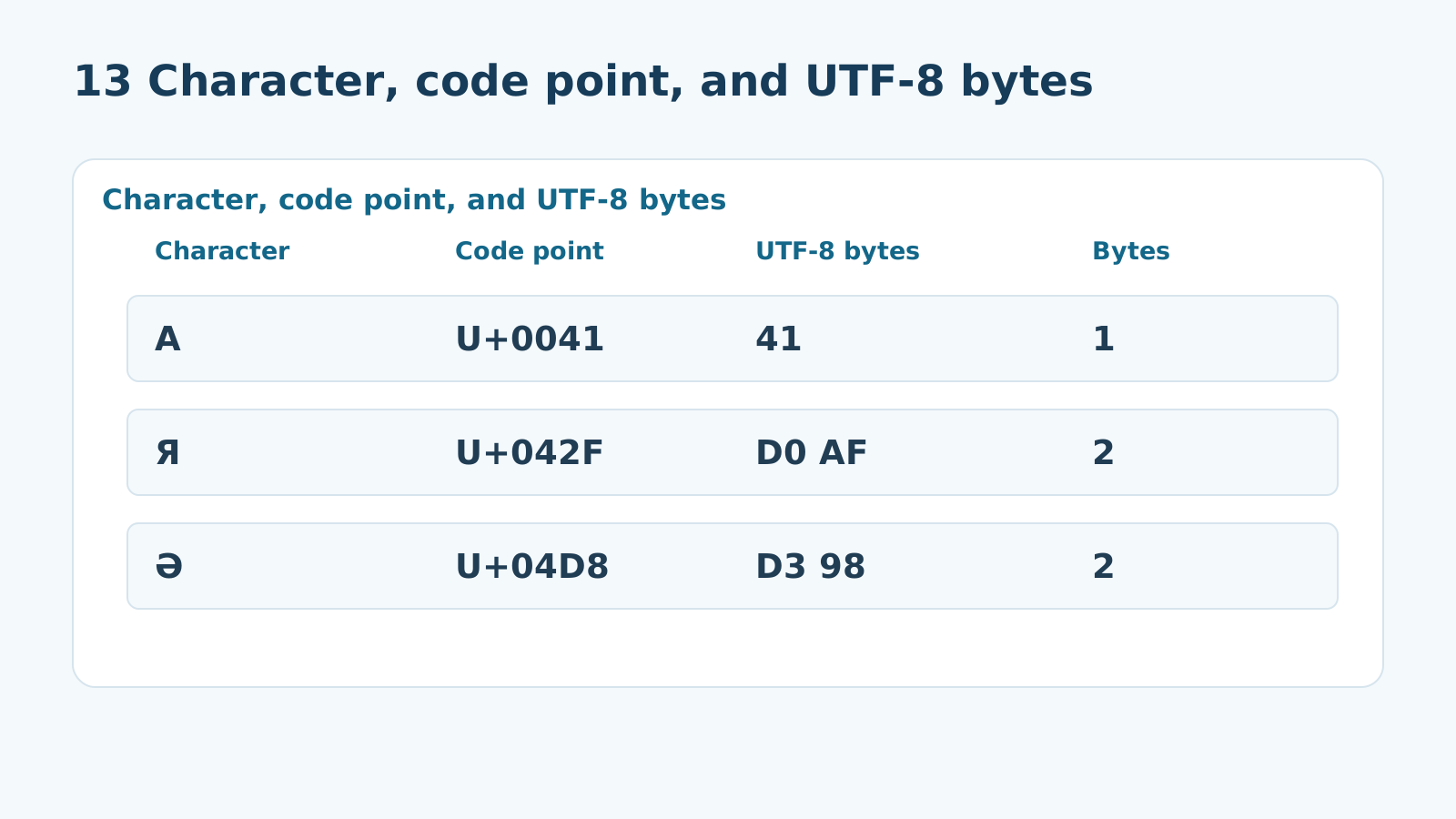
Unicode assigns code points to characters: A is U+0041, Я is U+042F, and Ә is U+04D8. UTF-8 turns code points into bytes: A → 41, Я → D0 AF, Ә → D3 98 (hexadecimal notation). Thus A takes one byte; Я and Ә take two bytes each in UTF-8. Counts of visible marks, code points, and bytes can differ, especially for combined characters.
Where the analogy ends
“One character is one byte” is false. A Unicode code point is not already a byte sequence: an encoding must be chosen for storage. Even one visible character can involve several code points, such as a letter followed by a separate accent mark.
The lesson’s support signal
visible mark → Unicode code point → UTF-8 encoding → bytes
Worked example
Record three rows: A / U+0041 / 41; Я / U+042F / D0 AF; Ә / U+04D8 / D3 98. The U+ value is a code point; the last value gives UTF-8 bytes. Read backwards: D3 98 in UTF-8 represents Ә.
Predict before observing
How many UTF-8 bytes does “AӘ” require? Count two characters first, then add 1 + 2 = 3 bytes. Do not include the file name or header.
Do not jump straight to the answer. Write your prediction and its reason first. Compare each intermediate step as well as the final result. If you were right by chance, repeat with different values.
Reconstruct without a hint
Without the table, explain why Я need not use the same number of bytes as A. Then check both concrete values against the table.
Cover the worked example with paper. Reconstruct the chain from the short support signal, explain every transition aloud, and then reveal the example to check yourself. If stuck, look back at only the preceding step.
Find and correct the mistake
“U+04D8 is the bytes D4 D8.” Correct the confusion between code point and encoding: UTF-8 stores Ә as D3 98. Name the encoding explicitly.
Transfer to a new situation
A friend saves Kazakh text as UTF-8, but another program reads it using a different encoding. Predict what might appear. Check the encoding on both sides, reopen the file, and compare it with the original text.
Project change
Create a test file with task title “Әлем” and the line “Я и A.” State in FORMAT.md that project files use UTF-8. Close and reopen the file; verify all three letters. Use no real personal data.
Exercise
Make a table for A, Я, Ә: code point, UTF-8 bytes, and byte count. Explain why counting visible characters cannot always give the exact text size.
Submit evidence that can be checked, rather than saying “I understood”: a table, calculation, file, or precise answer with a reason. Use fictional data. Ask another learner to repeat the action from your description; if they must guess, clarify the rule.
Return after 1, 7, and 30 days
Tomorrow reconstruct the path from mark to bytes. In a week explain the difference between U+04D8 and D3 98. In a month check that a file survives a move between two programs.
If you have found a mistake or a typo in this article, tell us about it
Comments (0)
Log in to leave a comment →
No comments yet. Be the first.