

Informatics: build your own digital assistant Lesson 62 of 72
Release 1.3: a protected and recoverable assistant
You hand the assistant to a classmate.
Where we are on the map
Lesson 62 of 72. Digital security block (55–62). We continue a local assistant with three fictional tasks. Each control has a defined boundary: the classroom version does not become a public service.
Situation and question
You hand the assistant to a classmate. Without spoken hints, they should open the page, obtain the same report and restore a damaged teaching copy. That is the release 1.3 test.
New words without gaps
A checkpoint is concrete code, data, commands and expected output. Recovery rebuilds a working copy from a verified one. A threat model explains what is protected and what lies outside the boundary. Residual risk is trouble still possible after controls are applied.
The lesson’s support signal
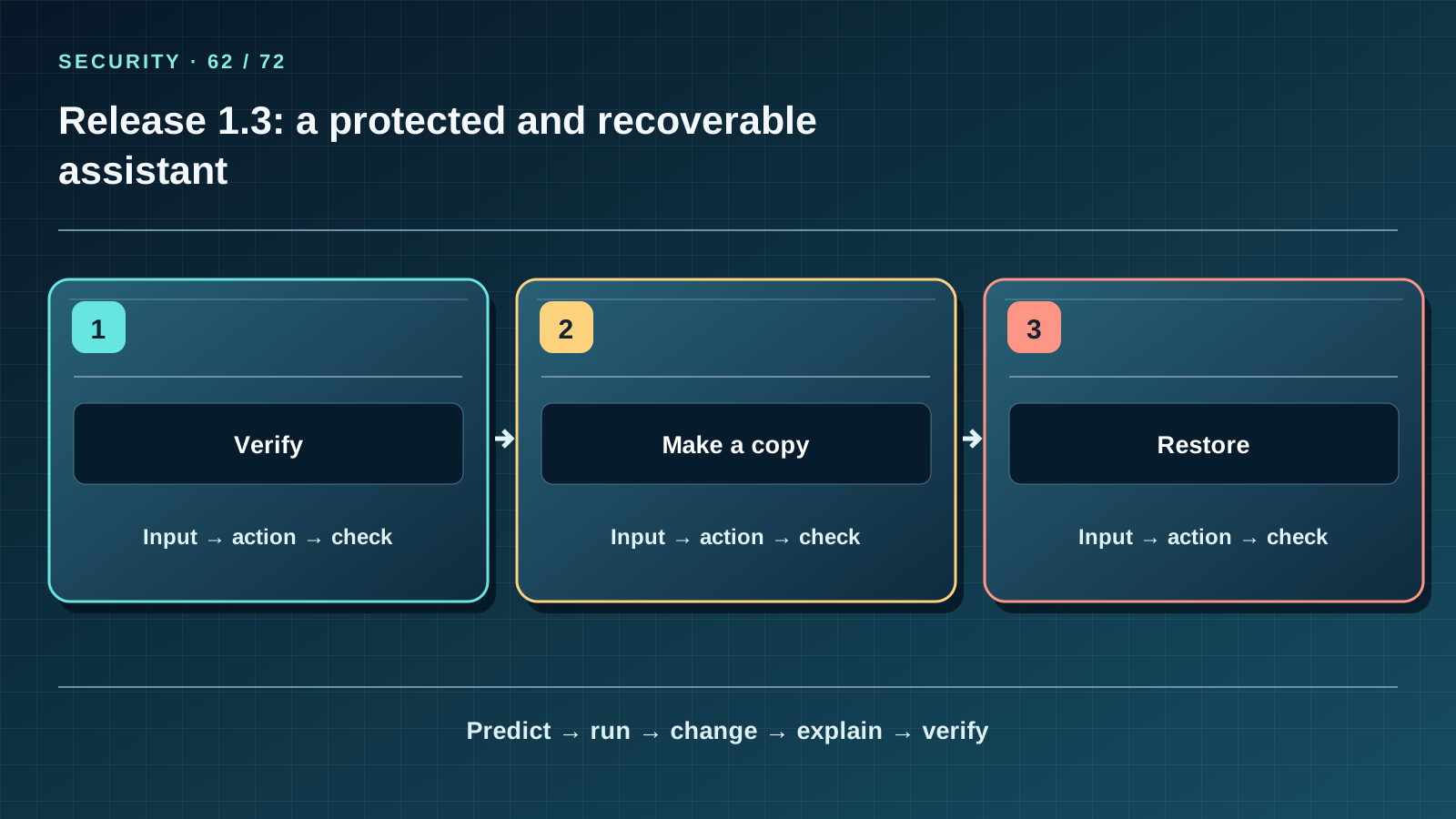
Read the three cells left to right, then cover the third. State the input and action in each cell; predict how the path ends and which observable fact checks it. Compare the drawing with a project file or worked example. If a number on the map cannot be derived from the data, correct the map rather than changing data for a pretty picture.
Work through it step by step
In step-06, run python3 data_assistant.py init, then python3 security_assistant.py verify assistant.db: expect tasks=3 sessions=4. Make a backup, restore into a new file and compare the 45/0/25 report. Check the page on 127.0.0.1: it still shows three tasks and REMIND, DONE, NO_DATE. Stop the server. Never commit the database, backup or checksum.
Predict and check
Write the expected output before running code. Execute it in step-06 or step-07, compare every character and explain each line. Then change one safe fictional input and repeat “predict — run — change — explain — verify.” Do not turn an observation on a tiny dataset into a promise about real people.
from pathlib import Path
from tempfile import TemporaryDirectory
from data_store import create_database, minutes_report
from security_assistant import backup, restore, verify
with TemporaryDirectory() as folder:
    a, b, c = (Path(folder) / name for name in ("a.db", "b.db", "c.db"))
    create_database(a, "tasks.json", "study_sessions.csv")
    backup(a, b); restore(b, c)
    print(verify(c), minutes_report(c))
Expected output
(3, 4) [('t-01', 45), ('t-02', 0), ('t-03', 25)]
Catch the error
Release 1.3 is protected only within its classroom boundary: local viewing, no overwrite, integrity checks and recovery. It has no accounts, encrypted backup or public-server protection. Do not put it on the internet.
Project change
Release 1.3 preserves the three tasks, four sessions and reminder rules. New operations live in security_assistant.py: validation, a separate backup and restore only into a new file. State which threat each change reduces and which it does not; all teaching data stay fictional.
Task and evidence
Show five pieces of evidence: three tasks, four sessions, the 45/0/25 report, a verified restore and refusal of a tampered backup. Answer 8 of 10 review questions now and 7 without hints in a week.
Ten questions for self-check
- What does mode=ro protect?
- What is the asset?
- How do threat and vulnerability differ?
- Why use distinct salts?
- Why are two passwords not two factors?
- What should you do with a phishing link?
- How does a hash differ from encryption?
- What does 3/4 mean?
- Why restore to a new file?
- What remains outside release 1.3?
Transfer to a new setting
A friend suggests exposing the server port to the whole class. What new requirements must be met first?
Return after 1, 7, and 30 days
After 1 day redraw the map from memory and name one boundary of the idea. After 7 days explain it to a friend without reading the lesson and answer 7 of 10 block questions; analyse mistakes with concrete inputs. After 30 days open a fresh project copy, reproduce the check and transfer the idea to a new case. Keep a record of input, expected output and actual output.
Primary reference to check
Next lesson
If you have found a mistake or a typo in this article, tell us about it
Comments (0)
Log in to leave a comment →
No comments yet. Be the first.