


Informatics: build your own digital assistant Lesson 29 of 38
Expressions without hidden conversions
Write the reminder condition as a readable expression and check operation order without hidden text-to-number conversion.
Where we are on the map
This is lesson 29 of 72 in the Python block (27–38). The support map shows verifiable transitions. We continue the 0.3 paper contract: five reminder outcomes and the original fictional tasks.
Situation and question
The assistant should remind us when a task is unfinished and zero to two days remain. A learner writes one long expression and gets an unexpected True. Which comparison runs first? Instead of guessing, split the rule into small questions, as with the paper cards.
New words without gaps
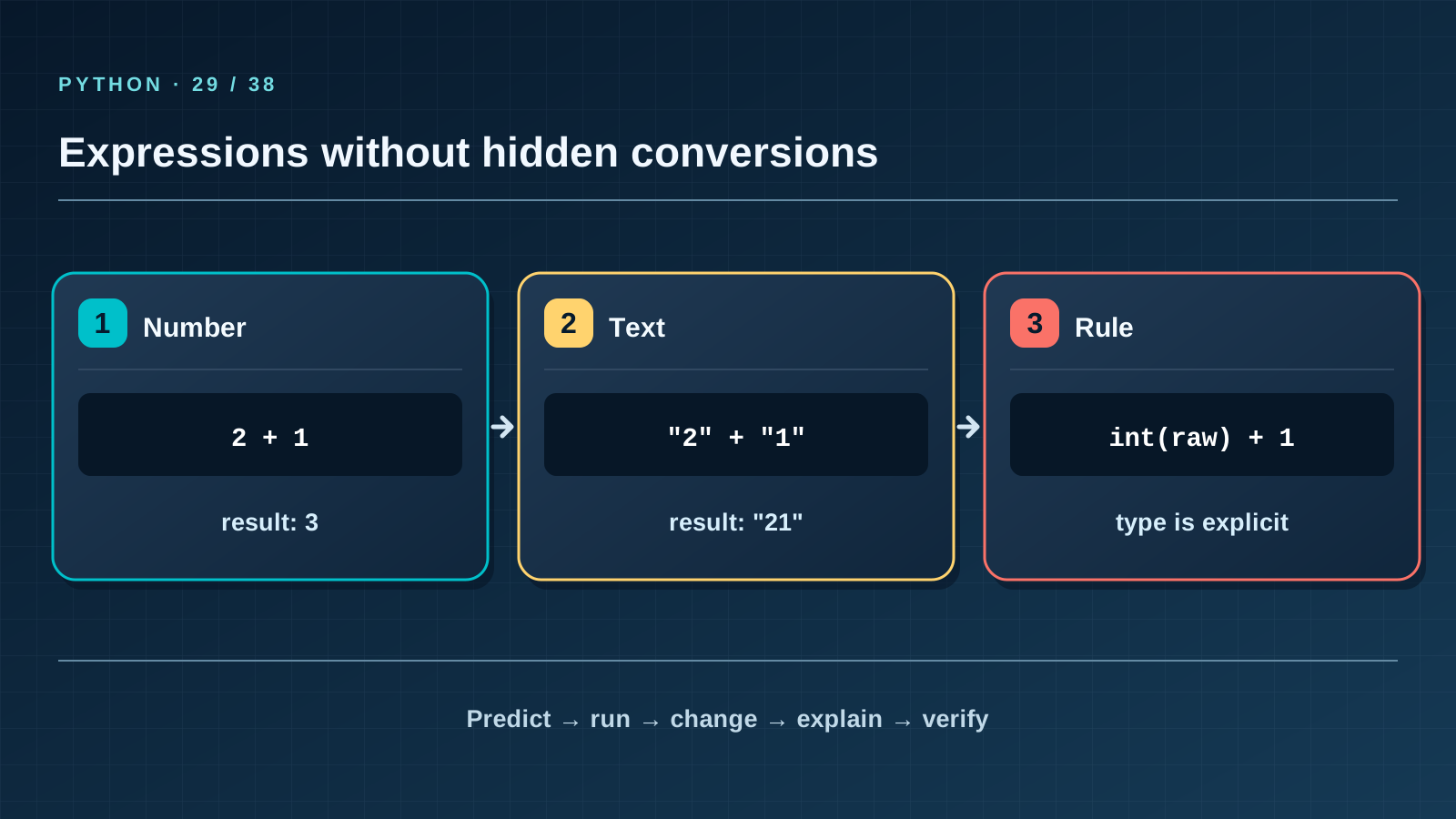
An expression computes a value: days + 1 yields a number; days <= 2 yields a Boolean. An operator says what to do: +, <=, and, not. Operands are the values it acts on. Precedence sets the order: multiplication precedes addition; parentheses make intent explicit. and needs both parts true; not done reverses a Boolean. The chained comparison 0 <= days <= 2 includes both ends. Python will not add string "2" to number 1 as arithmetic; convert its type first.
The lesson’s support signal
Input → check the rule → change state → observable result. Point to where the program reads data, compares it with the contract, and merely reports the result. If a step is absent from the map, find it in the code and add it to your own trace.
Work through it step by step
Try done=False, days=2: not done is True and 0 <= 2 <= 2 is also True, so the whole condition is True. Change only days to −1: the lower boundary becomes false. Then set done=True: even with two days left, no reminder is needed. In the example’s second line 3 * 4 happens before adding 2, giving 14 rather than 20. Draw two small tables before running it.
Predict and check
Cover the output block. Trace names line by line and write the exact predicted text, including case and line order. Only then run the code with python3 from step-03 and compare character by character. Change one input and predict again before running. If results differ, find the first divergent line instead of adjusting the prediction afterwards.
days = 2
limit = 2
print(days + 1)
print(days <= limit)
Expected output
3
True
Catch the error
The expression days <= 2 accidentally includes −1: that task is overdue, not upcoming. Repair it by adding the lower bound 0 <= days. This expression does not yet handle a missing date (None); do not compare None with a number. Check whether a number exists first.
Project change
Record not done and 0 <= days <= 2 as a temporary check of numbers on test cards. Until the file gains a date, do not present that number as a stored deadline.
Task and evidence
Make a table for days = −1, 0, 1, 2, 3 with each value of done. Fill ten answers in pencil before running code in a loop or by hand. For each mistaken prediction, identify the exact part of the expression that changed the result. “Python decided so” is not an explanation.
Transfer to a new setting
A school club accepts applications through 18:00 inclusive. Which comparisons distinguish 17:59, 18:00, and 18:01? Minutes and time zone matter here; our calendar-day expression transfers as a boundary idea, not ready-made code.
Return after 1, 7, and 30 days
After 1 day, recall the rule and one boundary case without this page. After 7 days, explain a new error example to a classmate. After 30 days, rerun the project test, check earlier records and output still match, and transfer the rule to a different task again.
Next lesson
If you have found a mistake or a typo in this article, tell us about it
Comments (0)
Log in to leave a comment →
No comments yet. Be the first.