


Informatics: build your own digital assistant Lesson 32 of 38
Lists and dictionaries for many tasks
Collect tasks in a list, read dictionary fields, and reject a duplicate `id` before it corrupts an answer.
Where we are on the map
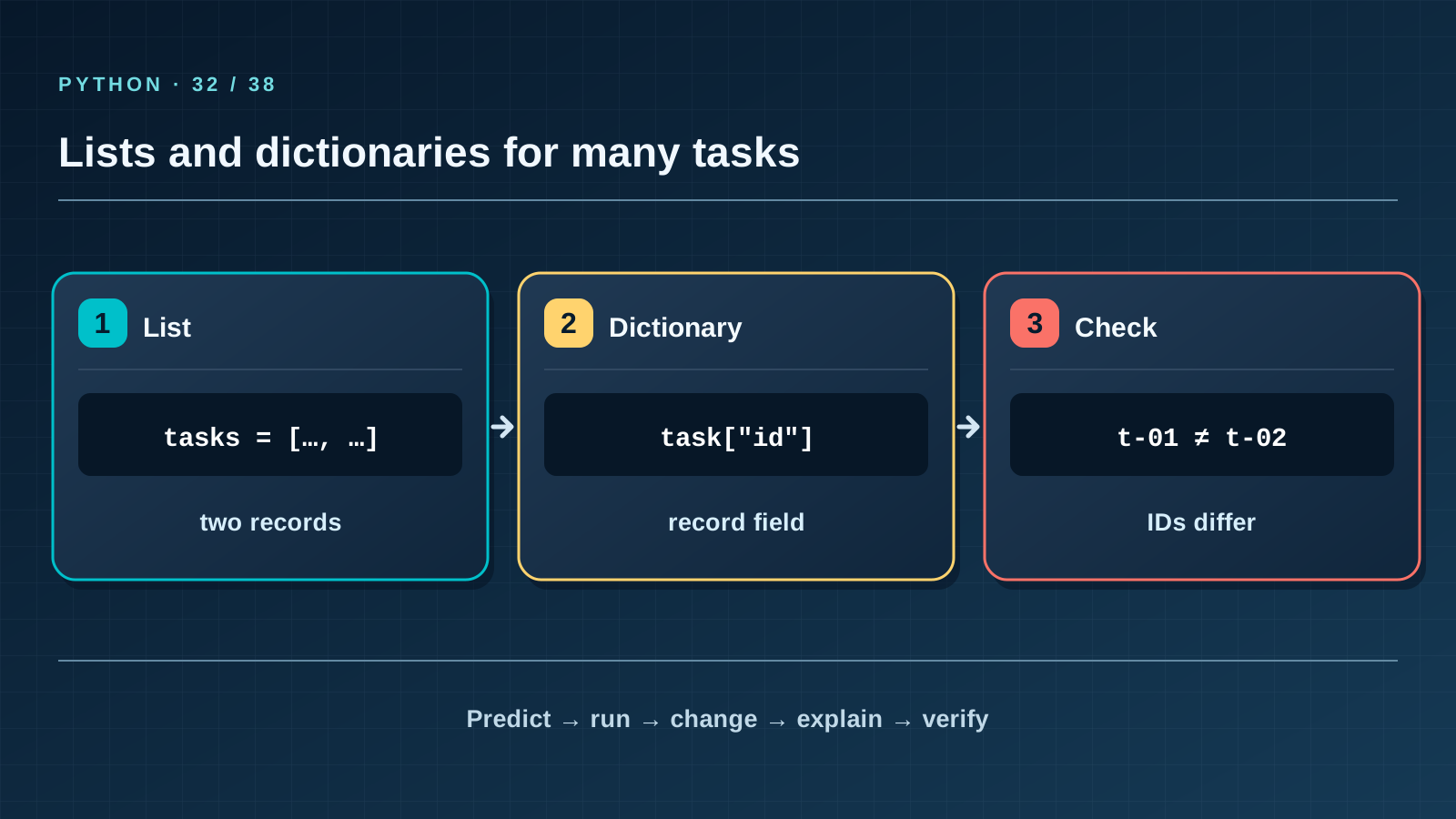
This is lesson 32 of 72 in the Python block (27–38). The support map shows verifiable transitions. We continue the 0.3 paper contract: five reminder outcomes and the original fictional tasks.
Situation and question
On paper each task was a separate card. In a file it becomes fields: id, title, done, later due_date. How do we find one when titles repeat? Why is the same id on two different cards dangerous? Choose data structures by the job they must do.
New words without gaps
A list [] keeps tasks in order and lets us visit them all. A dictionary {} maps a key to a value: task["id"] reads one task’s field. Here a key is a field name; do not confuse it with a task’s unique identifier. An index is a list position starting at zero. A set set() stores unique values and catches a repeated id. A dictionary indexed by task ID, by_id, makes lookup convenient, but building it before checking duplicates silently overwrites an earlier record.
The lesson’s support signal
Input → check the rule → change state → observable result. Point to where the program reads data, compares it with the contract, and merely reports the result. If a step is absent from the map, find it in the code and add it to your own trace.
Work through it step by step
Lay out two cards: id=t-01, done=False and id=t-02, done=True. The list preserves their order; by_id maps each ID to its card. The code below prints True for t-02. Add a third card also named t-02: a plain dictionary construction hides one of them. Walk the list with a seen set first and stop on the duplicate.
Predict and check
Cover the output block. Trace names line by line and write the exact predicted text, including case and line order. Only then run the code with python3 from step-03 and compare character by character. Change one input and predict again before running. If results differ, find the first divergent line instead of adjusting the prediction afterwards.
tasks = [{"id": "t-01", "done": False}, {"id": "t-02", "done": True}]
for task in tasks:
    print(task["id"], task["done"])
Expected output
t-01 False
t-02 True
Catch the error
Two tasks may both be titled “Кітап оқу” and have different IDs; that is not a duplicate. Two records with one ID and different titles are duplicates. Checking titles fails in both directions. Another trap: tasks[1] means the second item, not the task whose id is 1.
Project change
Move the three original tasks into a list of dictionaries without changing their values. Validate uniqueness before counting or reminding: bad input must not produce a convincing-looking answer.
Task and evidence
Make a list of the three original tasks and a duplicate-ID check using seen. Test the empty list, the original three, t-01,t-02,t-01, and two equal titles with distinct IDs. Draw the set contents after each step. Build by_id only after validation succeeds.
Transfer to a new setting
A library can hold two books with one title but different inventory IDs. Which structure preserves checkout order, and which finds a book by ID quickly? Where will you reject a repeated ID?
Return after 1, 7, and 30 days
After 1 day, recall the rule and one boundary case without this page. After 7 days, explain a new error example to a classmate. After 30 days, rerun the project test, check earlier records and output still match, and transfer the rule to a different task again.
Next lesson
If you have found a mistake or a typo in this article, tell us about it
Comments (0)
Log in to leave a comment →
No comments yet. Be the first.