


Informatics: build your own digital assistant Lesson 33 of 38
Text, dates, and Kazakh Unicode
Preserve Kazakh text and turn a date string into a calendar-day distance from a deadline.
Where we are on the map
This is lesson 33 of 72 in the Python block (27–38). The support map shows verifiable transitions. We continue the 0.3 paper contract: five reminder outcomes and the original fictional tasks.
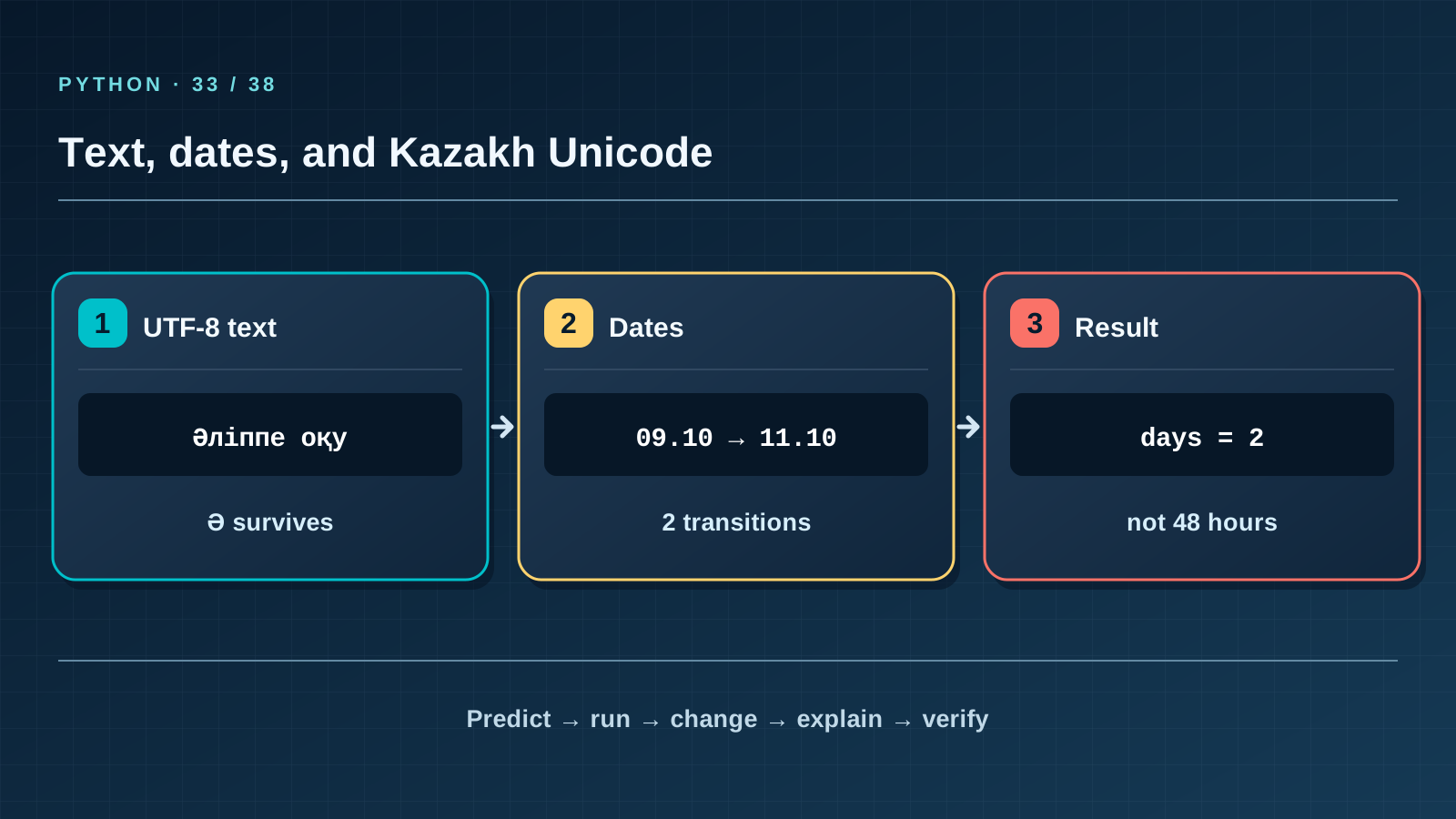
Situation and question
A task says “Әліппе оқу.” After saving, Ә becomes unreadable, while someone calls 2026-10-11 “two days away” without naming today’s date. These are separate faults: lost characters and an unstated reference date. Investigate both with reproducible data.
New words without gaps
Unicode assigns code points to characters, letting Ә and A remain different letters. UTF-8 encodes those characters as bytes; reading and writing must agree on encoding. The string "2026-10-11" is still just text. A date is a calendar day that Python can subtract. The ISO format YYYY-MM-DD fixes year–month–day order. A time zone determines what calendar day it is where the user lives. This experiment explicitly sets today to 9 October 2026; it does not pretend that the old 0.2 file stores a due date.
The lesson’s support signal
Input → check the rule → change state → observable result. Point to where the program reads data, compares it with the contract, and merely reports the result. If a step is absent from the map, find it in the code and add it to your own trace.
Work through it step by step
Write 2026-10-09 and 2026-10-11 on two cards and mark two calendar transitions. In code date.fromisoformat turns strings into dates, subtraction yields a timedelta, and .days gives integer 2. Ә prints correctly when the source file and terminal use UTF-8. Change the deadline to 2026-02-29: Python rejects a nonexistent day; this is useful evidence, not a reason to round the date.
Predict and check
Cover the output block. Trace names line by line and write the exact predicted text, including case and line order. Only then run the code with python3 from step-03 and compare character by character. Change one input and predict again before running. If results differ, find the first divergent line instead of adjusting the prediction afterwards.
from datetime import date
today = date.fromisoformat("2026-10-09")
due = date.fromisoformat("2026-10-11")
print("Әліппе оқу", (due - today).days)
Expected output
Әліппе оқу 2
Catch the error
Two calendar days are not always exactly 48 hours: a deadline may be in the morning while it is now evening. Version 0.3 specifies calendar dates. An alarm or stopwatch needs time of day and a time zone; do not reuse this calculation blindly.
Project change
Version 1.0 will store a due date in a separate due_date field as an ISO date string or null. Do not confuse it with the paper cards’ days_to_due: that number is computed from the date and chosen today.
Task and evidence
Use three fictional titles, one containing Ә, one Я, and one Latin A. Save and read them in UTF-8 without loss. For fixed today=2026-10-09, compute deadlines on 8, 9, 11, and 12 October: expect −1, 0, 2, 3. Show that 29 February 2026 is rejected before any reminder is made.
Transfer to a new setting
An international class is scheduled for “10 October, 09:00” without a time zone. Can a learner in Qostanay calculate exact hours remaining? Name the missing input that must be requested.
Return after 1, 7, and 30 days
After 1 day, recall the rule and one boundary case without this page. After 7 days, explain a new error example to a classmate. After 30 days, rerun the project test, check earlier records and output still match, and transfer the rule to a different task again.
Next lesson
If you have found a mistake or a typo in this article, tell us about it
Comments (0)
Log in to leave a comment →
No comments yet. Be the first.