


Informatics: build your own digital assistant Lesson 18 of 18
Mastery checkpoint: the assistant's data format
Assemble version 0.2 of the Digital Assistant: a format for three fictional tasks, reading rules, and evidence that copies survive.
This text was translated with AI.
Where we are on the map
The previous block showed how to find files and separate a program from its data. Now we ask how data can carry meaning that another person and another program will read in the same way. State your first guess, test it with numbers, and record what you had to revise.
Everyday analogy and exact model
Imagine handing the project to a classmate without an explanation. They must open the file, see three tasks, understand its fields, and recover the same data after copying. If they must call the author, the format is not ready.
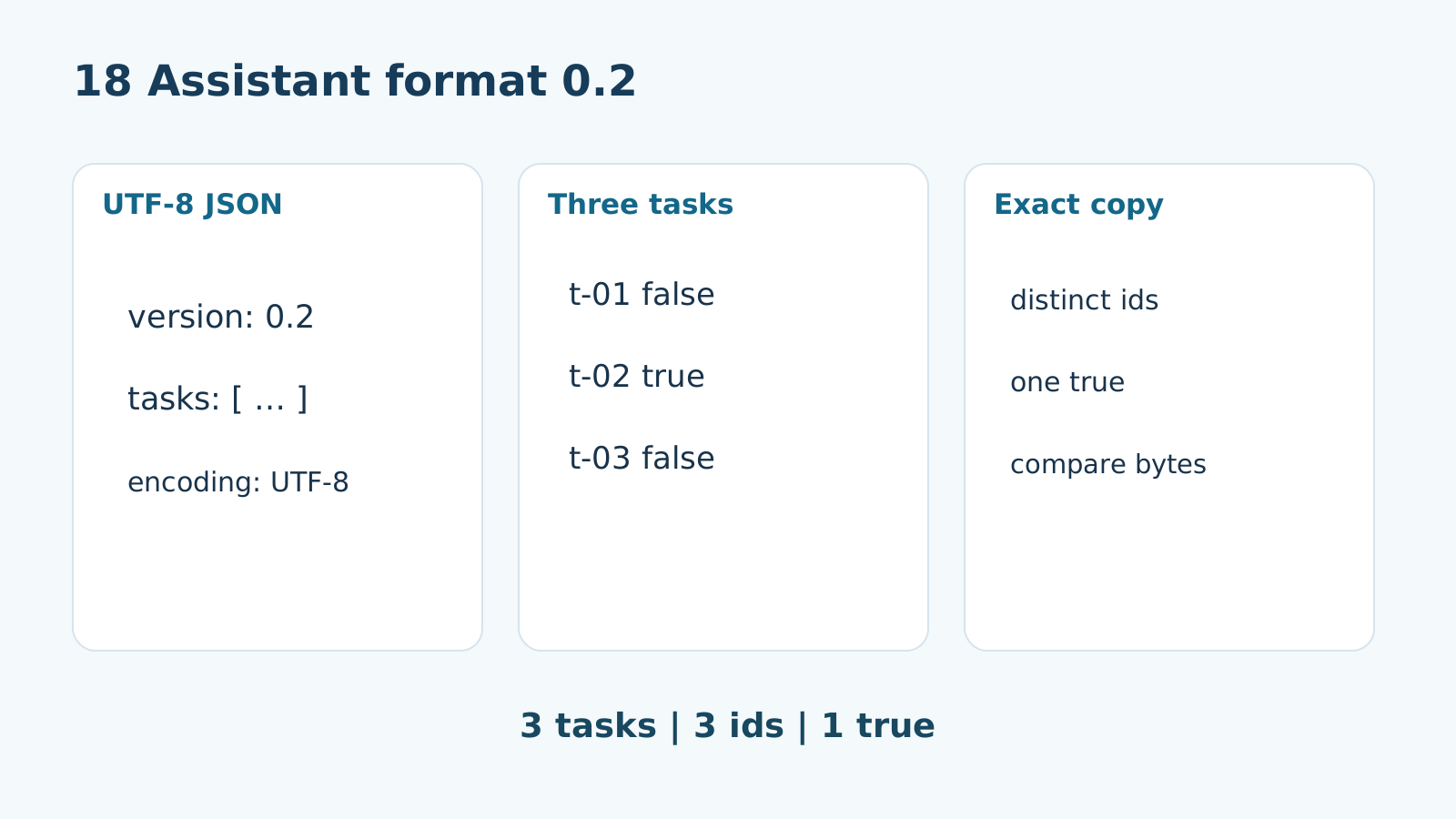
A data format is an agreement about structure and meaning. Version 0.2 uses UTF-8 JSON with a version field and a tasks array. Each task has a unique text id, a title, and a Boolean done. Three fictional records are t-01 “Кітап оқу” false; t-02 “Сурет салу” true; t-03 “Есеп шығару” false. JSON object field order does not change meaning, while array element order may matter for display. Store the file losslessly and compare an exact copy after transfer.
Where the analogy ends
Textual JSON does not store done as a single physical bit. Equal line counts do not prove files equal. The classroom checksum from the prior lesson is not a security measure. For a practical exact-copy check use byte comparison or a cryptographic hash from a trusted source.
The lesson’s support signal
three fictional tasks → UTF-8 JSON → reopen → check fields → compare copy
Worked example
Write {“version”:“0.2”,“tasks”:[{“id”:“t-01”,“title”:“Кітап оқу”,“done”:false},{“id”:“t-02”,“title”:“Сурет салу”,“done”:true},{“id”:“t-03”,“title”:“Есеп шығару”,“done”:false}]}. Check three distinct ids, three titles, and exactly one true. Save as data/tasks.json in UTF-8.
Predict before observing
If a copied file changes t-02 done to false, can it still be valid JSON? Yes. Does it preserve the original data? No. Syntax validation and exact-copy checking are separate tests.
Do not jump straight to the answer. Write your prediction and its reason first. Compare each intermediate step as well as the final result. If you were right by chance, repeat with different values.
Reconstruct without a hint
Hide the sample and describe the required fields of one task yourself. Reopen the file and check that you have not turned Boolean false into the string “false”.
Cover the worked example with paper. Reconstruct the chain from the short support signal, explain every transition aloud, and then reveal the example to check yourself. If stuck, look back at only the preceding step.
Find and correct the mistake
“The file opened, so its data are correct.” Correct this: opening is only step one. Check the schema, three ids, done values, and copy equality.
Transfer to a new situation
Give the format to a classmate using another operating system. They should open Ә in a new fictional task title without corruption and explain the role of UTF-8; changing platforms must not change the meaning.
Project change
Create data/tasks.json and FORMAT.md. In FORMAT.md describe UTF-8, version=0.2, required fields, valid done values, unique ids, and a check sequence. Keep a backup and compare it with the source byte by byte or with SHA-256.
Exercise
Complete the checkpoint: 8/10 checks now, including independent transfer to an unfamiliar record, and 7/10 in seven days. Show the file, rules, and comparison result. If you miss a step, fix its rule and repeat on a comparable new example.
Check ten points: (1) UTF-8; (2) valid JSON; (3) version = 0.2; (4) the original three tasks; (5) all ids distinct; (6) title is nonempty text; (7) done is a Boolean, not a string; (8) exactly one true; (9) a new fictional record follows the same rules; (10) the backup matches the source byte for byte. Points 9 and 10 are required for a pass at 8/10.
Submit evidence that can be checked, rather than saying “I understood”: a table, calculation, file, or precise answer with a reason. Use fictional data. Ask another learner to repeat the action from your description; if they must guess, clarify the rule.
Return after 1, 7, and 30 days
Tomorrow recall the three task fields without the page. In seven days ask someone else to add a fictional record using FORMAT.md and check at least 7/10 items. In a month reopen the copy and explain the whole path from character to byte.
If you have found a mistake or a typo in this article, tell us about it
Comments (0)
Log in to leave a comment →
No comments yet. Be the first.