

Go: from zero to your own blog Lesson 43 of 50
`context`: stopping work in time
The forty-third lesson of the Go course. The reader closed the tab, and the handler learns of it by itself: measured here, it drops the work after two hundred milliseconds. A deadline for a query, a key of your own type instead of a string, and the promised move of the signed-in person into the request's context.
Why this matters
The handlers of the past lessons assume the reader is waiting. The reader is not always.
They close the tab, lose the signal in a lift, press reload halfway through. The server has no idea: it keeps going to the database, computing and assembling an answer nobody will take. With ten such readers it goes unnoticed; with ten thousand it is half the server’s work wasted.
There is the opposite trouble too: a query to the database that hangs. With no deadline it holds one connection from the pool, then a second, then all of them — and the blog stops answering everybody because of one slow query.
Both are solved by the same thing — a context.
The whole thing at once
A new folder, go mod init sabaq40:
package main

import (
	"context"
	"database/sql"
	"errors"
	"fmt"
	"log"
	"net/http"
	"net/http/httptest"
	"time"

	_ "modernc.org/sqlite"
)

func main() {
	db, err := sql.Open("sqlite", ":memory:")
	if err != nil {
		log.Fatal(err)
	}
	defer db.Close()

	fmt.Println("== the reader closed the tab")
	cancelled()

	fmt.Println()
	fmt.Println("== a query given half a second")
	fmt.Println("fast:  ", count(db, 100*1000, 500*time.Millisecond))
	fmt.Println("slow:  ", count(db, 100*1000*1000, 500*time.Millisecond))
}

// cancelled starts a slow handler and cuts the request off halfway.
func cancelled() {
	done := make(chan string, 1)

	srv := httptest.NewServer(http.HandlerFunc(func(w http.ResponseWriter, r *http.Request) {
		start := time.Now()
		select {
		case <-time.After(2 * time.Second):
			done <- "finished the work"
		case <-r.Context().Done():
			// The request's context closes by itself once the reader is gone.
			done <- fmt.Sprintf("dropped the work after %s: %v",
				time.Since(start).Round(10*time.Millisecond), r.Context().Err())
		}
	}))
	defer srv.Close()

	// A client that gives up after two hundred milliseconds.
	ctx, cancel := context.WithTimeout(context.Background(), 200*time.Millisecond)
	defer cancel()

	req, _ := http.NewRequestWithContext(ctx, http.MethodGet, srv.URL, nil)
	if _, err := http.DefaultClient.Do(req); err != nil {
		fmt.Println("the reader: left —", context.Cause(ctx))
	}
	fmt.Println("the handler:", <-done)
}

// count counts in the database slowly on purpose: a recursive query of n steps.
func count(db *sql.DB, n int, limit time.Duration) string {
	ctx, cancel := context.WithTimeout(context.Background(), limit)
	defer cancel()

	start := time.Now()
	var got int
	err := db.QueryRowContext(ctx, `with recursive nums(i) as (
		select 1 union all select i + 1 from nums where i < ?
	) select count(*) from nums`, n).Scan(&got)

	switch {
	case errors.Is(err, context.DeadlineExceeded):
		return fmt.Sprintf("cut off after %s: %v", time.Since(start).Round(10*time.Millisecond), err)
	case err != nil:
		return "error: " + err.Error()
	}
	return fmt.Sprintf("counted %d in %s", got, time.Since(start).Round(10*time.Millisecond))
}
The output:
== the reader closed the tab
the reader: left — context deadline exceeded
the handler: dropped the work after 200ms: context canceled

== a query given half a second
fast:   counted 100000 in 60ms
slow:   cut off after 500ms: context deadline exceeded
Taking it apart
A request’s context closes by itself
Every request has a context of its own: r.Context(). Nobody makes it by hand — http.Server does, and it closes by itself once the connection to the reader is gone.
All a handler has to do is listen:
select {
case <-time.After(2 * time.Second):
	// the work finished
case <-r.Context().Done():
	// the reader left
}
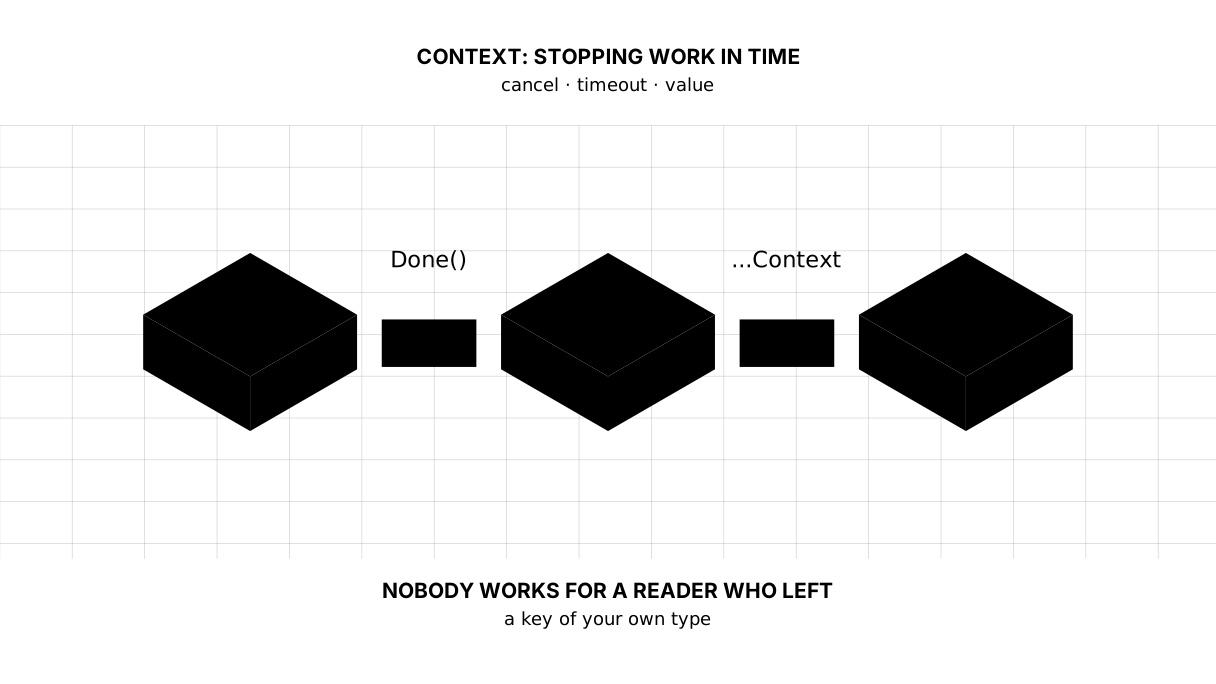
Done() is a channel that closes at the moment of cancellation. The output shows it: the reader gave up after two hundred milliseconds, and after exactly two hundred milliseconds the handler dropped two seconds of work.
Err() says why: context canceled — cancelled; context deadline exceeded — out of time.
Picture it. A waiter who has been told the guest has left. They will not carry the hot dish to an empty table and wait for it to go cold — they turn back halfway.
A deadline for the work: WithTimeout
The second half of the output is about something else: the reader did not leave, the work dragged on.
ctx, cancel := context.WithTimeout(context.Background(), limit)
defer cancel()
WithTimeout makes a new context that cancels itself after the given time. The fast query made it in sixty milliseconds; the slow one was cut off at exactly five hundred.
defer cancel() is compulsory, and not for tidiness: WithTimeout starts a timer and cancel releases it. Forget it and the timer lives to its deadline; on a busy server such forgotten timers pile up. Go complains about it when the code is checked, and rightly.
Notice where the parent came from: context.Background() is the “empty” context, the root of a chain. In a handler the parent must be r.Context() rather than Background: then a cancellation by the reader cuts the query to the database off as well.
Why database/sql has the ...Context twins
Now it is clear what those twin methods are for: QueryContext, QueryRowContext, ExecContext.
An ordinary QueryRow knows nothing about cancellation: it will wait for the database as long as the database likes. The version with a context hands the driver a deadline, and when it passes the query is cut off on the database’s side — the connection goes back to the pool instead of hanging.
The rule is simple: in a handler always ...Context, and always with r.Context(). The plain versions stay for scripts and migrations, where there is nobody to cancel.
A context is the first argument
func (s *Store) Get(ctx context.Context, slug string) — that is how any function that can wait looks.
The context goes first and is called ctx. That is not a matter of style but a convention of the whole ecosystem: the standard library is written that way, every driver is written that way, and when you do the same your code reads without explanation.
What is not done: a context is not kept as a field in a struct. A context lives exactly as long as one call; a struct lives longer, and a context stored inside it will one day be either already cancelled or, worse, eternal.
A value in a context and a key of your own type
A context can carry values — and here it is easy to do badly:
package main

import (
	"context"
	"fmt"
)

// A type of your own for the key is not a whim. A value in a context is found
// by a key compared together with its type: userKey(0) and another type with
// the same zero are different keys, while two "user" strings from different
// packages are the same key.
type userKey struct{}

type otherKey struct{}

func main() {
	ctx := context.Background()

	fmt.Println("== string keys")
	ctx = context.WithValue(ctx, "user", "aigul")     //lint:ignore SA1029 on purpose
	ctx = context.WithValue(ctx, "user", "a library") //lint:ignore SA1029 on purpose
	fmt.Println("what is left:", ctx.Value("user"))

	fmt.Println("== types of our own")
	ctx = context.WithValue(ctx, userKey{}, "aigul")
	ctx = context.WithValue(ctx, otherKey{}, "a library")
	fmt.Println("ours:  ", ctx.Value(userKey{}))
	fmt.Println("theirs:", ctx.Value(otherKey{}))
}
== string keys
what is left: a library
== types of our own
ours:   aigul
theirs: a library
The first pair of lines: two WithValue calls with the string key "user" — and our value is gone, somebody else’s is left. That is what happens in life: your "user" and the "user" of a library are the same key, and whoever writes last wins.
The second pair: keys of our own types. A key is compared together with its type, and a type declared in your package cannot be repeated from outside. Both values are there.
So a key is always declared with a type of your own, and access to the value is hidden behind two small functions — withUser and userFrom — so that nothing outside needs to know the key, or that a context is involved at all.
The signed-in person moves into the context
In the lessons on sessions and permissions I left a debt: every handler looked the signed-in person up again. This is where that belongs.
func withUser(next http.Handler) http.Handler {
	return http.HandlerFunc(func(w http.ResponseWriter, r *http.Request) {
		if u, ok := currentUser(r); ok {
			r = r.WithContext(context.WithValue(r.Context(), userKey{}, u))
		}
		next.ServeHTTP(w, r)
	})
}
The wrapper looks the person up once and puts what it found into the request’s context. Any handler then takes it with userFrom(r.Context()) — no trip to the database, no repeated code.
r.WithContext returns a copy of the request with a new context: a request is not changed in place. Hence the r = r.WithContext(...) — forget to assign it back and the wrapper does nothing, exactly like append in the slices lesson.
What does not go into a context
A context is for what belongs to the request as a whole: cancellation, a deadline, the signed-in person, the request id for the log, the language of the page.
Not for the parameters of a function. If a function needs a slug, it is passed as an argument rather than hidden in a context: an argument is visible in the signature and a value from a context is not, and its absence shows up only on a running server.
And not for what the program needs rather than the request: the store, the settings, the logger. Those are passed explicitly — the way we did with the app struct.
The lesson map
Say it in your own words
Without looking, answer out loud or on paper. The answers are at the end of the lesson.
- Who closes
r.Context(), and when? - Why is a string not used as a key in a context?
- Why is
defer cancel()compulsory even where the work finished in time?
Exercise
Required. Move the blog onto contexts: the store’s methods take ctx first and call the ...Context versions, the handlers pass r.Context(), and the signed-in person is found by a wrapper and put into the context under a key of its own type.
All of it is done in step-28 — compare against it once you have written your own.
Optional.
- Give every query to the database a three-second deadline through
http.TimeoutHandleror a wrapper of your own, and check that a slow query is cut off. - Add the reason to the log:
context.Cause(ctx)tells you more thanErr(). - Take
defer cancel()out and see whatgo vetsays.
Where this goes in your blog
The blog stops working into the void: the reader left, so we stopped too. And the signed-in person is no longer looked up in every handler.
Still open. Nothing but the example has a deadline on its queries. The background work from the previous lesson cannot stop on a context. And there is no graceful shutdown, in which unfinished requests live out their seconds — that is the deploy lesson.
Answers
Show the answers
http.Servercloses it when the connection to the reader is gone — the tab was closed, the signal was lost, the request was cancelled. Nobody creates or closes it by hand.- Because a key is compared by value and by type, and the string
"user"from your package and the same string from a library are the same key. The values overwrite each other in silence. A type of your own cannot be repeated from outside. - Because
WithTimeoutstarts a timer andcancelreleases it. Without that the timer lives to the end of its deadline, and on a busy server such timers pile up.
Sources
If you have found a mistake or a typo in this article, tell us about it
Comments (0)
Log in to leave a comment →
No comments yet. Be the first.