

Go: from zero to your own blog Lesson 20 of 50
Routing in Go: who handles which address
The twentieth lesson of the Go course. ServeMux sends requests to handlers: the method and the path are written on one line, {slug} pulls a piece out of the address, and {$} stops the front page from catching everything. The router answers 404 and 405 on its own, and two patterns that conflict are caught at start-up rather than in production.
Why this matters
In the previous lesson the handler checked the path and the method itself:
if r.Method != http.MethodGet { ... }
if r.URL.Path != "/" { ... }
That works exactly as far as the second page. By the fifth, such a handler turns into a ladder of ifs where it is easy to forget a branch and serve the front page instead of a 404.
Let the addresses be sorted out by the thing whose job that is — the router.
The whole thing at once
A new folder, go mod init sabaq18, main.go:
package main

import (
	"fmt"
	"log"
	"net/http"
)

func main() {
	mux := http.NewServeMux()

	mux.HandleFunc("GET /{$}", func(w http.ResponseWriter, r *http.Request) {
		fmt.Fprintln(w, "the home page")
	})

	mux.HandleFunc("GET /about", func(w http.ResponseWriter, r *http.Request) {
		fmt.Fprintln(w, "about the author")
	})

	mux.HandleFunc("GET /read/{slug}", func(w http.ResponseWriter, r *http.Request) {
		fmt.Fprintln(w, "article:", r.PathValue("slug"))
	})

	mux.HandleFunc("POST /read/{slug}/like", func(w http.ResponseWriter, r *http.Request) {
		fmt.Fprintln(w, "liked:", r.PathValue("slug"))
	})

	log.Println("http://localhost:8080")
	log.Fatal(http.ListenAndServe(":8080", mux))
}
Run it and check every case. Before looking below, say out loud what the answer to GET /read/dala/like will be:
GET  /                     → 200  the home page
GET  /about                → 200  about the author
GET  /read/dala            → 200  article: dala
POST /read/dala/like       → 200  liked: dala
GET  /read/dala/like       → 405  Allow: POST
GET  /kokek                → 404
POST /about                → 405  Allow: GET, HEAD
There is not a single path or method check left in the code — and the answers came out more precise than before.
Taking it apart
Method and path on one line
mux.HandleFunc("GET /about", ...)
Before Go 1.22 a pattern held only the path and the method was checked inside the handler. Now the method is part of the pattern, and that if is gone.
Hence the rule: one pattern, one action. GET /read/{slug} shows an article, POST /read/{slug}/like marks it. Two lines and two functions, not one with a fork inside.
Picture it. Labelled doors. In an office you do not ask one window for everything: each has a sign saying what is done there. You read the sign and go to the right one.
{slug} — a piece of the address as a value
mux.HandleFunc("GET /read/{slug}", func(w http.ResponseWriter, r *http.Request) {
	fmt.Fprintln(w, "article:", r.PathValue("slug"))
})
Braces in a pattern mean: any value goes here, call it slug. You fetch it with r.PathValue("slug").
The name inside the braces is yours — call it {id} or {name}, as long as PathValue asks for the same thing. And an article’s address on this site is built exactly that way: /read/go-marshruttar.
{$}, or the front page catches everything
In Go the pattern GET / does not mean “the front page” but “everything nobody else claimed”. The very case from the previous lesson.
See for yourself: replace GET /{$} with GET / and /kokek will get the front page with a 200 instead of a 404.
A {$} at the end of a pattern means “the path ends here”. GET /{$} is the front page itself and nothing else.
Picture it. A tray marked “everything else”. Such a tray is useful while everything else is what goes in it. Label it “incoming” and both the post and the rubbish land there, and you will not notice for a while.
Which one wins when two patterns fit
The order of registration makes no difference. The more specific pattern wins:
mux.HandleFunc("GET /read/{slug}", ...)   // any article
mux.HandleFunc("GET /read/dala", ...)     // this one exactly
/read/dala goes to the second, /read/kokek to the first, and it does not matter which order you wrote them in.
And if two patterns catch the same requests, the program will not start:
panic: pattern "GET /read/{name}" conflicts with pattern "GET /read/{slug}":
	GET /read/{name} matches the same requests as GET /read/{slug}
A panic at start-up looks harsh, but it is a gift: the routing conflict was found by you on your own machine rather than by a reader in production.
Picture it. Two identical signposts at a fork. Until one comes down you cannot drive on — and it is right that the car stops there rather than guessing.
The router answers 404 and 405 itself
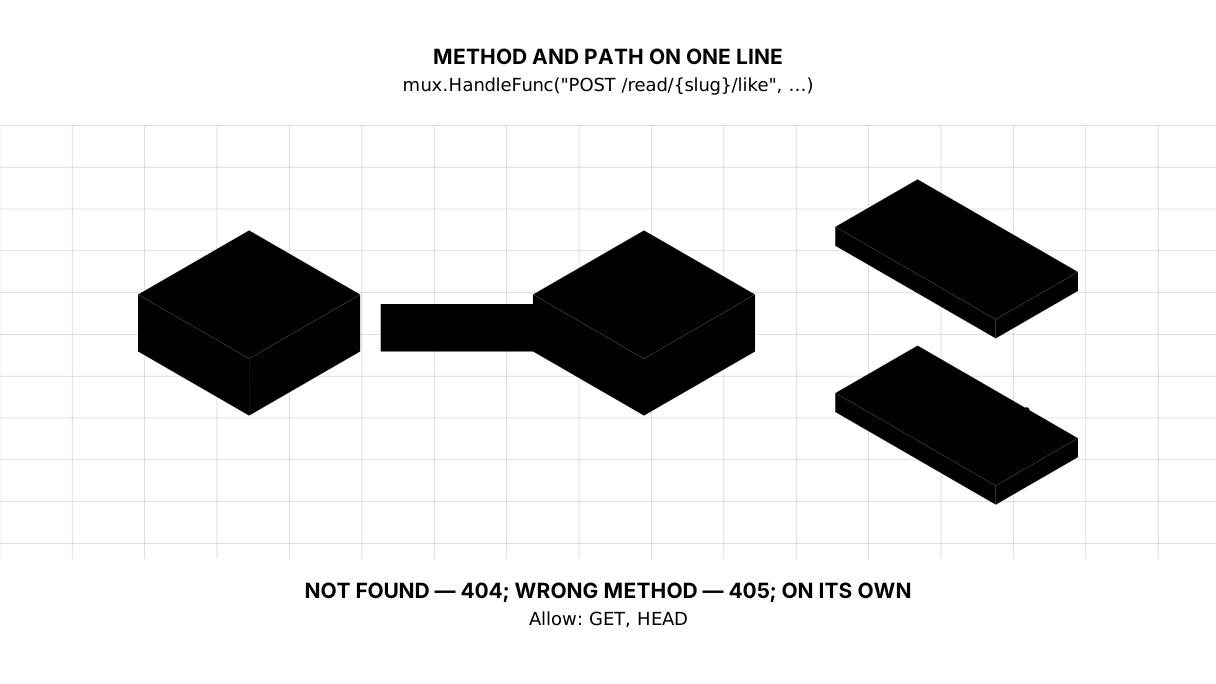
Not one handler contains a WriteHeader(404) or an Allow. Yet the answers are right, because ServeMux knows every pattern: no pattern matched the path — 404; the path matched but the method did not — 405 with the list of what is allowed.
Look at that list: Allow: GET, HEAD. HEAD appeared on its own — it is the same GET without a body, and Go answers it for you.
When there are many routes
After a dozen lines of registration main stops being readable. The usual move is to lift the routes into a function of their own that returns a ready router:
func routes() *http.ServeMux {
	mux := http.NewServeMux()
	mux.HandleFunc("GET /{$}", home)
	mux.HandleFunc("GET /about", about)
	mux.HandleFunc("GET /read/{slug}", article)
	return mux
}
Then main keeps one line, and every address of the site is visible in one place as a list. That same list can be handed to a test without bringing up a real server.
The nil that was in the second argument
http.ListenAndServe(":8080", mux)
Since the third lesson there was a nil there. Now it can be said what it meant: “use the default router” — the one http.HandleFunc without a mux writes into.
A mux of your own is better for three reasons: it is visible in the code, it can be handed to a test, and two different servers in one program do not get in each other’s way.
The lesson map
Say it in your own words
Without looking, answer out loud or on paper. The answers are at the end of the lesson.
- How does
GET /differ fromGET /{$}? - You registered
GET /read/{slug}andGET /read/dala. Where does/read/dalago, and does the order of the lines matter? - Where does
Allow: GET, HEADcome from if you never wrote it?
Exercise
Required. Split the blog across routes: GET /{$} for the list of articles, GET /read/{slug} for one article by its address, GET /about for yourself. Take the articles from a slice of structs, and answer 404 with your own text when there is no such address. Check every case with curl -i, POST /about included.
Optional.
- Replace
GET /{$}withGET /and see what becomes of/kokek. Then put it back. - Register two patterns that catch the same requests and read the panic in full.
- Add
GET /read/{slug}/{part}and see whatPathValuegives for both names.
Where this goes in your blog
The blog’s addresses are nearly real now: /, /about, /read/{slug}. Only the content is missing — for the moment strings travel in the response rather than pages.
The next lesson brings a wrapper that does the same thing for every route at once: a log, a response time, a check. After that come templates, and HTML rides in the body instead of fmt.Fprintln.
Answers
Show the answers
GET /catches every path no other pattern matched, non-existent ones included.GET /{$}catches only the root itself:{$}means the path ends there. Without it any typo in an address would return the front page with a 200.- To
GET /read/dala, because it is more specific. The order of the lines makes no difference: the router picks the most precise pattern rather than the first one that fits. ServeMuxadds it. It knows every pattern for that path and answers 405 with the list of allowed methods.HEADappears in the list because it is the sameGETwithout a body, and Go handles it itself.
Sources
If you have found a mistake or a typo in this article, tell us about it
Comments (0)
Log in to leave a comment →
No comments yet. Be the first.