

Go: from zero to your own blog Lesson 44 of 50
JSON and an API of your own: a blog is not read by browsers alone
The forty-fourth lesson of the Go course. The tags on a struct decide what a field is called outside and what is hidden altogether; an extra field in somebody's JSON stays silent unless you ask otherwise; a number with no type becomes a float64. And a handler whose errors are JSON too.
Why this matters
The blog hands out pages, and that is right up to the day its content is needed by something other than a person.
A mobile app wants the same articles without the markup. A neighbouring site wants the list of titles. You want a script that checks everything is in place. Handing any of them an <h1> is pointless: they parse the answer with a program, and they need a format a program understands.
That format is JSON, and in Go it lives in the standard library.
The whole thing at once
A new folder, go mod init sabaq41:
package main

import (
	"encoding/json"
	"fmt"
	"net/http"
	"net/http/httptest"
	"strings"
	"time"
)

// Article is what goes out. The tags decide what a field is called in JSON;
// omitempty drops what is empty, and a dash hides a field altogether.
type Article struct {
	Slug      string    `json:"slug"`
	Title     string    `json:"title"`
	Tags      []string  `json:"tags,omitempty"`
	UpdatedAt time.Time `json:"updated_at,omitzero"`
	Draft     bool      `json:"-"`
	secret    string    // lower case — it will never leave the package
}

func main() {
	fmt.Println("== what goes out")
	a := Article{
		Slug: "dala", Title: "The steppe", Draft: true, secret: "not for strangers",
		UpdatedAt: time.Date(2026, time.September, 6, 12, 0, 0, 0, time.UTC),
	}
	out, _ := json.MarshalIndent(a, "", "  ")
	fmt.Println(string(out))

	fmt.Println()
	fmt.Println("== empty fields")
	empty, _ := json.Marshal(Article{Slug: "salem", Title: "Hello"})
	fmt.Println(string(empty))

	fmt.Println()
	fmt.Println("== what comes in")
	body := `{"slug":"koktem","title":"Spring","tags":["steppe"],"extra":1}`
	var got Article
	fmt.Println("plain decoding:  ", json.Unmarshal([]byte(body), &got), "->", got.Slug, got.Tags)

	strict := json.NewDecoder(strings.NewReader(body))
	strict.DisallowUnknownFields()
	fmt.Println("strict decoding: ", strict.Decode(&Article{}))

	fmt.Println()
	fmt.Println("== a number with no type")
	var any1 any
	json.Unmarshal([]byte(`{"n":7}`), &any1)
	n := any1.(map[string]any)["n"]
	fmt.Printf("%v is a %T\n", n, n)

	fmt.Println()
	fmt.Println("== the handler's answer")
	srv := httptest.NewServer(routes())
	defer srv.Close()
	show(srv.URL + "/api/articles/dala")
	show(srv.URL + "/api/articles/joq")
}

func routes() http.Handler {
	mux := http.NewServeMux()

	mux.HandleFunc("GET /api/articles/{slug}", func(w http.ResponseWriter, r *http.Request) {
		if r.PathValue("slug") != "dala" {
			// An error is JSON too: whoever reads an API parses the answer
			// rather than looking at a page with a picture on it.
			writeJSON(w, http.StatusNotFound, map[string]string{"error": "no such article"})
			return
		}
		writeJSON(w, http.StatusOK, Article{Slug: "dala", Title: "The steppe", Tags: []string{"steppe"}})
	})

	return mux
}

// writeJSON sets the header before the status: after WriteHeader the headers
// are already on their way and changing them is too late.
func writeJSON(w http.ResponseWriter, code int, v any) {
	w.Header().Set("Content-Type", "application/json; charset=utf-8")
	w.WriteHeader(code)
	if err := json.NewEncoder(w).Encode(v); err != nil {
		// The status has gone out; the log is all that is left.
		fmt.Println("could not write the answer:", err)
	}
}
The show from the second file simply prints the answer. The output:
== what goes out
{
  "slug": "dala",
  "title": "The steppe",
  "updated_at": "2026-09-06T12:00:00Z"
}

== empty fields
{"slug":"salem","title":"Hello"}

== what comes in
plain decoding:   <nil> -> koktem [steppe]
strict decoding:  json: unknown field "extra"

== a number with no type
7 is a float64

== the handler's answer
200 application/json; charset=utf-8 -> {"slug":"dala","title":"The steppe","tags":["steppe"]}
404 application/json; charset=utf-8 -> {"error":"no such article"}
Taking it apart
Only what starts with a capital letter goes out
The first block of output has three fields; the struct has six. Where did the rest go?
secret is written in lower case, which makes it invisible outside its package — to encoding/json as well. That is the rule from the packages lesson, and here it has a pleasant consequence: an internal field cannot be handed out by accident.
Draft disappeared for a different reason: it carries the tag json:"-", which means “never output”. That is how what nobody outside needs to know is hidden: a draft flag, internal notes, housekeeping fields.
Picture it. A shop window. Not everything in the storeroom goes into it, and it is not the storeroom that decides.
Tags: the name, omitempty and omitzero
A tag is the string in back quotes after a field, and it tells encoding/json what to do:
Slug      string    `json:"slug"`
Tags      []string  `json:"tags,omitempty"`
UpdatedAt time.Time `json:"updated_at,omitzero"`
Without a tag a field goes out under its Go name — Slug, with a capital. Outside that is not how it is done: JSON says slug or updated_at, and the tag brings the name into line.
omitempty drops a field whose value is empty: an empty string, a zero, an empty slice. The second block of output shows it — an article with no tags has no tags field at all.
For a time.Time omitempty does not work: it is a struct, and a struct is never “empty” in that sense. Hence omitzero, which looks at the zero value of the type — and in the output the zero time went with it.
Decoding somebody’s JSON: the extra stays silent
The third block is about what comes in. The body has a field extra that the struct does not have, and plain decoding said nothing at all: <nil>, the article decoded.
That is by design, and it is convenient until it is dangerous: a typo in a field name turns into a silently skipped value. A reader sends titel instead of title — you accept an article with no title and never learn of it.
So wherever somebody’s JSON is accepted, strictness goes on:
dec := json.NewDecoder(r.Body)
dec.DisallowUnknownFields()
Then an extra field becomes an error: json: unknown field "extra" — and the sender learns of their typo straight away rather than a week later.
A number with no type becomes a float64
The fourth block is short, and people pay for it in hours of debugging.
Decode into an any (or a map[string]any) and every number becomes a float64. Not the int it looks like in the text, but a float64 — JSON has no separate integer type, and Go picks the most general one.
Hence the interface conversion: interface {} is float64, not int panic for those who decoded into an any. The cure is simple: decode into a struct. Then an int stays an int, and the extra fields fall away by type as well.
The header goes before the status
writeJSON does three things in a strict order:
w.Header().Set("Content-Type", "application/json; charset=utf-8")
w.WriteHeader(code)
json.NewEncoder(w).Encode(v)
The order is not accidental. WriteHeader sends the status line and every header at once; after it w.Header().Set changes nothing — Go quietly ignores it. That is how a Content-Type gets lost and a browser is left guessing what it was sent.
The same goes for the body: the first write to w without a WriteHeader means 200. If another status is wanted, it goes in before a single byte is written.
An error is JSON too
The last two lines of the output: both the 200 and the 404 came with application/json.
That is a rule rather than a detail. Whoever reads an API parses the answer with a program: if an HTML page with a picture arrives in place of an error, the parsing breaks at the very first character, and the log says “unexpected <” instead of “no such article”.
So an API has one shape for every answer. The status code says what happened, the body gives the detail: {"error": "no such article"}.
A stream instead of a string: Encoder and Decoder
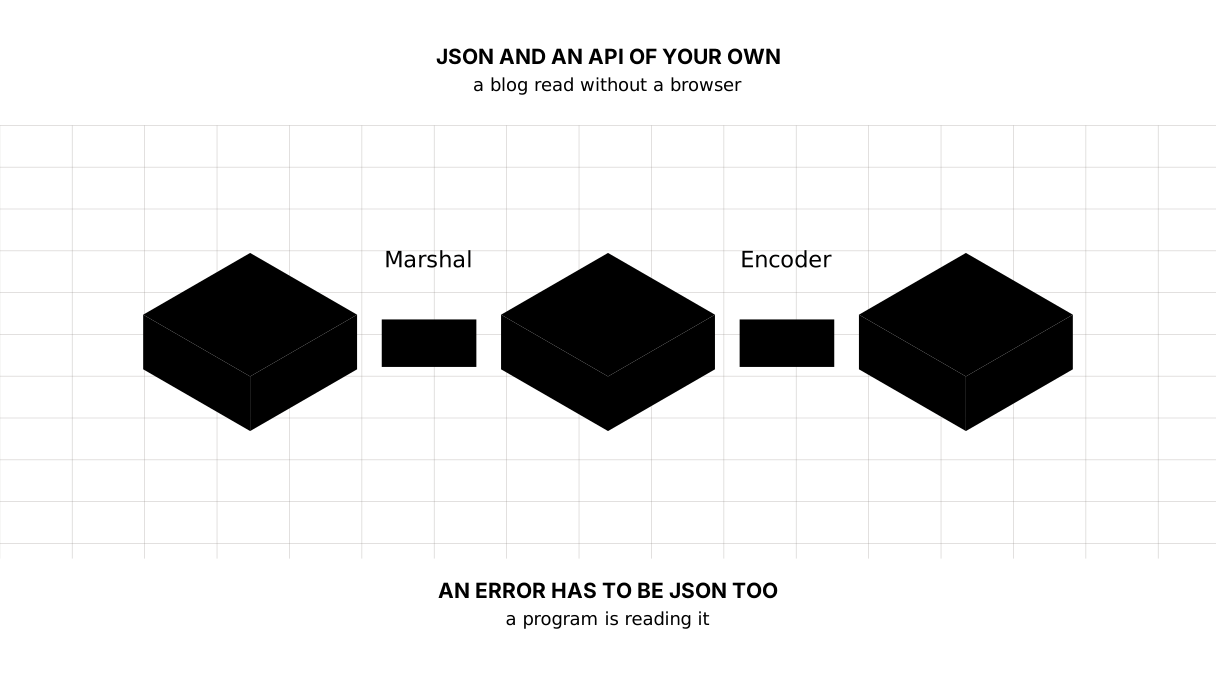
json.Marshal assembles the whole answer in memory, while json.NewEncoder(w).Encode(v) writes straight into the stream. For one article that makes no difference; for a list of ten thousand it is tens of megabytes that need not be held at once.
Decoding is the same: json.NewDecoder(r.Body).Decode(&v) reads from the body of the request without gathering it into a string. And only the decoder has DisallowUnknownFields, which is why we reached for it.
Do not forget the cap: the body comes from outside, so the http.MaxBytesReader from the upload lesson belongs here too.
The lesson map
Say it in your own words
Without looking, answer out loud or on paper. The answers are at the end of the lesson.
- Why does a field in lower case not reach the JSON?
- What happens to a typo in a field name under plain decoding?
- Why is
Content-Typeset beforeWriteHeader?
Exercise
Required. Give the blog an API: GET /api/articles hands back the list, GET /api/articles/{slug} one article. Answers and errors are JSON with the right header, and drafts and internal fields never leave.
All of it is done in step-29 — compare against it once you have written your own.
Optional.
- Add a
POST /api/articlesthat takes an article with a strict decoder and answers201with the address of what it made. - Add a
reading_timefield to the answer — a method of a type does not reach JSON, so it has to be computed while the answer is assembled. - Check your API from a terminal:
curl -s localhost:8090/api/articles | jq.
Where this goes in your blog
The blog gets a second way of being read — and the first that does not depend on markup. From now on a page can be rewritten without breaking whoever reads the data.
Still open. The API hands everything back at once, with no paging. Nothing limits it: a hundred requests a second from one script go unstopped. And there is no writing through the API — which would mean deciding how to guard it.
Answers
Show the answers
- Because
encoding/jsonsees exported fields only — the same rule as for any other package. A field in lower case does not exist for it, and cannot be handed out by accident. - Nothing: plain decoding silently skips fields the struct does not have. The sender is sure they sent a title; you get an empty string.
DisallowUnknownFieldscures it. - Because
WriteHeadersends the status and the headers as one piece. After it a header is too late to change — Go ignores it, and the reader gets an answer with noContent-Type.
Sources
If you have found a mistake or a typo in this article, tell us about it
Comments (0)
Log in to leave a comment →
No comments yet. Be the first.