

Go: from zero to your own blog Lesson 37 of 50
Sessions and cookies: how a server remembers who signed in
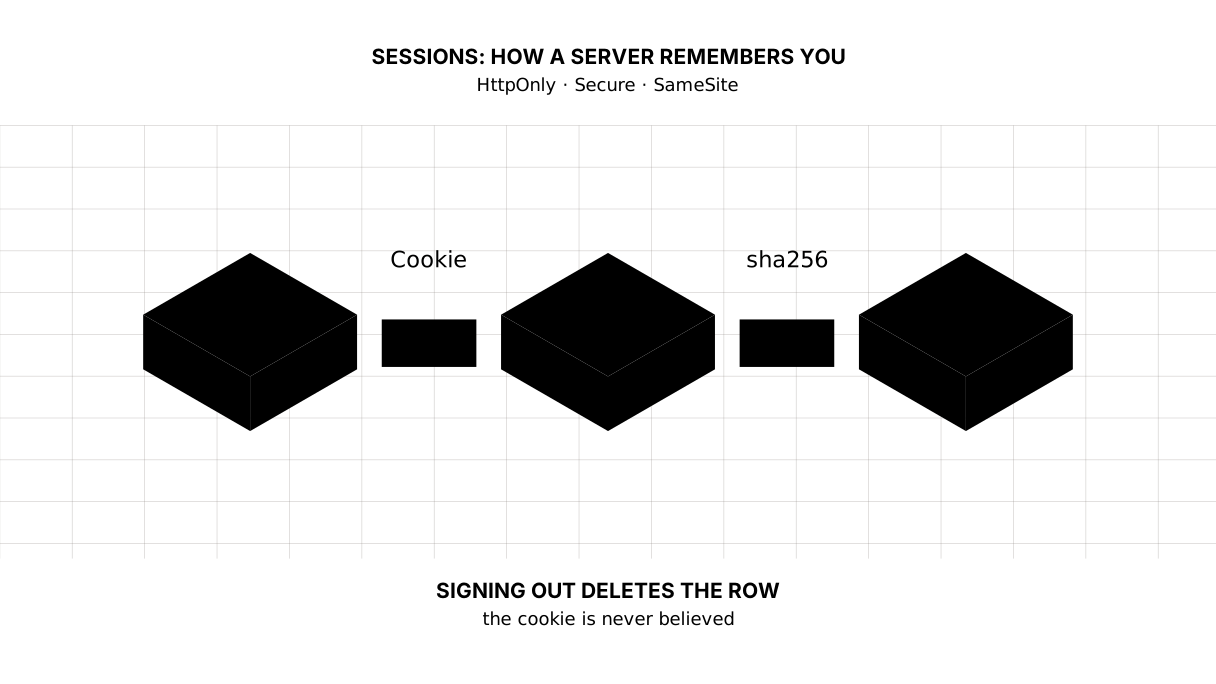
The thirty-seventh lesson of the Go course. HTTP remembers nothing: every request arrives from a stranger. A cookie holding a user number is forged in a second. So the browser carries a random token, the database keeps its hash, and three words close the rest: HttpOnly, Secure, SameSite.
Why this matters
In the last lesson a person registered. Now they want to sign in — and here the unpleasant part shows up: HTTP remembers nothing.
Every request arrives on its own. The server answered one and forgot it; the next request from the same person is indistinguishable from one by a passer-by. There is no connection between them in the protocol at all.
The connection has to be made by us, and it is made with a cookie — a small piece the server asks the browser to keep and send back with every request.
The whole thing at once
A new folder, go mod init sabaq34. The program starts a server and calls it itself, so both the header and what happens on each request are visible:
package main

import (
	"crypto/rand"
	"crypto/sha256"
	"database/sql"
	"encoding/base64"
	"encoding/hex"
	"errors"
	"fmt"
	"net/http"
	"net/http/httptest"
	"os"
	"strings"
	"time"

	"golang.org/x/crypto/bcrypt"
	_ "modernc.org/sqlite"
)

const cookieName = "session"

// sessionLife is how long a sign-in lasts. A week: long enough not to sign in
// daily, short enough that a forgotten session does not live for years.
const sessionLife = 7 * 24 * time.Hour

func main() {
	os.Remove("blog.db")
	db := open()
	defer db.Close()

	srv := httptest.NewServer(routes(db))
	defer srv.Close()

	fmt.Println("== signing in")
	fmt.Println("wrong password: ", login(srv.URL, "aigul@example.kz", "guessing"))

	header, token := loginOK(srv.URL, "aigul@example.kz", "secretpass123456")
	fmt.Println("right password: ", header)

	fmt.Println("== who came")
	fmt.Println("no cookie:           ", ask(srv.URL, ""))
	fmt.Println("with cookie:         ", ask(srv.URL, token))
	fmt.Println("forged:              ", ask(srv.URL, "user_id=1"))
	fmt.Println("someone else's token:", ask(srv.URL, strings.Repeat("A", 43)))

	fmt.Println("== signing out")
	fmt.Println("signing out:         ", logout(srv.URL, token))
	fmt.Println("the same cookie:     ", ask(srv.URL, token))
}

func routes(db *sql.DB) http.Handler {
	mux := http.NewServeMux()

	mux.HandleFunc("GET /me", func(w http.ResponseWriter, r *http.Request) {
		email, ok := current(db, r)
		if !ok {
			fmt.Fprint(w, "a guest")
			return
		}
		fmt.Fprintf(w, "signed in as %s", email)
	})

	mux.HandleFunc("POST /login", func(w http.ResponseWriter, r *http.Request) {
		id, err := authenticate(db, r.FormValue("email"), r.FormValue("password"))
		if err != nil {
			http.Error(w, "address or password does not fit", http.StatusUnauthorized)
			return
		}

		token, err := newSession(db, id)
		if err != nil {
			http.Error(w, "did not work", http.StatusInternalServerError)
			return
		}
		http.SetCookie(w, &http.Cookie{
			Name:     cookieName,
			Value:    token,
			Path:     "/",
			Expires:  time.Now().Add(sessionLife),
			HttpOnly: true,
			Secure:   overHTTPS(r),
			SameSite: http.SameSiteLaxMode,
		})
		w.WriteHeader(http.StatusSeeOther)
	})

	mux.HandleFunc("POST /logout", func(w http.ResponseWriter, r *http.Request) {
		if c, err := r.Cookie(cookieName); err == nil {
			db.Exec(`delete from sessions where token_hash = ?`, hashToken(c.Value))
		}
		// The browser is asked to forget the cookie: same name, empty value, a
		// date in the past. The row is already deleted, which matters more.
		http.SetCookie(w, &http.Cookie{
			Name: cookieName, Value: "", Path: "/",
			Expires: time.Unix(0, 0), MaxAge: -1,
			HttpOnly: true, Secure: overHTTPS(r), SameSite: http.SameSiteLaxMode,
		})
		fmt.Fprint(w, "signed out")
	})

	return mux
}

// newSession hands out a random token and keeps its hash. The cookie carries
// the token; the database keeps only the hash, so a leaked database lets
// nobody sign in as anybody.
func newSession(db *sql.DB, userID int64) (string, error) {
	raw := make([]byte, 32)
	if _, err := rand.Read(raw); err != nil {
		return "", err
	}
	token := base64.RawURLEncoding.EncodeToString(raw)

	_, err := db.Exec(
		`insert into sessions (token_hash, user_id, expires_at) values (?, ?, ?)`,
		hashToken(token), userID, time.Now().Add(sessionLife).UTC().Format(time.RFC3339))
	return token, err
}

func hashToken(token string) string {
	sum := sha256.Sum256([]byte(token))
	return hex.EncodeToString(sum[:])
}

// current says who sent this request, and never takes the cookie's word for
// it: the cookie holds a random string and nothing else.
func current(db *sql.DB, r *http.Request) (string, bool) {
	c, err := r.Cookie(cookieName)
	if err != nil {
		return "", false
	}
	var email string
	err = db.QueryRow(`select u.email from sessions s
		join users u on u.id = s.user_id
		where s.token_hash = ? and s.expires_at > ?`,
		hashToken(c.Value), time.Now().UTC().Format(time.RFC3339)).Scan(&email)
	if err != nil {
		return "", false
	}
	return email, true
}

func authenticate(db *sql.DB, email, password string) (int64, error) {
	var id int64
	var hash string
	err := db.QueryRow(`select id, password_hash from users where email = ?`,
		strings.ToLower(strings.TrimSpace(email))).Scan(&id, &hash)
	if err != nil {
		return 0, errors.New("does not fit")
	}
	if err := bcrypt.CompareHashAndPassword([]byte(hash), []byte(password)); err != nil {
		return 0, errors.New("does not fit")
	}
	return id, nil
}

// overHTTPS reports whether the request really arrived over TLS. The Secure
// flag depends on it: a cookie marked Secure does not travel over plain http,
// so on your own machine it would be set once and never sent back.
func overHTTPS(r *http.Request) bool { return r.TLS != nil }
The helpers (open, login, ask and the rest) live in a second file, helpers.go, and do what a browser normally does: step-22 shows the same thing in the blog, where the browser is real.
The output:
== signing in
wrong password:  401, no cookie
right password:  303, session=0HhwSnNtWOgQrUxJZv9YXCFz9-Ojj0XdOO6zNClfRe4; Path=/; Expires=Sun, 13 Sep 2026 13:08:58 GMT; HttpOnly; Secure; SameSite=Lax
== who came
no cookie:            a guest
with cookie:          signed in as aigul@example.kz
forged:               a guest
someone else's token: a guest
== signing out
signing out:          signed out
the same cookie:      a guest
Taking it apart
A cookie is a header, not magic
http.SetCookie writes a Set-Cookie header into the response, and the whole of it is there in the second line of the output. A browser that receives it saves the string and from then on adds a Cookie header to every request to this site.
That is all. A cookie needs no storage on the server and means nothing by itself: it is a string the browser carries back and forth.
Picture it. A cloakroom ticket. There is no coat on it and no owner’s name — only a number. The coat is with the attendant, and the number is how they find yours.
Why user_id must not go into a cookie
The temptation is clear: put user_id=1 in and read it on the server. The “forged” line of the output shows how that ends — or rather how it would end if the server believed it.
A cookie lives in the browser. Its owner can open the developer tools and write whatever they like: user_id=1, admin=true, balance=1000000. Nothing is signed, nothing is checked, and it takes two seconds.
The rule: nothing the server intends to believe goes into a cookie. What goes in is a ticket — a random string that means nothing on its own.
Randomness comes in kinds
The token is made by crypto/rand, not math/rand, and that is not pedantry.
math/rand was built for something else: it is fast and predictable by design. Knowing a few of the numbers it gave out, the next one can be worked out. For shuffling a list that does not matter; for the ticket to somebody’s account it matters a great deal.
crypto/rand takes its randomness from the operating system and exists for exactly this. Thirty-two bytes of it are so many possibilities that guessing is pointless on any hardware.
base64.RawURLEncoding turns the bytes into a string that can go in a header: 32 bytes make 43 characters, with no +, / or = to spoil a link.
The database keeps the hash, not the token
Look at the sessions table: it holds token_hash, not token.
The reason is the one from the password lesson. If the database leaks with live tokens in it, whoever took it signs in as anybody without guessing a thing. A hash does not allow that: signing in needs the token itself, and it cannot be got out of a hash.
There is one difference from a password: sha256 is enough here, not bcrypt. A password is invented by a person and may well be qwerty123 — only slowness saves it from being guessed. The token was invented by us out of 32 random bytes; guessing it is pointless, so there is nothing to pay slowness for.
Three words in the header
Three words stand in the Set-Cookie of the output, and each closes a hole of its own:
- HttpOnly — the cookie is invisible to JavaScript. If a stranger’s script gets onto the page, it cannot read the token and send it away. This is the main defence against a session stolen through XSS;
- Secure — the browser sends the cookie over HTTPS only. Without it the token travels in plain text across any café wifi. It cannot be nailed to on: while the blog runs on
http://127.0.0.1a cookie marked that way is accepted and never sent back — you sign in and the next page has forgotten you. So the flag follows the request: over TLS it is set, over plain http on your own machine it is not; - SameSite=Lax — the cookie is not attached to cross-site
POSTs, to requests for images and styles, or to background calls. On an ordinary link followed from another site — a top-levelGET— it is attached, and that is deliberate, so that you are not signed out every time you open the blog from a search. SoLaxcloses the forged form and does not replace a token check: there will be a separate lesson on CSRF.
Plus Path=/ — for the whole site, and Expires — how long the browser keeps it. Without Expires a cookie lives until the browser closes.
Signing out is deleting a row
Notice the last two lines of the output: after signing out the very same cookie no longer works.
That is how it should be. Asking the browser to forget a cookie is politeness, not a defence: a copy of the string could be anywhere. Signing out for real is delete from sessions, after which the token is found by nobody, whoever brings it.
That is also what the sessions table is good for: a person can be shown the list of their sign-ins and given a “sign out everywhere” button, which is simply deleting all their rows.
What this lesson still leaves out
Every sign-in issues a new token — the code does exactly that — so a ticket slipped to you in advance does not become authorised afterwards. Session fixation is closed here.
What remains is the older sessions: sign in from somebody else’s laptop, change your password, and that row in the table still works. A “sign out everywhere” button has to delete them, and that is not done yet.
Expired rows are cleaned up by nobody: a request will not find them, but they pile up. A real blog runs delete from sessions where expires_at < ... once a day.
And the signed-in person is looked up afresh in every handler. The place for that is a wrapper that does it once and puts what it found into the request context; context gets a lesson of its own.
The lesson map
Say it in your own words
Without looking, answer out loud or on paper. The answers are at the end of the lesson.
- Why can
user_idnot go into a cookie and be believed? - Why is the token in the database hashed, but not with
bcryptthe way a password is? - Why is signing out a deleted row rather than a request to the browser to forget the cookie?
Exercise
Required. Add signing in and out to the blog. A migration creates the sessions table. POST /login checks the pair from the last lesson and hands out a cookie; POST /logout deletes the row. The header shows who is signed in and a link to sign out, and a guest gets a link to sign in.
All of it is done in step-22 — compare against it once you have written your own.
Optional.
- Hand out a fresh token on every sign-in and delete the old one. Check that the old cookie stops working.
- Show a list of sessions on the profile page, with times and a “sign out everywhere” button.
- Take
HttpOnlyout and look in the developer tools at whatdocument.cookienow shows.
Where this goes in your blog
The blog can tell people apart for the first time. Everything after this is built on it: permissions, other people’s drafts, “my articles”.
Still open. Sessions are neither renewed nor cleaned up. The signed-in person is looked up by every handler. And the sign-in form is not protected from guessing yet — no delay and no limit on attempts.
Answers
Show the answers
- Because the cookie sits in a person’s browser and they can write whatever they like in it in two seconds. Only what the server keeps for itself can be believed; what goes into the cookie is a meaningless ticket.
- Because
bcryptis for a secret a person invented, which may be weak: slowness saves it from guessing. The token was invented by us out of 32 random bytes; guessing it is pointless, so a fastsha256is enough. - Because a copy of the cookie could be anywhere, and a request to the browser binds nothing. While the row is alive the token works; delete the row and it is dead for everyone at once.
Sources
If you have found a mistake or a typo in this article, tell us about it
Comments (0)
Log in to leave a comment →
No comments yet. Be the first.