

Go: from zero to your own blog Lesson 15 of 50
Packages and modules in Go: go mod and the capital letter
The fifteenth lesson of the Go course. A package is a folder, and a capital letter in a name is the door out of it. How to split a program across folders, what go.mod and go.sum hold, how to bring in someone else's package with go get, what the internal folder is for, and why go mod tidy is run before the code goes anywhere.
Why this matters
main.go has grown: the type, the methods, the store, the errors — all in one file. Time to spread it out.
And the other half of the lesson: sooner or later you will want somebody else’s code. Writing your own identifier generator or JSON parser is a waste of a life when it has already been written and tried by thousands of people.
The whole thing at once
A new folder sabaq-14, and another one inside it called blog. Three files:
sabaq-14/
  go.mod
  main.go
  blog/
    article.go
    store.go
blog/article.go:
package blog

import "fmt"

type Article struct {
	Title string
	Words int
}

func (a Article) ReadingTime() int {
	return (a.Words + 199) / 200
}

func (a Article) String() string {
	return fmt.Sprintf("%s (%d min)", a.Title, a.ReadingTime())
}
blog/store.go:
package blog

import (
	"errors"
	"fmt"
)

var ErrNotFound = errors.New("article not found")

type Store struct {
	items map[string]Article
}

func NewStore() *Store {
	return &Store{items: map[string]Article{}}
}

func (s *Store) Add(slug string, a Article) {
	s.items[slug] = a
}

func (s *Store) Get(slug string) (Article, error) {
	a, ok := s.items[slug]
	if !ok {
		return Article{}, fmt.Errorf("get %q: %w", slug, ErrNotFound)
	}
	return a, nil
}

func (s *Store) Len() int { return len(s.items) }
main.go:
package main

import (
	"errors"
	"fmt"

	"github.com/google/uuid"

	"sabaq14/blog"
)

func main() {
	s := blog.NewStore()
	s.Add("dala", blog.Article{Title: "About the steppe", Words: 400})

	a, err := s.Get("dala")
	if err != nil {
		fmt.Println(err)
		return
	}
	fmt.Println(a)
	fmt.Println("articles:", s.Len())

	if _, err := s.Get("kokek"); errors.Is(err, blog.ErrNotFound) {
		fmt.Println("404:", err)
	}

	fmt.Println("new id:", uuid.NewSHA1(uuid.NameSpaceURL, []byte("shanraq.org/dala")))
}
Three commands, in order:
go mod init sabaq14
go get github.com/google/uuid
go run .
Before you run it, and without looking below, say out loud what the program will print. Then run it and compare.
About the steppe (2 min)
articles: 1
404: get "kokek": article not found
new id: 7046abf7-a993-54e5-8960-558b4e3d88d9
You will get exactly the same identifier: it is computed from the address rather than from chance.
Taking it apart
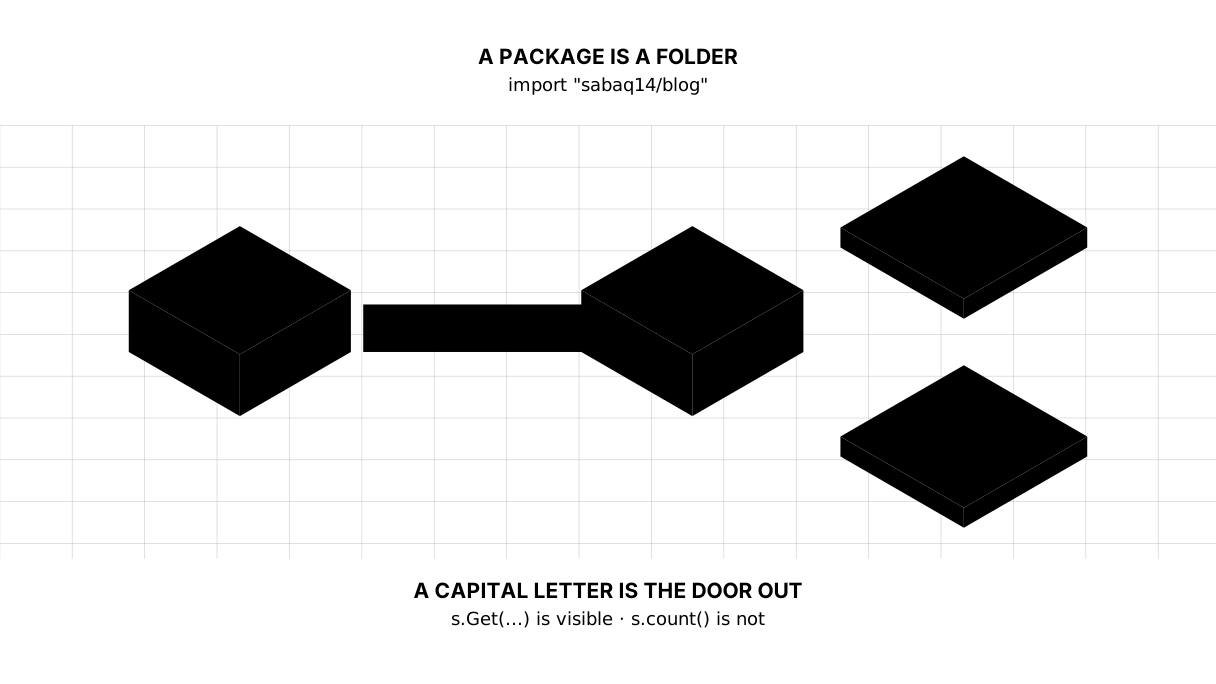
A package is a folder
Every file in a folder belongs to one package, and the first line in each of them is the same: package blog. How you split a package across files is up to you — the compiler does not care, and a person finds it easier by meaning: the type in one file, the store in another.
The package name usually matches the folder name. Inside a package the files see each other whole, with no imports at all: store.go uses the Article type from the file next door and does nothing to get at it.
Picture it. A room in a house. Inside the room everything is to hand. What goes out into the corridor is only what you carried to the door yourself.
A capital letter is the door out
Now it is clear why the fields in the structs lesson were called Title and Words.
There is one rule and no exceptions: a name starting with a capital letter is visible from other packages, one starting with a small letter is not. It applies to everything: types, functions, methods, fields, variables.
In our store the field items is written in lower case, and that is not an accident. Try this from main.go:
len(s.items)
The program will not build:
s.items undefined (cannot refer to unexported field items)
That is exactly why Store has a Len() method: what leaves the package is the ability, not the arrangement. Replace the map with a database tomorrow and nothing outside breaks.
go mod init, and what is in go.mod
go mod init sabaq14
This command declares a module — the unit that can be built and published. A module is a tree of folders with a go.mod at its root; the packages are the folders inside it.
After go get the file looks like this:
module sabaq14

go 1.27.1

require github.com/google/uuid v1.6.0
The first line is the module’s name, which is also the start of every internal import path. The second is the language version you are building with; yours will be your own. The third is the list of what you took from other people, with exact versions.
Importing your own package
import "sabaq14/blog"
The path starts with the module’s name, then the folder’s path inside it. Not a relative ./blog, not an absolute path on disk: only this way.
Notice the order in the import block: the standard library first, then other people’s packages, then your own, with a blank line between the groups. That is not a rule of the language but a shared habit, and the editor will arrange it for you on save.
Someone else’s package: go get, go.sum, go mod tidy
go get github.com/google/uuid does three things: it downloads the package, adds a line to go.mod, and writes a fingerprint of what it downloaded into go.sum.
go.sum is not a list of dependencies but a list of checksums. On the next build Go checks that what was downloaded matches what was recorded. Both files go into the repository.
Picture it. A receipt with a fingerprint on it. The list of books you borrowed is
go.mod.go.sumis the mark that shows the book handed back is the same one, not a similar-looking copy with different text inside.
go mod tidy puts things in order: it adds what you imported and forgot to declare, and removes what is no longer used. Run it before sending your code anywhere: right after go get our package was marked // indirect, and only tidy removed that note.
The package name is read at the call site
From outside people write blog.Article and blog.NewStore. So there is no need to repeat the package name inside it: blog.BlogArticle is a stutter, while blog.Article reads as a phrase.
For the same reason package names are short and single-word, lower case, with no underscores: http, fmt, errors.
internal/ — the folder closed from outside
Name a folder internal and only its neighbours within the module can import what is in it. Another project that pulls in your module cannot reach it — the compiler enforces this itself.
It takes a minute to check. Two modules: in the first the package sits in internal, and the second tries to import it.
$ cd lib && go build ./...          # свой модуль читает свой internal
свой модуль: собралось

$ cd ../app && go build ./...       # чужой модуль лезет в тот же пакет
package example.com/app
	main.go:6:2: use of internal package example.com/lib/internal/store not allowed
The compiler does not advise and does not warn — it refuses to build. internal is the one folder name Go understands as a rule of the language rather than a habit.
Handy when you want packages but do not want to promise strangers that they will never change.
Picture it. A door marked “staff only”. It is in the same building and not locked to the staff, but a visitor does not go through it.
The tree of a project: cmd, internal and pkg
Our blog has a flat tree: main.go beside the blog folder, and no cmd or internal at all. That is not a simplification for the sake of a lesson — it is what Go itself advises for a program of this size: while the module is one program, extra folders only lengthen the import paths and add nothing.
Three names you will meet in other people’s repositories:
cmd/— for when a module holds more than one program.cmd/app,cmd/migrate,cmd/export: each has its ownmain, while the shared code sits beside them and is imported by all.internal/— what cannot be imported from outside. The rule of the language we have just measured.pkg/— a folder for code meant for other people’s projects. This is not a rule of Go but a habit of part of the community: the compiler knows nothing aboutpkg.
The site you are reading this lesson on is laid out like that: four programs in cmd/ — app, migrate, export and adminctl — five packages in internal/ and seventeen in pkg/. That tree grew out of a flat one, and it grew when the second program appeared rather than in advance.
Does the course’s blog suffer for not having any of it? No: it has one program and one shared package, and any of those names would add an empty folder. But when your blog gains a second program — a separate migrate, say — you already know where to put it.
And one last thing. Do not start with folders. While there is one file with two hundred lines in it, leave it alone. Splitting is worth doing when you can already see where the boundary runs, not before.
The lesson map
Say it in your own words
Without looking, answer out loud or on paper. The answers are at the end of the lesson.
- Why can
main.gonot reachs.items, when both files are part of one program? - How does
go.moddiffer fromgo.sum, and why are both needed? - Why
blog.Articlerather thanblog.BlogArticle? - How does
internal/differ frompkg/?
Exercise
Required. Take your program from the errors lesson and split it into two packages: blog, holding the type, the store and the errors, and main, which only calls them. Leave the data field in lower case and add a Len() method. Check that go run . works and that reaching for the internal field from main does not build.
Optional.
- Bring in
github.com/google/uuidand give every article an identifier. - Delete the
requireline fromgo.modand rungo mod tidy. See what happens. - Rename the
blogfolder tointernal/blogand fix the import. The program should work as before.
Where this goes in your blog
This site is built the same way: the server in one package, the articles in another, the store in a third, each talking to the rest through a handful of names that start with a capital letter. The state of the blog after this lesson is step-6: the same blog, spread across folders.
Answers
Show the answers
- Because
itemsis written in lower case, so it is visible only inside theblogpackage. There is one program but two packages, and the boundary runs through the first letter of the name. What leaves the package is theLen()method — the ability, not the arrangement. go.modis the list of what you took and in which versions; a person reads it.go.sumholds the checksums of what was downloaded; Go reads it to notice a substitution. Both files are kept in the repository.- Because the package name is read at the call site: from outside it comes out as
blog.Article. Repeating the package name inside it is a stutter, and it shows up on every line of your code that other people read. internalis a rule of the language: another module that reaches into it simply does not build, and it is the compiler that says so.pkgis an ordinary folder name and a habit of part of the community; Go knows nothing about it and forbids nothing through it.
Sources
If you have found a mistake or a typo in this article, tell us about it
Comments (0)
Log in to leave a comment →
No comments yet. Be the first.