

Go: from zero to your own blog Lesson 12 of 50
Pointers and methods in Go: why the change never stuck
The twelfth lesson of the Go course. The answer to last lesson's trap: a pointer is the address of a value, not a copy of it. How & and * actually work, how a method differs from a plain function, when the receiver takes a pointer and when a value, and why for i := range fixes the very thing that for _, a := range quietly breaks.
Why this matters
In the previous lesson a change made inside range vanished without trace, and the compiler said nothing. We said then that the real answer is pointers. Here it is.
A pointer is wanted exactly where you need to change someone else’s value rather than a copy of it: publish an article, add words to it, fix its title.
The whole thing at once
A new folder, go mod init sabaq11, main.go:
package main

import "fmt"

type Article struct {
	Title     string
	Words     int
	Published bool
}

func (a Article) ReadingTime() int {
	return (a.Words + 199) / 200
}

func (a *Article) Publish() {
	a.Published = true
}

func rename(a *Article, title string) {
	a.Title = title
}

func main() {
	first := Article{Title: "About the steppe", Words: 400}

	fmt.Println(first.Title, "·", first.ReadingTime(), "min ·", first.Published)

	first.Publish()
	rename(&first, "About the steppe: the full version")
	fmt.Println(first.Title, "·", first.Published)

	blog := []Article{
		{Title: "Hello, world", Words: 150},
		{Title: "What a shanyraq is", Words: 1000},
	}

	for i := range blog {
		blog[i].Publish()
	}
	for _, a := range blog {
		fmt.Println(a.Title, "·", a.Published)
	}

	p := &first
	fmt.Printf("%T · %s\n", p, p.Title)
}
Before you run it, and without looking below, say out loud what it will print. Then run it and compare.
About the steppe · 2 min · false
About the steppe: the full version · true
Hello, world · true
What a shanyraq is · true
*main.Article · About the steppe: the full version
Taking it apart
A pointer is an address, not the thing itself
p := &first        // take the address
fmt.Println(*p)    // follow the address back to the value
& in front of a value gives its address. * in front of a pointer follows the address back to the value. And the same * in a type declaration means “the address of”: *Article is “the address of an article”, not an article.
%T confirmed it: the type of p is *main.Article, star and all.
Picture it. A key and a photograph of a flat. Given the photograph, draw on it all you like — nothing in the flat moves. Given the key, you can walk in and rearrange the furniture for real. A pointer is the key.
A copy is cheaper and safer, which is why Go copies by default. The key is handed over when something has to change.
A function with a pointer changes the original
func rename(a *Article, title string) {
	a.Title = title
}

rename(&first, "About the steppe: the full version")
The parameter is declared as *Article, and at the call we pass &first, the address. The title changed on the outside, which is what the second line of output shows.
Compare that with the previous lesson: there the function took an Article, got a copy, and its edits never arrived anywhere.
A method is a function written onto a type
func (a Article) ReadingTime() int {
The brackets before the name are the receiver. They say: this function belongs to the type Article, and it is called through a dot — first.ReadingTime(), not ReadingTime(first).
Picture it. Instructions printed on the thing itself. A washing machine has its programmes on the panel, not in a separate book you have to find first. A method is the same: the ability sits on the type.
The receiver: a value or a pointer
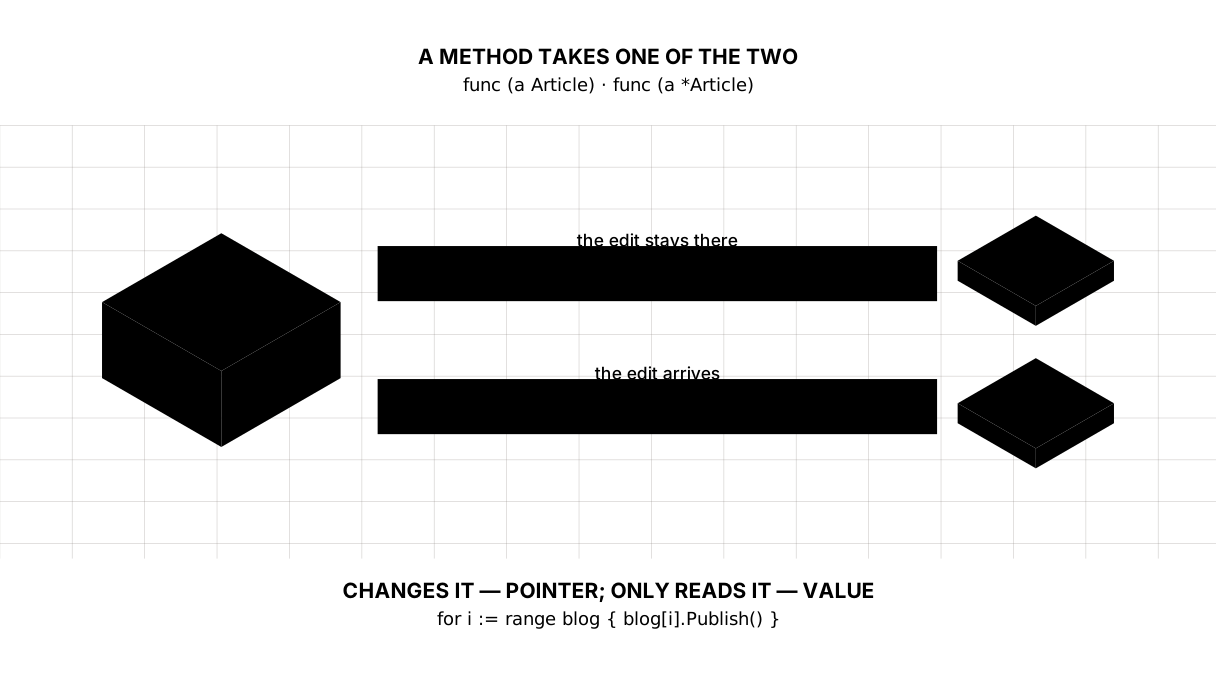
The whole rule of the lesson fits in two lines.
func (a Article) ReadingTime() int   // only reads — take a value
func (a *Article) Publish()          // changes it — take a pointer
ReadingTime counts and touches nothing: a copy is enough. Publish writes to a field, and without the pointer the write would go into a copy while Published stayed false — exactly the trap this lesson opened with.
One note for later: if one method of a type takes a pointer, the others usually take one too. Mixing is allowed, but anyone reading your code then has to remember which kind each method is.
Go puts the stars in for you
first is an ordinary value, not a pointer. first.Publish() works all the same. And the other way round: p is a pointer, and p.Title is written with no star at all.
Go inserts & and * itself where it is unambiguous. That is why stars barely appear in everyday code — only in type declarations.
How last lesson’s trap gets fixed
for i := range blog {
	blog[i].Publish()
}
Here range hands over only the index. blog[i] is the element of the slice itself rather than a copy of it, and Go takes its address automatically, because an element of a slice is addressable.
for _, a := range blog { a.Publish() } still does nothing at all: a is a copy, a copy has an address of its own, and it is the copy that gets published. The compiler says nothing here either.
It is easy to remember: if you are changing it, go by index.
The nil pointer
A pointer may point nowhere. Its zero value is nil:
var p *Article
fmt.Println(p.Title)   // panic: invalid memory address or nil pointer dereference
Picture it. An address on a piece of paper with nothing built there. You arrive and find an empty lot.
This is neither rare nor a disaster: the message says plainly what happened. In the lesson on errors we learn to hand such situations back like human beings.
The lesson map
Say it in your own words
Without looking, answer out loud or on paper. The answers are at the end of the lesson.
- How does
func (a Article) ReadingTime()differ fromfunc (a *Article) Publish(), and how do you choose between them? firstis not a pointer, yetfirst.Publish()works. Why?for _, a := range blog { a.Publish() }publishes nothing whilefor i := range blog { blog[i].Publish() }publishes. What is the difference?
Exercise
Required. Give the type Article a method Shorten(limit int) that trims the title to limit letters and puts an ellipsis at the end. Letters, not bytes, as in the runes lesson. Apply it to every article in the slice and print the result. Think about what the receiver has to be before you write it.
Optional.
- Call
Shorteninside afor _, a := range blogloop and confirm that nothing changed. - Print
%Tforfirstand for&first. - Write a function
publishAll(blog []Article)and check whether it works. If it does not, work out why, and how one character in the declaration fixes it.
Where this goes in your blog
From here on almost everything comes with a pointer: a handler receives a *http.Request — you met that star in your very first server — the database hands back *sql.Rows, and a template takes a *template.Template. Now you know what it means there: you are being given the key, not the photograph.
Answers
Show the answers
- The first only reads the fields and gets a copy, which is enough. The second writes to a field, and without a pointer the write would land in a copy that disappears immediately. The rule: changes it — pointer; only reads it — value.
- Because Go inserts the
&itself when the value is addressable.firstis a variable, it has an address, so the call becomes(&first).Publish(). Writing stars and ampersands by hand is rarely necessary. - In the first case
ais a copy of the element; the method publishes the copy, and the copy disappears on the next turn of the loop. In the second,blog[i]is the element of the slice itself, it has an address, and a pointer method changes what is actually in the slice.
Sources
If you have found a mistake or a typo in this article, tell us about it
Comments (0)
Log in to leave a comment →
No comments yet. Be the first.