

Go: from zero to your own blog Lesson 21 of 50
Handlers and middleware: one wrapper for every route
The twenty-first lesson of the Go course. A wrapper around the router does the same thing for every request: a log line, a response time, a check. What http.Handler is, why a wrapper takes a handler and returns a handler, which order two of them run in, and how to learn the status code that ResponseWriter refuses to hand back.
Why this matters
A log line is wanted on every page. A sign-in check on half of them. A timing on all. Copying three lines into every handler means forgetting them in one of them some day, and spending half a day working out why “this page never shows up in the log”.
Things like that are written once and put on everything at once.
The whole thing at once
A new folder, go mod init sabaq19, main.go:
package main

import (
	"fmt"
	"log"
	"net/http"
	"time"
)

// logging wraps any handler and writes a line to the log.
func logging(next http.Handler) http.Handler {
	return http.HandlerFunc(func(w http.ResponseWriter, r *http.Request) {
		start := time.Now()
		rec := &recorder{ResponseWriter: w, code: http.StatusOK}

		next.ServeHTTP(rec, r)

		log.Printf("%s %s → %d in %s", r.Method, r.URL.Path, rec.code, time.Since(start).Round(time.Millisecond))
	})
}

// recorder remembers the status code: ResponseWriter does not keep it.
type recorder struct {
	http.ResponseWriter
	code int
}

func (rec *recorder) WriteHeader(code int) {
	rec.code = code
	rec.ResponseWriter.WriteHeader(code)
}

func home(w http.ResponseWriter, r *http.Request) {
	fmt.Fprintln(w, "the home page")
}

func slow(w http.ResponseWriter, r *http.Request) {
	time.Sleep(120 * time.Millisecond)
	fmt.Fprintln(w, "the slow page")
}

func gone(w http.ResponseWriter, r *http.Request) {
	http.Error(w, "gone", http.StatusNotFound)
}

func main() {
	mux := http.NewServeMux()
	mux.HandleFunc("GET /{$}", home)
	mux.HandleFunc("GET /slow", slow)
	mux.HandleFunc("GET /gone", gone)

	log.Println("http://localhost:8080")
	log.Fatal(http.ListenAndServe(":8080", logging(mux)))
}
Run it and visit all four addresses — /, /slow, /gone and the non-existent /kokek. Before looking below, say out loud whether the last one reaches the log. Then compare with the terminal:
GET / → 200 in 0s
GET /slow → 200 in 121ms
GET /gone → 404 in 0s
GET /kokek → 404 in 0s
That last line is the important one. /kokek never reached a handler of yours — the router answered 404 by itself — and the log has an entry all the same.
Taking it apart
http.Handler is an interface with one method
type Handler interface {
	ServeHTTP(w http.ResponseWriter, r *http.Request)
}
Anything that can do ServeHTTP is a handler. And ServeMux is a handler too: it has that method, looks at the path and calls the right function.
The whole construction of this lesson follows from that. Since the router is a handler, it can be passed anywhere a handler is expected. Into another handler, for instance.
HandlerFunc — the bridge from a function to the interface
Your home and slow are ordinary functions with no ServeHTTP method. http.HandlerFunc turns them into handlers: it is a type with a single method that simply calls the function itself.
http.HandlerFunc(func(w http.ResponseWriter, r *http.Request) { ... })
Do not be put off by the spelling: it is a type conversion, like int64(n). You declare a function as a function and dress it as the interface with that line.
Middleware is a function that takes a handler and returns a handler
func logging(next http.Handler) http.Handler
The whole point is in the signature. In goes what you had. Out comes the same thing, wrapped. Which is why wrappers can be put on one another, and neither the router nor the handlers know about them.
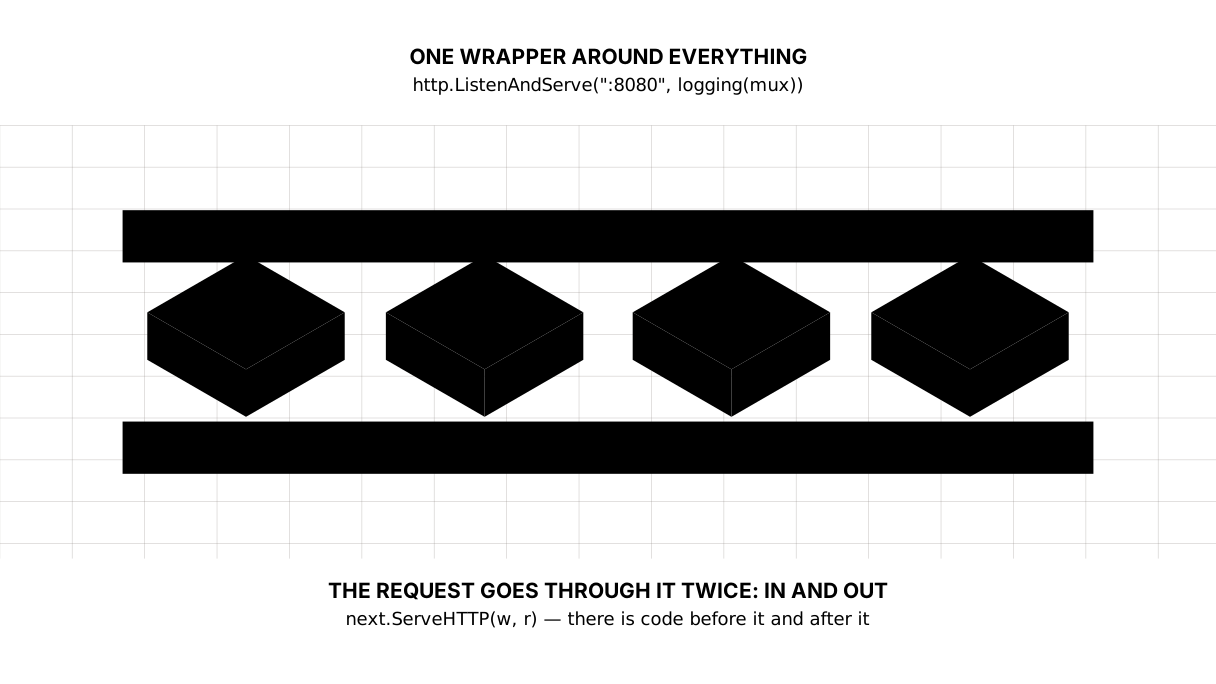
Inside a wrapper there are three parts: something before, the call to next.ServeHTTP(w, r), something after.
Picture it. The turnstile at a building’s entrance. It does not know which office you are going to and does not decide for you. It notes the time you came in, lets you through, and notes the time you left — the same for everyone.
The order: wrappers go on like nesting dolls
Put two on and see which order they run in:
http.ListenAndServe(":8080", mark("outer")(mark("inner")(mux)))
outer in
inner in
the handler
inner out
outer out
The outer one meets the request first and sees the response out last. Hence a simple rule: whatever must happen before everything else goes on last, on the outside.
Picture it. Nesting dolls. Take off the outer one and the next is underneath, down to the smallest; put them back in the reverse order. The request goes right through them and comes back the same way.
The status code has to be remembered yourself
Here is where beginners trip. ResponseWriter has no way of being asked which code has gone out. It can only write.
So the wrapper slips in one of its own:
type recorder struct {
	http.ResponseWriter
	code int
}

func (rec *recorder) WriteHeader(code int) {
	rec.code = code
	rec.ResponseWriter.WriteHeader(code)
}
The first line of the struct is embedding: recorder gets every method of ResponseWriter for nothing and remains a fully-fledged ResponseWriter. It has one method of its own — WriteHeader, which remembers the code and passes it on.
A caveat. This
recorderis a teaching one. A real one does more: it stops the status being written twice (Go silently ignores a secondWriteHeader, which is worth knowing) and passes on the extra abilities of aResponseWriter—http.Flusher, for one, without which streaming does not work. Ours is enough for a log; it is not enough for a library.
And code: http.StatusOK at creation is not decoration: a handler that simply writes a body never calls WriteHeader at all, and the response still goes out as a 200.
Picture it. Carbon paper under a form. The original goes to the recipient, the copy stays with you — and nothing about what the recipient received has changed.
A wrapper for every route, and a wrapper for one
http.ListenAndServe(":8080", logging(mux))          // on everything
mux.Handle("GET /admin", onlyStaff(adminPage))      // on one route
The first is for the whole site: the log, the timing, recovering from a panic. The second is for what not everything needs: a sign-in check, a rate limit.
What does not belong in a wrapper
A wrapper is tempting: it sees everything. So things that have no business being there move in quickly.
The rule is simple: a wrapper does the same thing for everyone. The moment an if r.URL.Path == … appears inside it, it is no longer a wrapper but a router written a second time and worse. That belongs either in a handler of its own or in a wrapper put on one route.
The lesson map
Say it in your own words
Without looking, answer out loud or on paper. The answers are at the end of the lesson.
- Why can
loggingwrapmuxwhenmuxis not a function? - Put two wrappers on. Which of them sees the request first?
- Why does the wrapper need a
recorderof its own when the status code has already gone out throughw?
Exercise
Required. Write a wrapper withHeader that adds an X-Blog: go-oqu header to every response, and put it on the whole router together with logging. Check with curl -i that the header is on all three addresses, the 404 included. Then write a second wrapper that prints a message before and after, and confirm the order is the one you predicted.
Optional.
- Have
recordercount the bytes of the response as well and print that in the log. - Write a
recoverwrapper that catches a handler’s panic and answers 500 instead of dropping the connection. - Put a wrapper on
/slowalone, throughmux.Handle, and check that it does not fire on the other addresses.
Where this goes in your blog
You have just written the log, and it stays to the end of the course. Recovering from a panic and a sign-in check join it once there are users.
And in the next lesson HTML finally travels in the body: templates turn []Article into a page, and fmt.Fprintln leaves the handlers.
Answers
Show the answers
- Because a wrapper takes not a function but the
http.Handlerinterface — anything with aServeHTTPmethod.ServeMuxhas one, so the router is a handler like any other. - The outer one: it gets the request first and hands the response over last. The order is the nesting dolls’ — whatever is on the outside meets it first.
- Because
ResponseWritercan only write; the code it sent cannot be read back from it. The wrapper substitutes its ownrecorder, which notes the code on the way past and passes it to the real writer unchanged.
Sources
If you have found a mistake or a typo in this article, tell us about it
Comments (0)
Log in to leave a comment →
No comments yet. Be the first.