

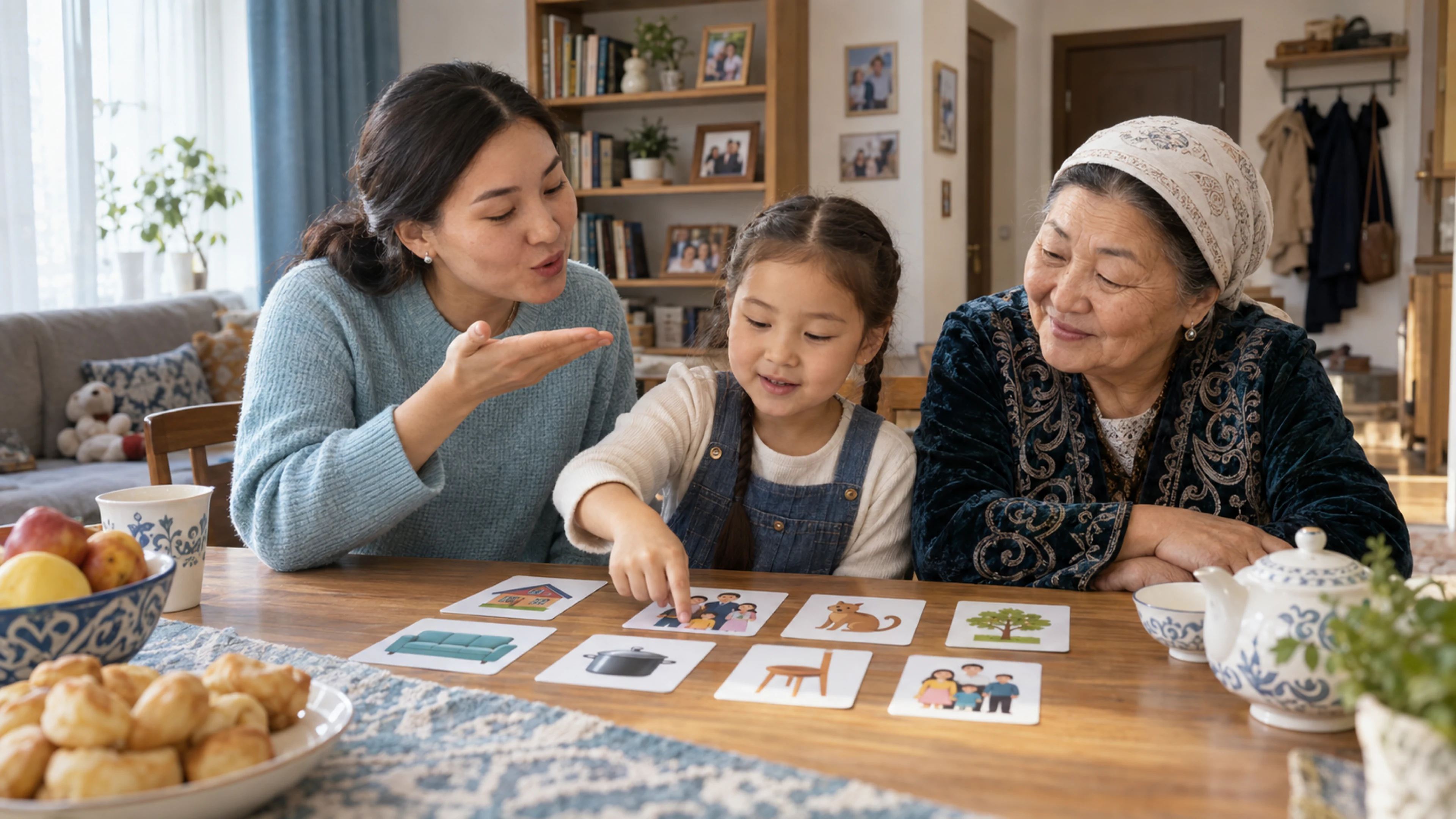
Kazakh: start speaking from the first meeting Lesson 10 of 16
Бұл кім? Talking about family accurately and respectfully
You will name close relations, ask “Who is this?”, and answer in a complete frame without making assumptions about somebody else's family.
This text was translated with AI.
Where we are on the map
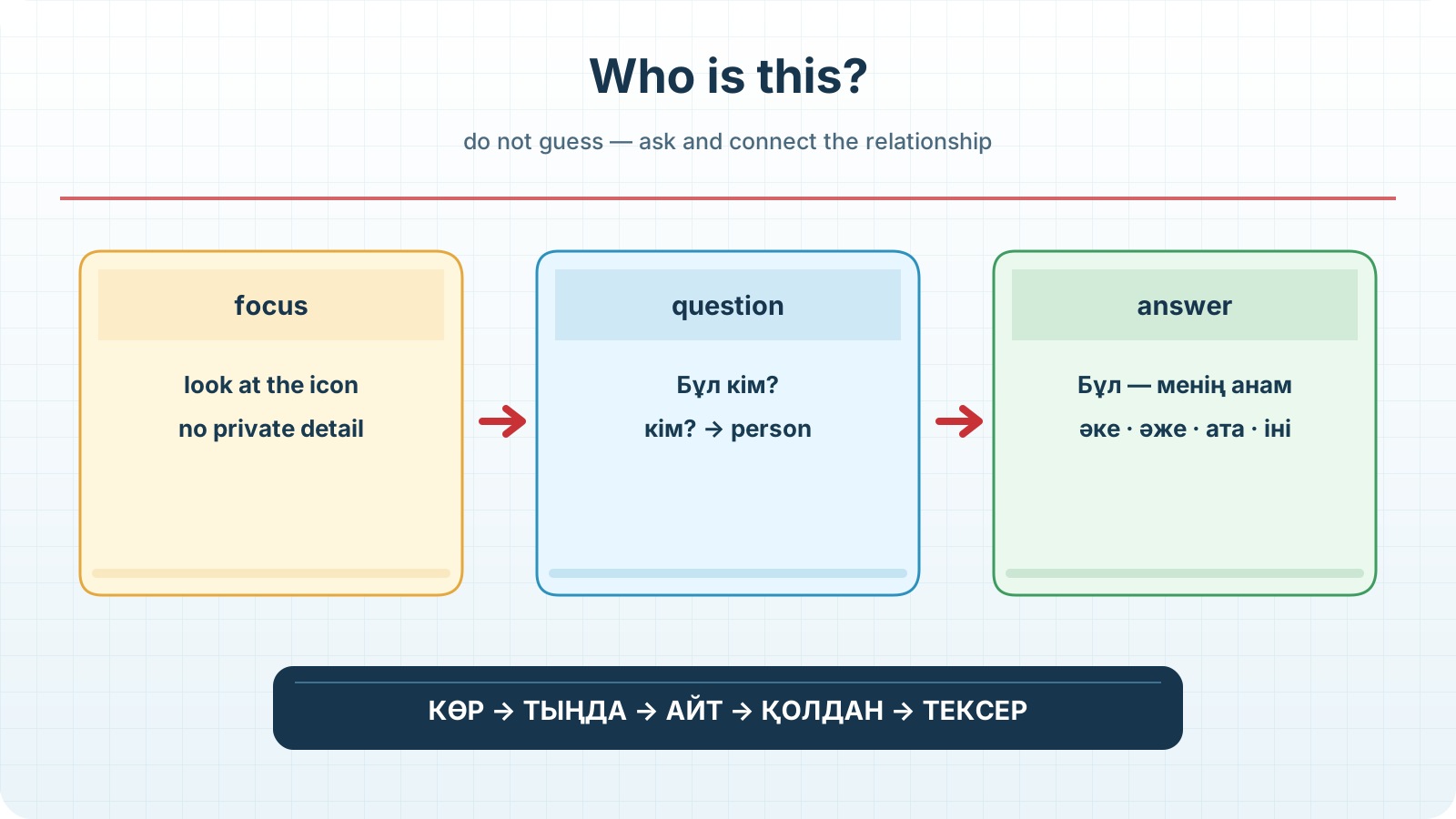
The support map shows one complete meaning link. Trace it with a finger, then rebuild the route without the picture.
A real situation
Several people appear in a photograph. Instead of guessing, ask the neutral question Бұл кім? — “Who is this?” The owner of the photograph chooses the answer. We use a fictional family for practice, so nobody has to disclose personal information.
Listen and respond
Listen: Бұл кім? — Who is this?
Listen: Бұл — менің анам. — This is my mother.
Listen: Бұл — менің әкем. — This is my father.
Listen: Бұл — менің әжем. — This is my grandmother.
Listen: Бұл — менің атам. — This is my grandfather.
Listen: Бұл — менің інім. — This is my younger brother relative to the speaker.
How to practise
Listen with the text hidden and catch only the target meaning. Next, trace the map with a finger and repeat after the model. On the third pass, hide the model, tap its short rhythm with your palm, and make a sentence of your own. Device speech is a model; use a speaker, teacher, or comparison with your own recording as evidence of pronunciation.
The precise model
Бұл points to the person or object in focus, while кім? asks about a person. A stable response has three cards: Бұл + менің + relationship. The terms аға, әпке, іні, қарындас, and сіңлі depend on the relative age and sometimes the gender of the speaker as well as the relative. They form a relationship map rather than one-to-one translations. Use ана, әке, әже, ата, and бала confidently today, and verify sibling terms from the speaker’s position.
The support signal
PICTURE → БҰЛ КІМ? → БҰЛ — МЕНІҢ АНАМ/ӘКЕМ/ӘЖЕМ/АТАМ
The limit of the rule
In the beginner model, кім? is for people and не? for things and animals. Do not call an unfamiliar older person ата or әже merely from appearance; a kinship word expresses a relationship. The dash marks a useful pause in the diagram, not a separate spoken word.
Predict before the explanation
Sort picture cards into person, object, and unknown. Choose кім? or не? for each, then predict which facts only the owner of the picture has the right to provide.
Rebuild it without the prompt
Hide the list and draw a five-icon family map for a fictional character. Point, ask Бұл кім?, and answer. In the final round, a partner changes the order of the cards.
Find and repair the mistake
A learner asks Бұл не? about a grandmother and immediately labels an unknown person Бұл менің әжем. Repair the question to кім? and leave the answer to the owner of the image. Linguistic accuracy includes respect for the person.
Transfer to a new setting
Replace the photograph with the audio description Бұл — менің анам. Оның аты — Айгүл. Draw only a privacy-safe relationship map and ask one clarifying question without requesting an address, age, or other private detail.
Change to the My World project
Add a People panel to project version 0.2: five fictional characters, their connections, and one neutral label each. Add a listening action to three lines and a label-free version for recall.
Exercise
Required. Make an eight-line dialogue around a fictional family picture: three Бұл кім? questions, three different answers, one name clarification, and a polite close.
Transfer check. Receive a new family map, choose the appropriate younger-sibling term from the speaker’s position, and explain the choice.
Retrieval after 1, 7, and 30 days
- Tomorrow name five relationships from icons without the list.
- After seven days rebuild the exchange with a new picture.
- After thirty days describe a fictional family for forty seconds without a memorised order.
Next lesson: Whose home is it? Building possession as a two-sided link
If you have found a mistake or a typo in this article, tell us about it
Comments (0)
Log in to leave a comment →
No comments yet. Be the first.