


Kazakh: start speaking from the first meeting Lesson 15 of 16
What is in the home? Бар and жоқ instead of a translated ‘have’
You will state what exists or is absent in a place or for a character, ask with бар ма, and answer without copying an English structure.
This text was translated with AI.
Where we are on the map
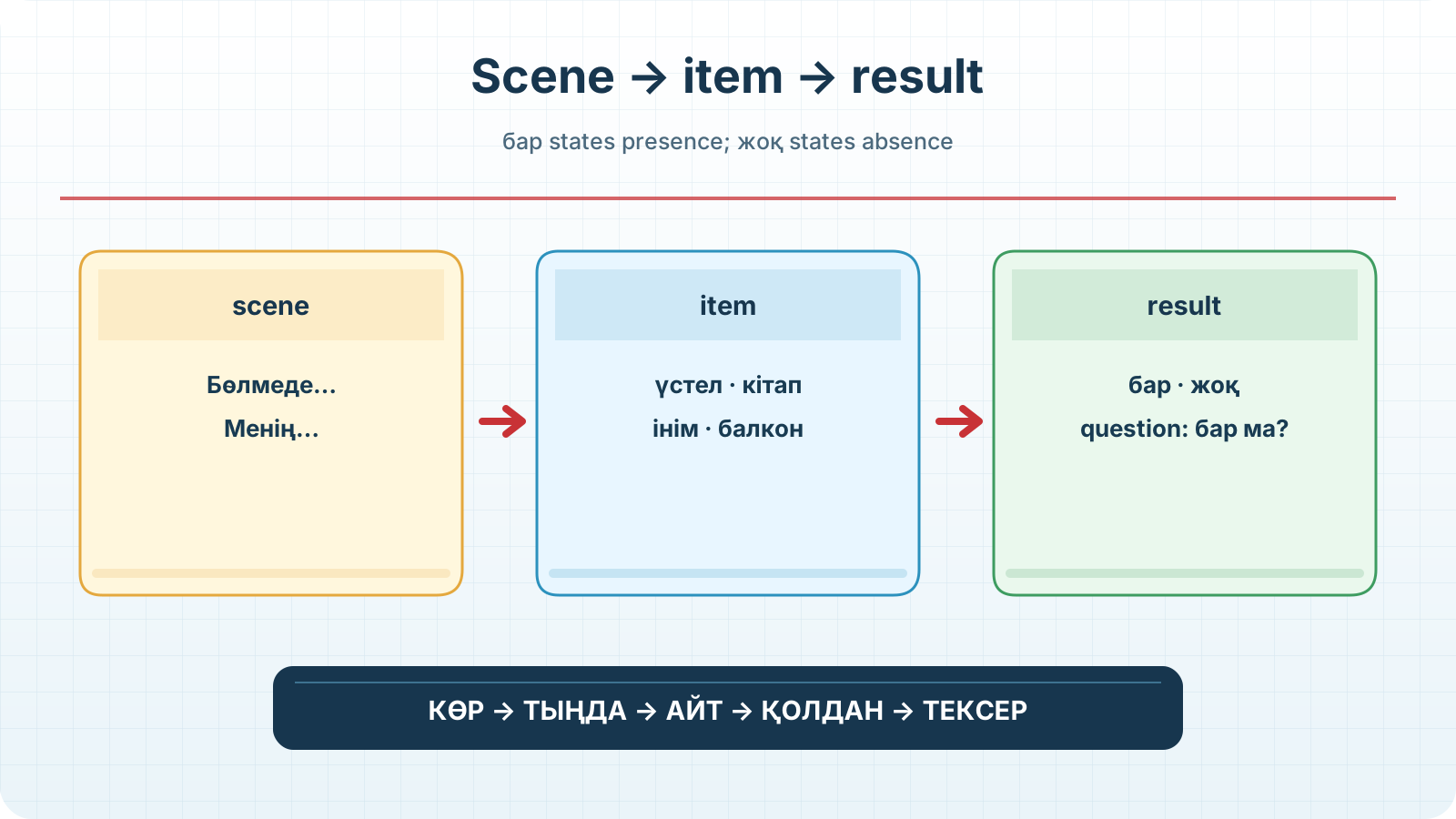
The support map shows one complete meaning link. Trace it with a finger, then rebuild the route without the picture.
A real situation
A guest asks whether the home has a desk. Kazakh sets the scene, then the item, then the result: Бөлмеде үстел бар — there is a table in the room.
Listen and respond
Listen: Бөлмеде үстел бар. — There is a table in the room.
Listen: Үстелде кітап жоқ. — There is no book on the table.
Listen: Үйде ас үй бар ма? — Is there a kitchen in the home?
Listen: Иә, ас үй бар. — Yes, there is a kitchen.
Listen: Жоқ, балкон жоқ. — No, there is no balcony.
Listen: Менің інім бар. — I have a younger brother.
How to practise
Listen with the text hidden and catch only the target meaning. Next, trace the map with a finger and repeat after the model. On the third pass, hide the model, tap its short rhythm with your palm, and make a sentence of your own. Device speech is a model; use a speaker, teacher, or comparison with your own recording as evidence of pronunciation.
The precise model
The existence frame is place/possessor + item + бар/жоқ. Бар states presence; жоқ states absence. Add a separate question particle for бар ма? while preserving the basic order. With a person, the possessive phrase fills the scene role: Менің інім бар is organised roughly as “my younger brother exists”. This is a natural Kazakh construction, not a missing translation of have.
The support signal
PLACE/POSSESSOR → ITEM → БАР / ЖОҚ | QUESTION: БАР МА?
The limit of the rule
Бар has other meanings in other structures, including an imperative “go”; the sentence determines its role. Do not require disclosure about a real family or property. Жоқ needs no separate negative verb in this frame.
Predict before the explanation
Show six plan cells, three occupied and three empty. Select бар or жоқ before listening, then turn two statements into questions.
Rebuild it without the prompt
Hide the map and rebuild the order from three cards. A partner changes only the location or object; preserve the frame and update the answer.
Find and repair the mistake
Repair Мен бар кітап, Үйде жоқ үстел, and Барма?. Restore the scene first, item second, and result last; write the question particle ма separately.
Transfer to a new setting
Run an audio inventory: one learner sees a room and another sees a blank plan. The second learner reconstructs it through five бар ма? questions and marks uncertainty.
Change to the My World project
Add a бар/жоқ layer to the plan with five statements and three questions. Use only fictional relationships and objects for characters.
Exercise
Required. Write six statements and six бар/жоқ questions about a fictional home. Answers must vary a location or item as well as yes or no.
Transfer check. Rebuild an unfamiliar plan in no more than six questions and explain the word order in one line.
Retrieval after 1, 7, and 30 days
- Tomorrow rebuild scene, item, and result.
- After seven days run an inventory on a new plan.
- After thirty days describe the presence and absence of six objects without a text.
Next lesson: Mastery checkpoint: people and home without a script
If you have found a mistake or a typo in this article, tell us about it
Comments (0)
Log in to leave a comment →
No comments yet. Be the first.