

Kazakh: start speaking from the first meeting Lesson 21 of 48
From where, to where, and as far as where?
You will mark a route’s start, destination, and boundary with -дан/-ден/-тан/-тен, -ға/-ге/-қа/-ке, and `дейін`.
This text was translated with AI.
Where we are on the map
The support is a route rather than a poster to memorise. Find the starting point, trace the arrows, and name the meaning of each step. Then hide the map and rebuild it on a blank sheet.
A real situation
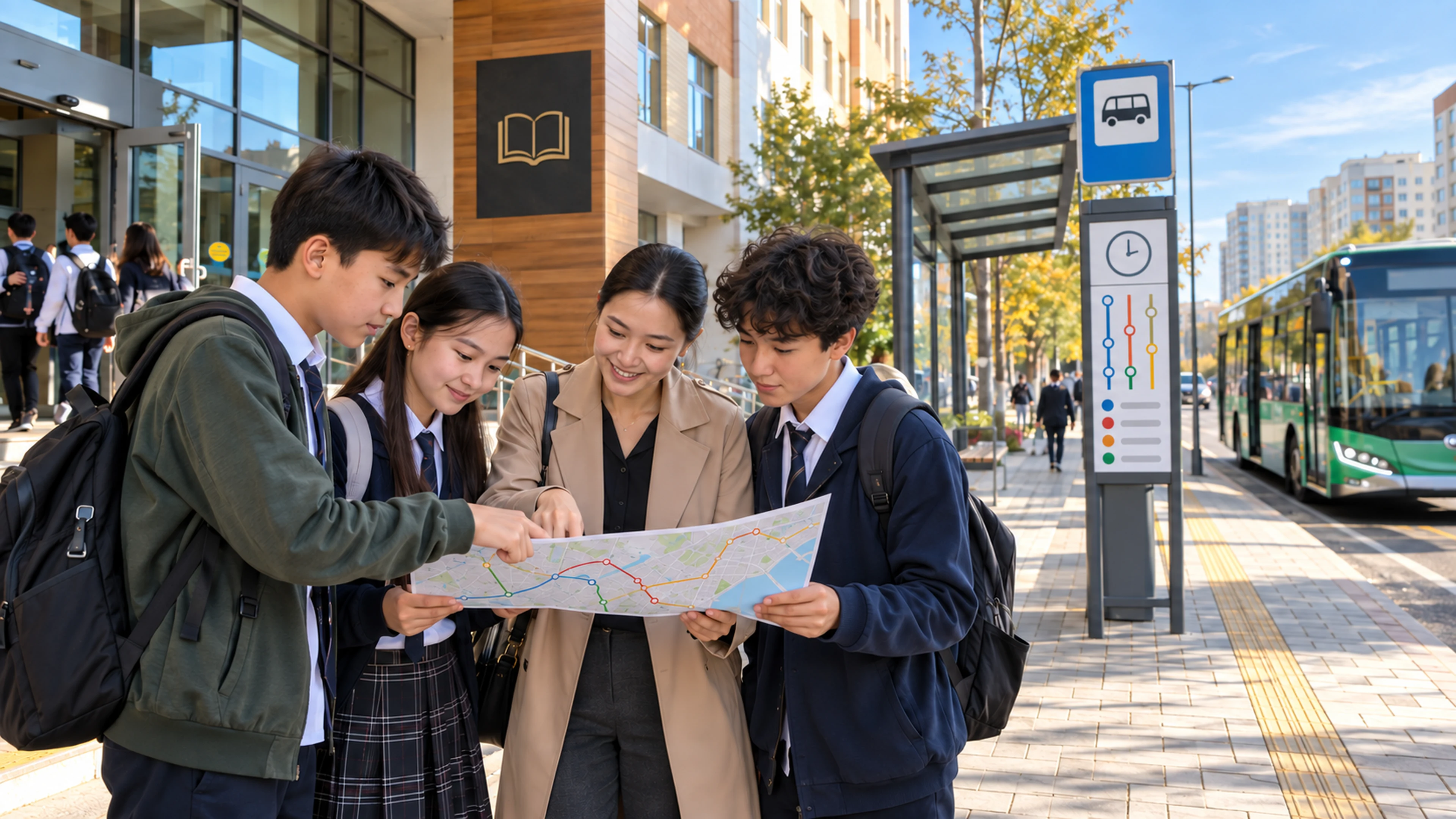
You must explain the route from a school to a library to someone who recognises the buildings but does not know where the route starts or ends.
Listen and respond
Listen: Мен мектептен кітапханаға барамын. — I go from the school to the library.
Listen: Аялдамадан дүкенге дейін жаяу барамын. — I walk from the stop as far as the shop.
Listen: Мектеп қайда орналасқан? — Where is the school located?
Listen: Көшенің соңына дейін тура жүріңіз. — Go straight to the end of the street.
Listen: Саябақтан кейін оңға бұрылыңыз. — Turn right after the park.
Listen: Кітапхана мектептің жанында. — The library is beside the school.
How to practise
On the first listen, hide the text and identify only the situation. On the second, reveal the Kazakh line, point to its meaning units, and repeat after the recording. On the third, remove the model, change a place, time, or direction card, and produce a new sentence. The recording supplies a pronunciation model; compare your speech with it or ask a live speaker to check it.
The precise model
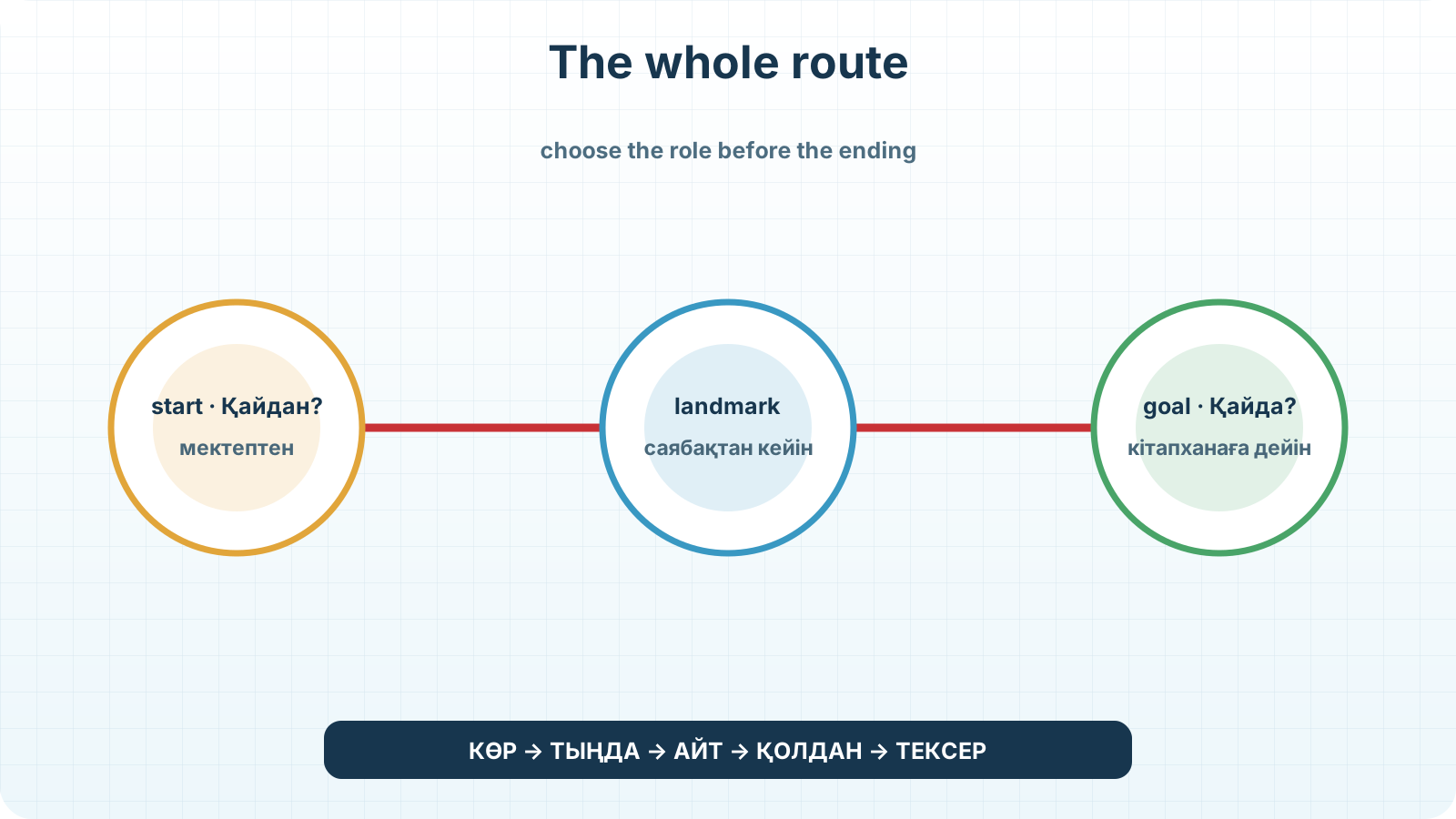
A route has three roles. The start answers қайдан?: мектептен, аялдамадан, саябақтан. The destination answers movement towards қайда?: кітапханаға, дүкенге. A boundary takes дейін: дүкенге дейін, көшенің соңына дейін. Select the role before selecting the harmony and final-sound variant.
The support signal
ҚАЙДАН? start → ҚАЙДА? destination → ҚАЙ ЖЕРГЕ ДЕЙІН? boundary
The limit of the rule
One English preposition can conceal distinct Kazakh roles. Мектепте means being at school, мектептен means leaving school, and мектепке means heading to school. Дейін adds an endpoint after the directional form. Learn the spatial roles rather than substituting endings in a table.
Predict before the explanation
Before reading the rule, inspect the new cards and choose a form by meaning: where an action happens, where a route starts, where it ends, when an event starts, or which rule applies. Record the prediction, then explain which signal confirmed or changed it.
Rebuild it without the prompt
Hide the page and draw the support from memory in sixty seconds. Use it to say three lines: the familiar model, one changed line, and one entirely your own. If a link is missing, reveal only that link, hide the page again, and rebuild the whole chain.
Find and repair the mistake
A learner says мектепте кітапханаға барамын. The first form locates the action at school even though the route should start there. Lay out ‘point — arrow — goal’ cards and repair the form to мектептен.
Transfer to a new setting
Change the situation rather than replacing a single word: use another school, day, time, route, or rule. A partner supplies one unseen card and checks whether your ending still matches the intended meaning.
Change to the My World project
Add one fictional city route to the project with a start, destination, boundary, and two landmarks. Never publish a home address.
Exercise
Required. Build three card routes and name the start, destination, and boundary in each. Underline only the endings and explain their meanings. Transfer check. Receive a new pair of places and build the route without an ending table.
Retrieval after 1, 7, and 30 days
- Tomorrow rebuild the support and say four lines without reading.
- After seven days work with a new route or timetable and meet at least 7 of 10 criteria.
- After thirty days use the construction in a safe real setting and mark the support you no longer need.
If you have found a mistake or a typo in this article, tell us about it
Comments (0)
Log in to leave a comment →
No comments yet. Be the first.