


Kazakh: start speaking from the first meeting Lesson 46 of 48
Ask and negate precisely: when an action did not happen
You will build questions and negatives whose time and meaning do not contradict one another.
This text was translated with AI.
Where we are on the map
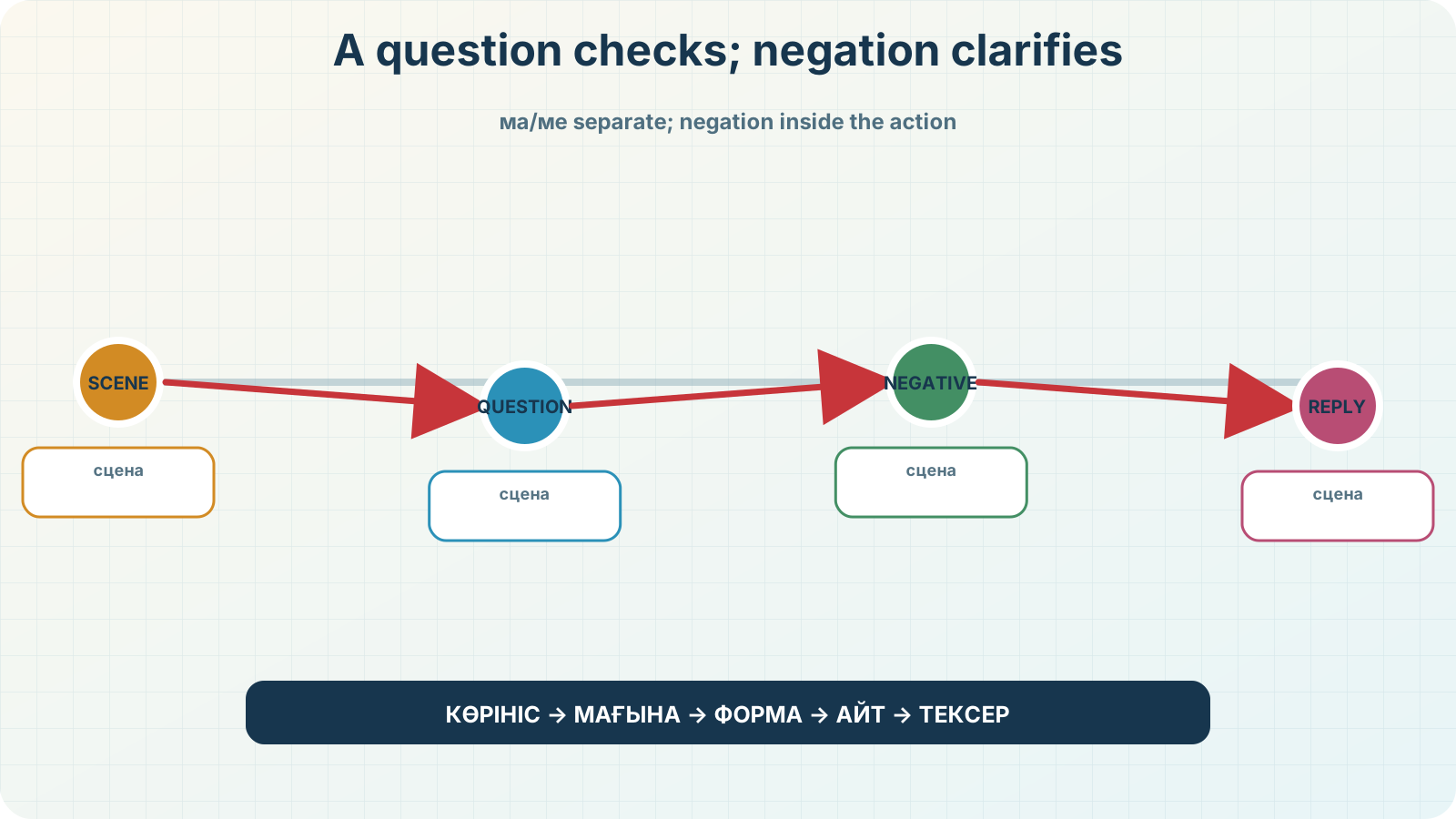
The support map presents time as an observable scene rather than a row of labels. First find a time beacon: yesterday, usually, now, or tomorrow. Then inspect the state of the action: has it finished, does it repeat, is it unfolding at speech time, or is it only planned? Trace the route from beacon to scene and form, hide the labels, and rebuild it in your own words.
A real situation
A team log contains gaps. Nobody knows whether the file was saved, whether the group is working now, or whether tomorrow’s meeting will happen. Instead of accusing anyone, the participants ask neutral questions, receive an answer, and record a verifiable fact.
Listen and respond
Listen: Сен кеше файлды сақтадың ба? — Did you save the file yesterday?
Listen: Жоқ, мен файлды сақтамадым. — No, I did not save the file.
Listen: Олар қазір жұмыс істеп жатыр ма? — Are they working now?
Listen: Жоқ, олар қазір жұмыс істеп жатқан жоқ. — No, they are not working now.
Listen: Ертең кездесеміз бе? — Will we meet tomorrow?
Listen: Жоқ, ертең кездеспейміз. — No, we will not meet tomorrow.
How to practise
On the first listen, hide the text and identify only the time of the action. On the second, reveal the Kazakh line, point to the time beacon and verb form, and repeat the complete line after the recording. On the third, replace the day, participant, or action and choose the meaning again before the form. The recording supplies pronunciation; a suitable new sentence proves understanding.
The precise model
The question particle ма/ме/ба/бе/па/пе is written separately after a form: сақтадың ба?, жатыр ма?, кездесеміз бе?. In the completed past, negation comes before the time marker: сақта-ма-ды-м. In the habitual or future form: кездес-пей-міз. A process can be negated as істеп жатқан жоқ, literally stating that the process is absent.
The support signal
СҰРАҚ: ФОРМА + БӨЛЕК ПЕ? | ТЕРІС: ТҮБІР + МА/МЕ ... | ҮДЕРІС + ЖОҚ
The limit of the rule
The question particle is not the negative suffix even though their variants look similar. A negative reply does not always require a negative verb: Жоқ, кейін сақтадым is suitable if the event happened at another time. Avoid a question whose wording already accuses a person.
Predict before the explanation
Before the explanation, lay out four cards: completed, usual, happening now, and planned. For every line you hear, choose a card first and name the observable clue. Only then predict the verb form. Keep your first answer, compare it with the model, and explain any change with one sentence about meaning.
Rebuild it without the prompt
Hide the lesson and draw a past, present, and future line in one minute. Rebuild one familiar line, then change its time and produce a new one. Say both naturally without separating suffixes in your voice. If the choice disappears, return to the question ‘what is happening in the scene?’ instead of reciting a list of endings.
Find and repair the mistake
A learner writes сақтадыңба as one word and replies сақтамадым ба, producing another question. Separate the function cards: a detached particle asks, while a suffix inside the verb negates. Then rebuild a neutral question-and-answer pair.
Transfer to a new setting
Take an unseen card containing a person, an action, and a time condition. Produce a line without a model, ask your partner a clarifying question, and change the time after the reply. The partner checks whether the time beacon, state of the action, and form agree instead of demanding a memorised sentence.
Change to the My World project
Add a verification log to the project: three neutral questions, one confirmed answer, and a corrected schedule. Do not record assumptions about people as facts.
Exercise
Required. Build two question-and-answer pairs each for past, current process, and future. Transfer check. A partner changes an affirmative fact; turn it into an accurate question and a negative in the same time frame.
Retrieval after 1, 7, and 30 days
- Tomorrow rebuild the time support and produce three new lines without reading.
- After seven days describe yesterday, now, and tomorrow from unseen pictures and meet at least 7 of 10 criteria.
- After thirty days record a one-minute account, find one time-related inaccuracy, and repair it independently.
Next lesson: From frames to a story: connect yesterday, now, and tomorrow
If you have found a mistake or a typo in this article, tell us about it
Comments (0)
Log in to leave a comment →
No comments yet. Be the first.