


Kazakh: start speaking from the first meeting Lesson 28 of 48
At a café: a polite order without guessing
You will choose a dish, clarify its ingredients, place a polite order, and check it before confirmation.
This text was translated with AI.
Where we are on the map
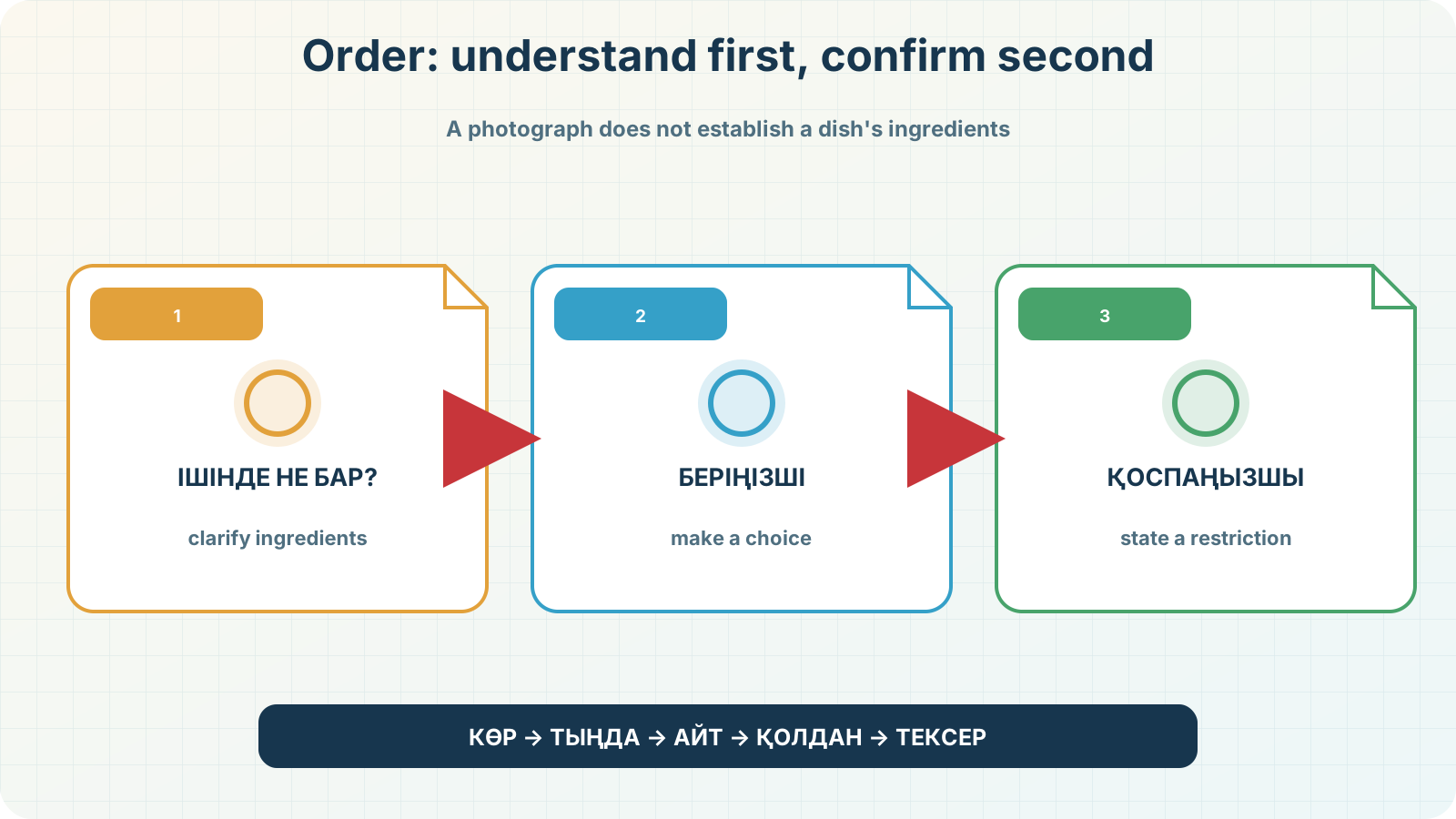
The support map presents an action as a short route: the situation cue, a useful line, the other person’s response, and a result check. Trace the arrows and state the meaning of each node, then hide the map and rebuild it on a blank sheet. Colour helps you find a step, but the response must eventually work without colour.
A real situation
A menu contains an unfamiliar dish, and a visitor has a dietary restriction. Instead of guessing, you ask short questions, listen to the answer, and only then confirm the order.
Listen and respond
Listen: Мәзірді беріңізші. — Please give me the menu.
Listen: Бұл тағамның ішінде не бар? — What is in this dish?
Listen: Маған көкөніс салатын беріңізші. — Please give me the vegetable salad.
Listen: Шайға қант қоспаңызшы. — Please do not add sugar to the tea.
Listen: Тапсырысым дайын ба? — Is my order ready?
Listen: Дәмді болды, рақмет. — It was delicious, thank you.
How to practise
On the first listen, hide the text and identify the place and the speaker’s intention. On the second, reveal the Kazakh line, divide it into meaning units, and repeat after the recording without rushing. On the third, remove the model, change the time, product, service, or reason, and produce your own line. The recording models pronunciation; an appropriate response or action proves comprehension.
The precise model
A polite request often ends in -ңызшы/-ңізші, as in беріңізші and қоспаңызшы. A negative request keeps the action but adds a negative marker: қоспаңызшы asks someone not to add an item. First clarify ingredients with ішінде не бар?, then state the choice and restriction, and finally repeat the order.
The support signal
МӘЗІР → ҚҰРАМ? → ТАҢДАУ → ӨТІНІШ → ҚАЙТАЛАУ → РАҚМЕТ
The limit of the rule
Asking about ingredients can reduce risk but cannot guarantee the absence of an allergen or cross-contact. A person with a severe allergy should tell staff clearly and follow their medical plan; a lesson dialogue is not a safety guarantee. Never infer ingredients from a photograph alone.
Predict before the explanation
Before reading the model, inspect the situation and choose the line that would actually complete the task. Record your prediction. After the explanation, identify the meaning cue rather than an isolated ending: habit, sequence, quantity, request, appointment time, symptom, or detected error.
Rebuild it without the prompt
Hide the page and draw the four main nodes of the support map in sixty seconds. Use the drawing to produce the familiar line, one changed line, and an appropriate reply. If a step disappears, reveal only that area and rebuild the chain once more.
Find and repair the mistake
A learner sees a green dish and assumes that it contains no nuts. Colour proves nothing. Restore the question Бұл тағамның ішінде не бар?, name the relevant restriction, and ask staff to confirm their understanding.
Transfer to a new setting
Change the life task itself: another morning, purchase, dish, time, institution, or problem. A partner supplies one unseen card and checks whether you clarify its meaning instead of reciting the practised dialogue.
Change to the My World project
Add a fictional four-item menu with clear ingredient pictograms and an order card to the project. Do not use other organisations’ logos or real payment information.
Exercise
Required. Act out six turns: menu, ingredient question, choice, one exclusion request, order repetition, and thanks. Transfer check. A partner changes one ingredient; ask for clarification before confirming.
Retrieval after 1, 7, and 30 days
- Tomorrow rebuild the support map and act out two lines without reading.
- After seven days complete a new everyday task and meet at least 7 of 10 criteria.
- After thirty days use the construction in a safe real setting and mark the support you no longer need.
Next lesson: Booking a service: choosing and confirming a time
If you have found a mistake or a typo in this article, tell us about it
Comments (0)
Log in to leave a comment →
No comments yet. Be the first.