

Kazakh: start speaking from the first meeting Lesson 14 of 16
Where is it? The home and -да/-де/-та/-те
You will name core parts of a home and locate a person or object by selecting the locative ending from harmony and the final sound.
This text was translated with AI.
Where we are on the map
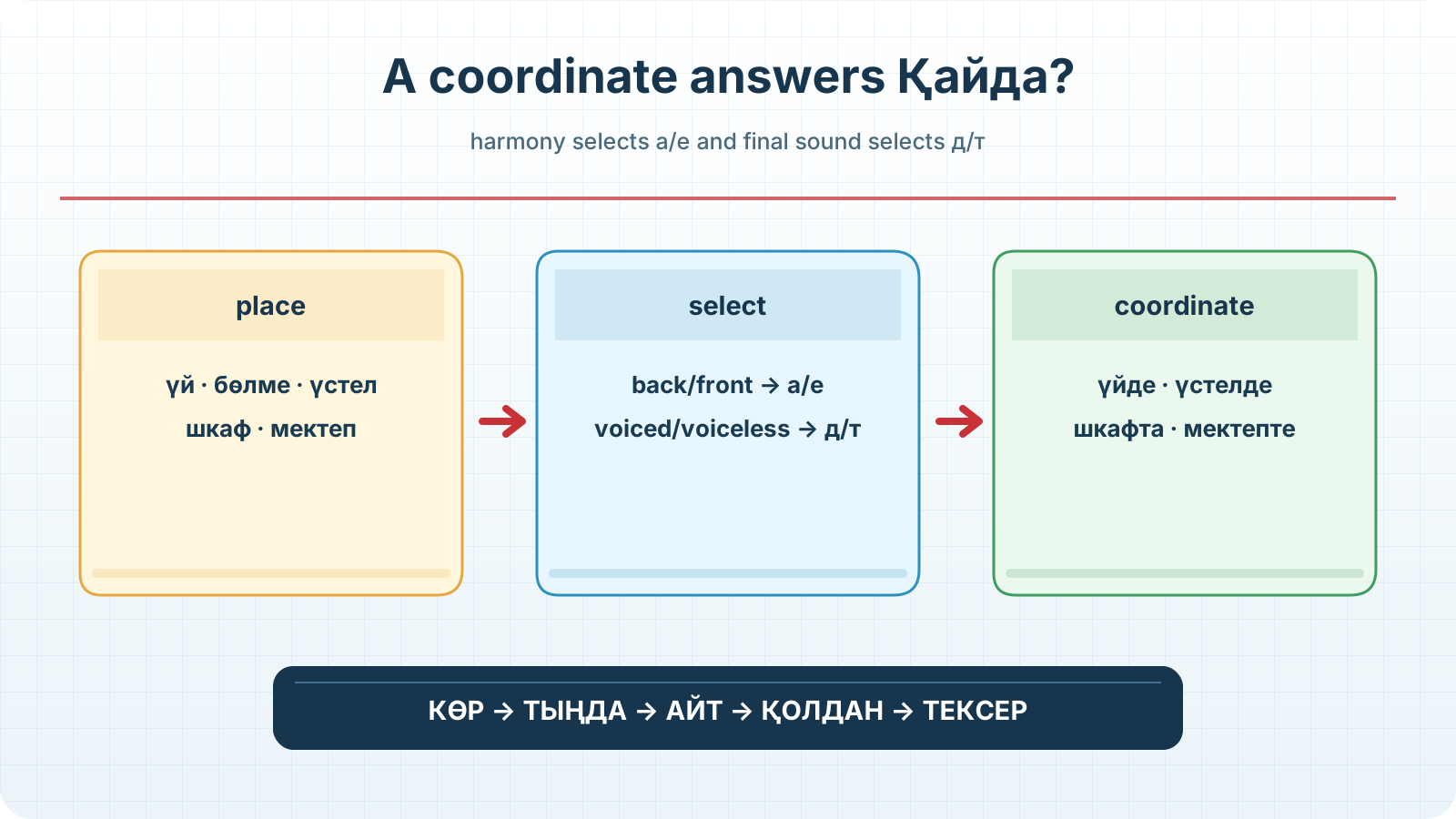
The support map shows one complete meaning link. Trace it with a finger, then rebuild the route without the picture.
A real situation
Someone is looking for a book. The answer кітап names it but does not help them find it. Add a coordinate: Кітап үстелде — the book is on the table.
Listen and respond
Listen: Үйде үш бөлме бар. — There are three rooms in the home.
Listen: Анам ас үйде. — My mother is in the kitchen.
Listen: Кітап үстелде. — The book is on the table.
Listen: Гүл терезеде. — The flower is by the window.
Listen: Киім шкафта. — The clothes are in the wardrobe.
Listen: Бала мектепте. — The child is at school.
How to practise
Listen with the text hidden and catch only the target meaning. Next, trace the map with a finger and repeat after the model. On the third pass, hide the model, tap its short rhythm with your palm, and make a sentence of your own. Device speech is a model; use a speaker, teacher, or comparison with your own recording as evidence of pronunciation.
The precise model
The locative answers қайда? — where? The last vowel selects а/е; the final sound selects voiced д or voiceless т: үй-де, бөлме-де, үстел-де, but шкаф-та, мектеп-те. A Kazakh form does not have to encode English in, on, or at separately; the place noun and situation often provide the relation.
The support signal
ҚАЙДА? → HARMONY: -ДА/-ДЕ → FINAL SOUND: Д OR Т → ҮЙДЕ · МЕКТЕПТЕ
The limit of the rule
The locative alone does not express every spatial relation. Under, in front of, and between will later need relational words. Depending on context, үйде can mean in the house or at home.
Predict before the explanation
Sort үй, бөлме, үстел, шкаф, and мектеп by а/е and д/т. Build each ending before listening and explain both signals.
Rebuild it without the prompt
Hide the examples, draw a five-place plan, and move a token. A partner asks Қайда? on each move; answer with a complete short sentence.
Find and repair the mistake
Repair үйте, мектепде, and бөлмада. The first two select the wrong suffix consonant; the third damages the stem and harmony. Preserve the word first, then select the ending.
Transfer to a new setting
Hide an object in one of five safe locations and give a partner three spoken clues in Kazakh. The partner draws the coordinate without seeing the room.
Change to the My World project
Add a fictional home plan with five labels and three movable objects. Make an audio route that asks a listener to place the icons correctly.
Exercise
Required. Make ten answers to Қайда? with at least five locations and both д/т variants.
Transfer check. Give four coordinates from a new plan; a partner places the items and explains one ending error.
Retrieval after 1, 7, and 30 days
- Tomorrow retrieve five places and four endings.
- After seven days run an audio route on a new plan.
- After thirty days locate five objects without labels.
Next lesson: What is in the home? Бар and жоқ instead of a translated ‘have’
If you have found a mistake or a typo in this article, tell us about it
Comments (0)
Log in to leave a comment →
No comments yet. Be the first.