


Kazakh: start speaking from the first meeting Lesson 23 of 48
May, must not, and need to: understanding rules
You will distinguish permission, prohibition, and necessity at school, in a library, and on the street.
This text was translated with AI.
Where we are on the map
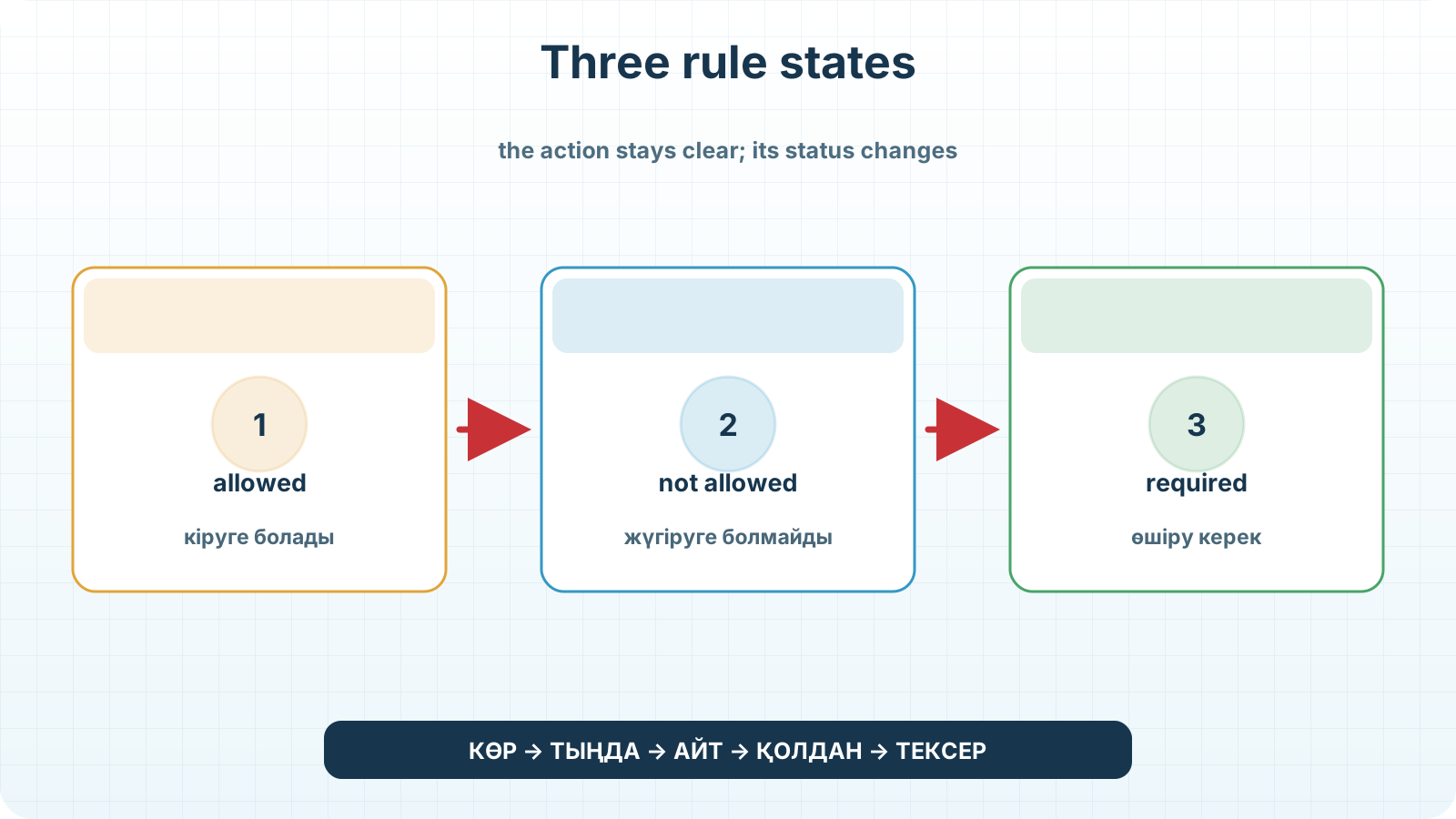
The support is a route rather than a poster to memorise. Find the starting point, trace the arrows, and name the meaning of each step. Then hide the map and rebuild it on a blank sheet.
A real situation
Doors and corridors display signs without a translation. You must identify what is allowed, forbidden, or required for safety, then ask for permission politely.
Listen and respond
Listen: Кітапханада тыныш сөйлеу керек. — You need to speak quietly in the library.
Listen: Дәлізде жүгіруге болмайды. — Running in the corridor is not allowed.
Listen: Сыныпқа кіруге бола ма? — May I enter the classroom?
Listen: Иә, кіруге болады. — Yes, you may enter.
Listen: Телефонды өшіру керек. — The phone needs to be switched off.
Listen: Жолдан жасыл шам жанғанда өту керек. — Cross the road when the green light comes on.
How to practise
On the first listen, hide the text and identify only the situation. On the second, reveal the Kazakh line, point to its meaning units, and repeat after the recording. On the third, remove the model, change a place, time, or direction card, and produce a new sentence. The recording supplies a pronunciation model; compare your speech with it or ask a live speaker to check it.
The precise model
An action takes a form such as сөйлеуге, жүгіруге, кіруге, or өтуге. A modal word then completes its status: болады means allowed, болмайды means not allowed, and керек means needed. The question particle is separate in бола ма? Identify the action first and the rule status second.
The support signal
ӘРЕКЕТ + -УҒА/-УГЕ → болады / болмайды / керек
The limit of the rule
Керек may express practical necessity, a rule, or advice; the situation determines the force. Do not turn lesson examples into universal legal claims. A pictogram, a staff instruction, and a formal regulation can carry different authority.
Predict before the explanation
Before reading the rule, inspect the new cards and choose a form by meaning: where an action happens, where a route starts, where it ends, when an event starts, or which rule applies. Record the prediction, then explain which signal confirmed or changed it.
Rebuild it without the prompt
Hide the page and draw the support from memory in sixty seconds. Use it to say three lines: the familiar model, one changed line, and one entirely your own. If a link is missing, reveal only that link, hide the page again, and rebuild the whole chain.
Find and repair the mistake
A learner sees a quiet sign and says сөйлеуге болмайды, banning all speech. If the sign asks for quiet speech, the precise line is тыныш сөйлеу керек. Separate prohibition of an action from a requirement to change how it is done.
Transfer to a new setting
Change the situation rather than replacing a single word: use another school, day, time, route, or rule. A partner supplies one unseen card and checks whether your ending still matches the intended meaning.
Change to the My World project
Add six clear signs to the school and city map: two permissions, two prohibitions, and two necessities. Every caption must match its image exactly.
Exercise
Required. Sort nine cards under болады, болмайды, and керек, explaining three ambiguous cases. Ask two бола ма? questions. Transfer check. Receive a new sign and formulate its rule without copying a model line.
Retrieval after 1, 7, and 30 days
- Tomorrow rebuild the support and say four lines without reading.
- After seven days work with a new route or timetable and meet at least 7 of 10 criteria.
- After thirty days use the construction in a safe real setting and mark the support you no longer need.
Next lesson: Mastery checkpoint: a school day and city route without a script
If you have found a mistake or a typo in this article, tell us about it
Comments (0)
Log in to leave a comment →
No comments yet. Be the first.