


Kazakh: start speaking from the first meeting Lesson 47 of 48
From frames to a story: connect yesterday, now, and tomorrow
You will assemble separate time forms into a clear account with sequence and cause.
This text was translated with AI.
Where we are on the map
The support map presents time as an observable scene rather than a row of labels. First find a time beacon: yesterday, usually, now, or tomorrow. Then inspect the state of the action: has it finished, does it repeat, is it unfolding at speech time, or is it only planned? Trace the route from beacon to scene and form, hide the labels, and rebuild it in your own words.
A real situation
An editor receives three project frames, but the audience knows neither their order nor their relationship. The speaker must guide the listener from a completed step through current work to the next plan without repeating the same opening.
Listen and respond
Listen: Кеше біз деректерді жинадық. — Yesterday we collected the data.
Listen: Содан кейін жоспар құрдық. — After that we made a plan.
Listen: Қазір нәтижені тексеріп жатырмыз. — We are checking the result now.
Listen: Себебі бір сан өзгерді. — Because one number changed.
Listen: Сондықтан кестені түзетеміз. — Therefore we will correct the table.
Listen: Ертең қорытындыны көрсетеміз. — Tomorrow we will present the conclusion.
How to practise
On the first listen, hide the text and identify only the time of the action. On the second, reveal the Kazakh line, point to the time beacon and verb form, and repeat the complete line after the recording. On the third, replace the day, participant, or action and choose the meaning again before the form. The recording supplies pronunciation; a suitable new sentence proves understanding.
The precise model
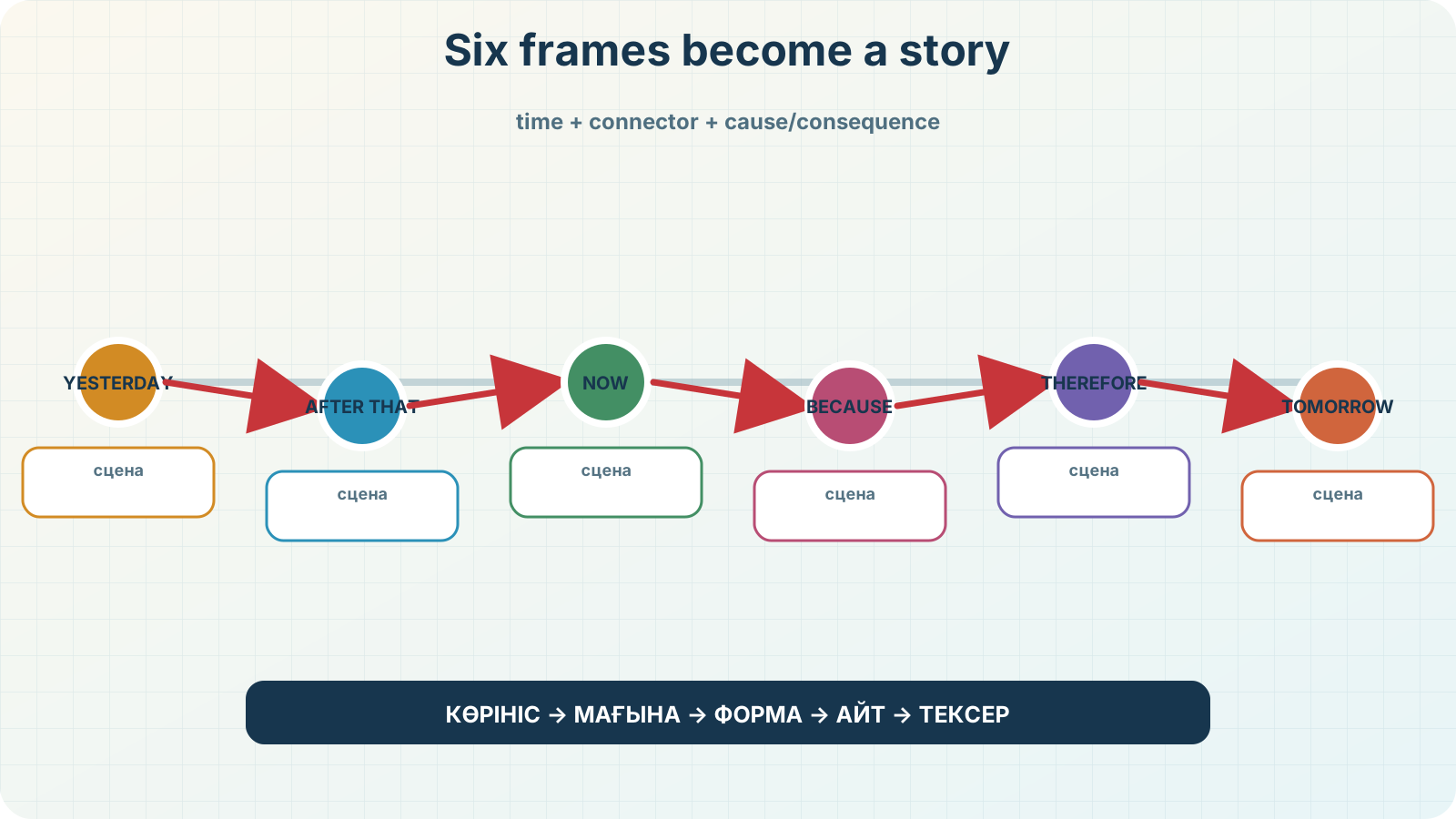
A coherent account follows two lines. The time line uses кеше, содан кейін, қазір, and ертең. The logic line uses себебі for a cause and сондықтан for a consequence. Each verb form must match its frame: жинадық completes, тексеріп жатырмыз unfolds, and көрсетеміз leads to a plan.
The support signal
КЕШЕ → СОДАН КЕЙІН → ҚАЗІР → СЕБЕБІ → СОНДЫҚТАН → ЕРТЕҢ
The limit of the rule
Себебі and сондықтан cannot simply exchange places without rebuilding the meaning: a speaker may state a result and then its cause, or a cause and then its consequence. Connectors do not repair an incorrect time form. Split a long account into short, clear sentences.
Predict before the explanation
Before the explanation, lay out four cards: completed, usual, happening now, and planned. For every line you hear, choose a card first and name the observable clue. Only then predict the verb form. Keep your first answer, compare it with the model, and explain any change with one sentence about meaning.
Rebuild it without the prompt
Hide the lesson and draw a past, present, and future line in one minute. Rebuild one familiar line, then change its time and produce a new one. Say both naturally without separating suffixes in your voice. If the choice disappears, return to the question ‘what is happening in the scene?’ instead of reciting a list of endings.
Find and repair the mistake
A learner says Себебі кестені түзетеміз, сондықтан бір сан өзгерді and reverses the cause. Lay out two cards: the changed number is the cause; correcting the table is the consequence. Rebuild Бір сан өзгерді, сондықтан кестені түзетеміз.
Transfer to a new setting
Take an unseen card containing a person, an action, and a time condition. Produce a line without a model, ask your partner a clarifying question, and change the time after the reply. The partner checks whether the time beacon, state of the action, and form agree instead of demanding a memorised sentence.
Change to the My World project
Assemble a one-minute My World 1.2 story from six frames: two completed steps, one current process, a cause, a consequence, and the next plan. Keep the data and characters fictional.
Exercise
Required. Tell the story without reading, using at least five connectors and three time pictures. Transfer check. A partner changes the middle frame; rebuild the cause, consequence, and plan until the account is logical again.
Retrieval after 1, 7, and 30 days
- Tomorrow rebuild the time support and produce three new lines without reading.
- After seven days describe yesterday, now, and tomorrow from unseen pictures and meet at least 7 of 10 criteria.
- After thirty days record a one-minute account, find one time-related inaccuracy, and repair it independently.
Next lesson: Mastery checkpoint 1.2: yesterday, now, and tomorrow unscripted
If you have found a mistake or a typo in this article, tell us about it
Comments (0)
Log in to leave a comment →
No comments yet. Be the first.