


Kazakh: start speaking from the first meeting Lesson 11 of 16
Whose home is it? Building possession as a two-sided link
You will build a “whose + what” link, distinguish my, respectful your, his or her, and a named person's item, and make both sides agree.
This text was translated with AI.
Where we are on the map
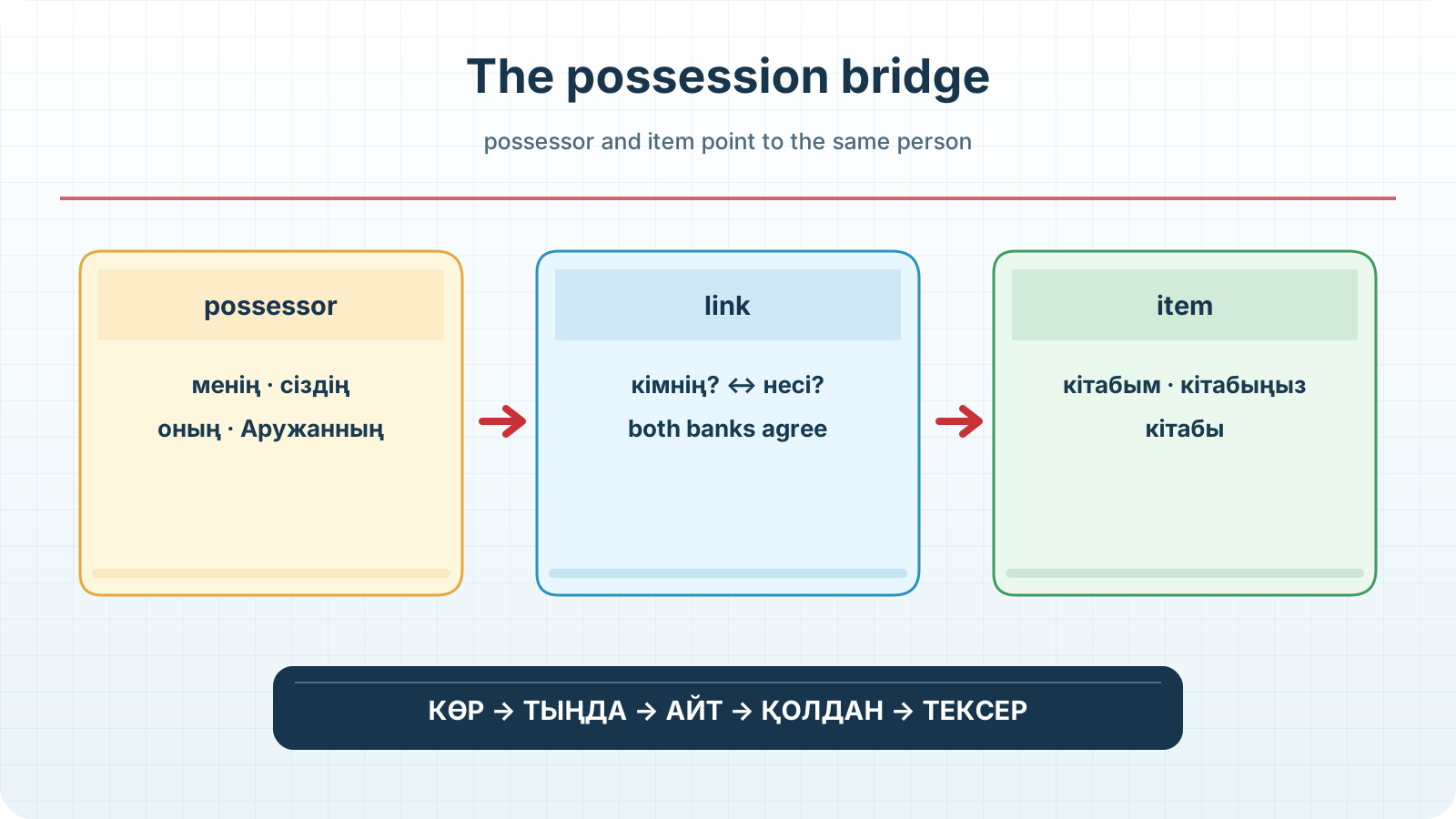
The support map shows one complete meaning link. Trace it with a finger, then rebuild the route without the picture.
A real situation
Three books are on a table. Saying кітап is not enough to return them. Ask Бұл кімнің кітабы? — “Whose book is this?” — and connect the possessor and item with markings on both sides.
Listen and respond
Listen: Бұл кімнің кітабы? — Whose book is this?
Listen: Бұл — менің кітабым. — This is my book.
Listen: Бұл — сіздің кітабыңыз. — This is your book, respectfully.
Listen: Бұл — оның кітабы. — This is his or her book.
Listen: Бұл — Аружанның кітабы. — This is Aruzhan’s book.
Listen: Менің үйім үлкен. — My home is large.
How to practise
Listen with the text hidden and catch only the target meaning. Next, trace the map with a finger and repeat after the model. On the third pass, hide the model, tap its short rhythm with your palm, and make a sentence of your own. Device speech is a model; use a speaker, teacher, or comparison with your own recording as evidence of pronunciation.
The precise model
Kazakh possession is like a bridge marked on both banks. The possessor takes менің / сіздің / оның / Аружанның, and the item takes the matching ending: кітабым / кітабыңыз / кітабы / Аружанның кітабы. The form is shorter after a vowel: бөлме + м → бөлмем, бөлме + сі → бөлмесі. A linking vowel appears after a consonant: үй + ім → үйім. Say the pairs as complete chunks first; use the ending chart to verify rather than guess at speed.
The support signal
МЕНІҢ ↔ -ЫМ/-ІМ/-М | СІЗДІҢ ↔ -ЫҢЫЗ/-ІҢІЗ | ОНЫҢ/АРУЖАННЫҢ ↔ -Ы/-І/-СЫ/-СІ
The limit of the rule
Оның means both his and her; context supplies gender. Менің үй leaves the bridge incomplete in a neutral full sentence, where үйім is required. A known possessor may be omitted in conversation, but the ending on the item remains meaningful.
Predict before the explanation
Connect four possessor cards to four endings by colour. Before listening, predict first- and third-person forms of үй, бөлме, and кітап, then check whether a linking vowel is needed.
Rebuild it without the prompt
Hide the chart and draw a bridge with a possessor on the left and an item on the right. Rebuild four forms of кітап, then replace the stem with үй. Say the question and answer without splitting a word.
Find and repair the mistake
Repair Бұл менің кітап and Бұл оның кітабым. The first item has lost its possessor marking; the second bridge points to different persons on its two banks. Explain the meaning mismatch before selecting an ending.
Transfer to a new setting
Find three harmless objects in a room and ask who owns them without assuming the answer. Then run a fictional lost-property desk using names and the respectful сіздің form.
Change to the My World project
Give each fictional character one non-valuable object and a Бұл — … caption. Link possessor and ending by colour, then remove colour in a recall copy.
Exercise
Required. Write eight кімнің? question-and-answer pairs using менің, сіздің, оның, and two fictional names, with stems ending in a vowel and a consonant.
Transfer check. A partner supplies a new noun. Verify its form in a dictionary, use it with two possessors, and explain the linking vowel.
Retrieval after 1, 7, and 30 days
- Tomorrow rebuild the four bridge sides and the forms of
үй. - After seven days run the lost-property exchange without the chart.
- After thirty days find and repair three mismatched possessor-item pairs.
Next lesson: One or several: choosing six plural endings as one system
If you have found a mistake or a typo in this article, tell us about it
Comments (0)
Log in to leave a comment →
No comments yet. Be the first.