

Kazakh: start speaking from the first meeting Lesson 38 of 48
From where and made of what? Ablative shows a beginning
You will identify a departure point, the source of an item, and the material from which it is made.
This text was translated with AI.
Where we are on the map
The support shows a word’s role in a scene rather than a table of endings. First find the image: actor, relationship, affected object, goal, location, source, or shared means. Only then trace the arrow to a question and form. Hide the labels and rebuild the route from the pictures.
A real situation
For an exhibition, you need to explain where participants came from, where materials were obtained, and what a model was made from. Every answer looks back to a source, although the kinds of beginning differ.
Listen and respond
Listen: Мен мектептен келемін. — I come from school.
Listen: Дүкеннен қағаз алдым. — I obtained paper from a shop.
Listen: Досымнан хабарлама келеді. — A message comes from my friend.
Listen: Үстел ағаштан жасалған. — The table is made of wood.
Listen: Сағат тоғыздан бастап жұмыс істейміз. — We work starting from nine.
Listen: Сіз қайдан келесіз? — Where do you come from?
How to practise
On the first listen, hide the text and identify the role of the highlighted word. On the second, reveal the Kazakh line, point to the stem and ending, and repeat the whole sentence. On the third, replace the place, object, or participant and choose the role again before choosing an ending. Use the recording for pronunciation and prove understanding with a new example.
The precise model
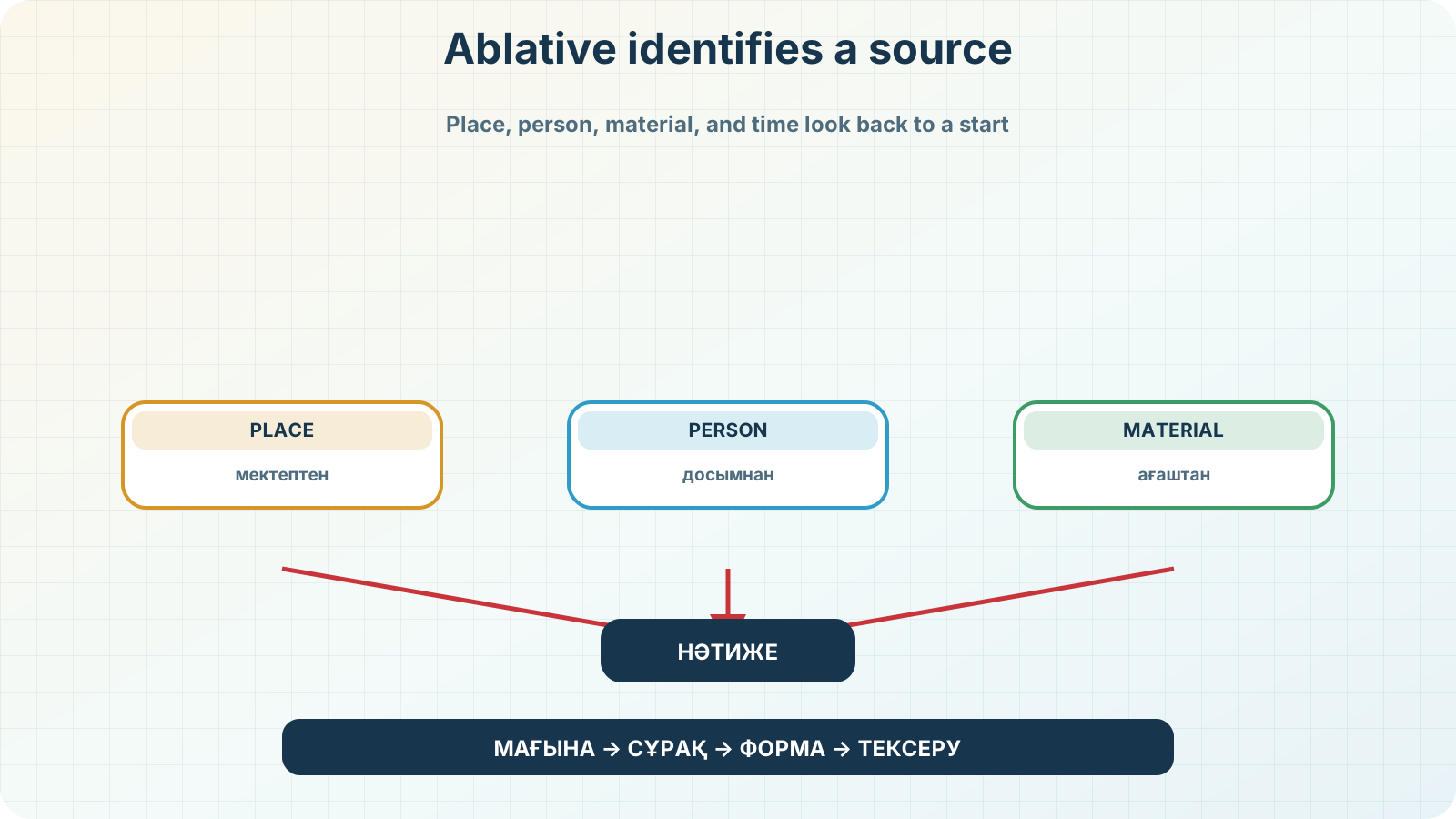
Ablative answers кімнен/неден/қайдан? and takes -дан/-ден, -тан/-тен, or -нан/-нен after a nasal: мектептен, дүкеннен, досымнан, and ағаштан. It identifies the point from which movement, receipt, material, or a time span begins. Бастап makes the start explicit in тоғыздан бастап.
The support signal
БАСТАУ ● ─────→ ҚАЙДАН/КІМНЕН/НЕДЕН? → мектептен / досымнан / ағаштан
The limit of the rule
A source is not always a physical place. A message comes from a person, an item is made from a material, and a period begins at a time. Ablative can also contribute to comparison, but this lesson secures only the source image. Мектептен does not state the endpoint; add dative for a complete route.
Predict before the explanation
Before the explanation, act out the scene with objects. Ask who acts, whose part it is, what is specifically affected, to whom or where it goes, where it is, where it comes from, and with whom or by what it is done. Record the role and question, then predict the form. The rule checks your decision rather than replacing it.
Rebuild it without the prompt
Hide the lesson and draw a three-object scene. Label roles without case names, then add questions and finally endings. Say the familiar sentence, a changed sentence, and your own. If a form disappears, return to the meaning arrow instead of mechanically trying every option.
Find and repair the mistake
A learner says дүкенге қағаз алдым, turning the shop into a goal although the paper was obtained from it. Place the paper at the shop and draw an arrow outwards: дүкеннен қағаз алдым. If someone is travelling there for paper, the scene changes to дүкенге барамын.
Transfer to a new setting
Receive an unseen scene with another object, person, route, or means. Explain the form with one short reason: ‘this is the goal’, ‘this is the location’, or ‘this is the source’. A partner changes one role; change only the ending and meaning connected with that role.
Change to the My World project
Add three privacy-safe sources to the project map: a place, person, and material. Place one complete ‘from → to’ pair beside them without a real home address.
Exercise
Required. Build six source scenes and sort them into movement, receipt, material, and time. Transfer check. A partner turns a source into a goal; reverse the arrow and choose dative.
Retrieval after 1, 7, and 30 days
- Tomorrow rebuild the role map and give three new examples without a table.
- After seven days analyse an unseen scene and meet at least 7 of 10 criteria.
- After thirty days use the forms in an independent account and mark which questions now appear without a prompt.
Next lesson: With whom and by what? Instrumental joins companion, tool, and means
If you have found a mistake or a typo in this article, tell us about it
Comments (0)
Log in to leave a comment →
No comments yet. Be the first.