


Kazakh: start speaking from the first meeting Lesson 25 of 48
My usual day: actions from morning to evening
You will build a daily routine from clear actions and say what you usually do yourself.
This text was translated with AI.
Where we are on the map
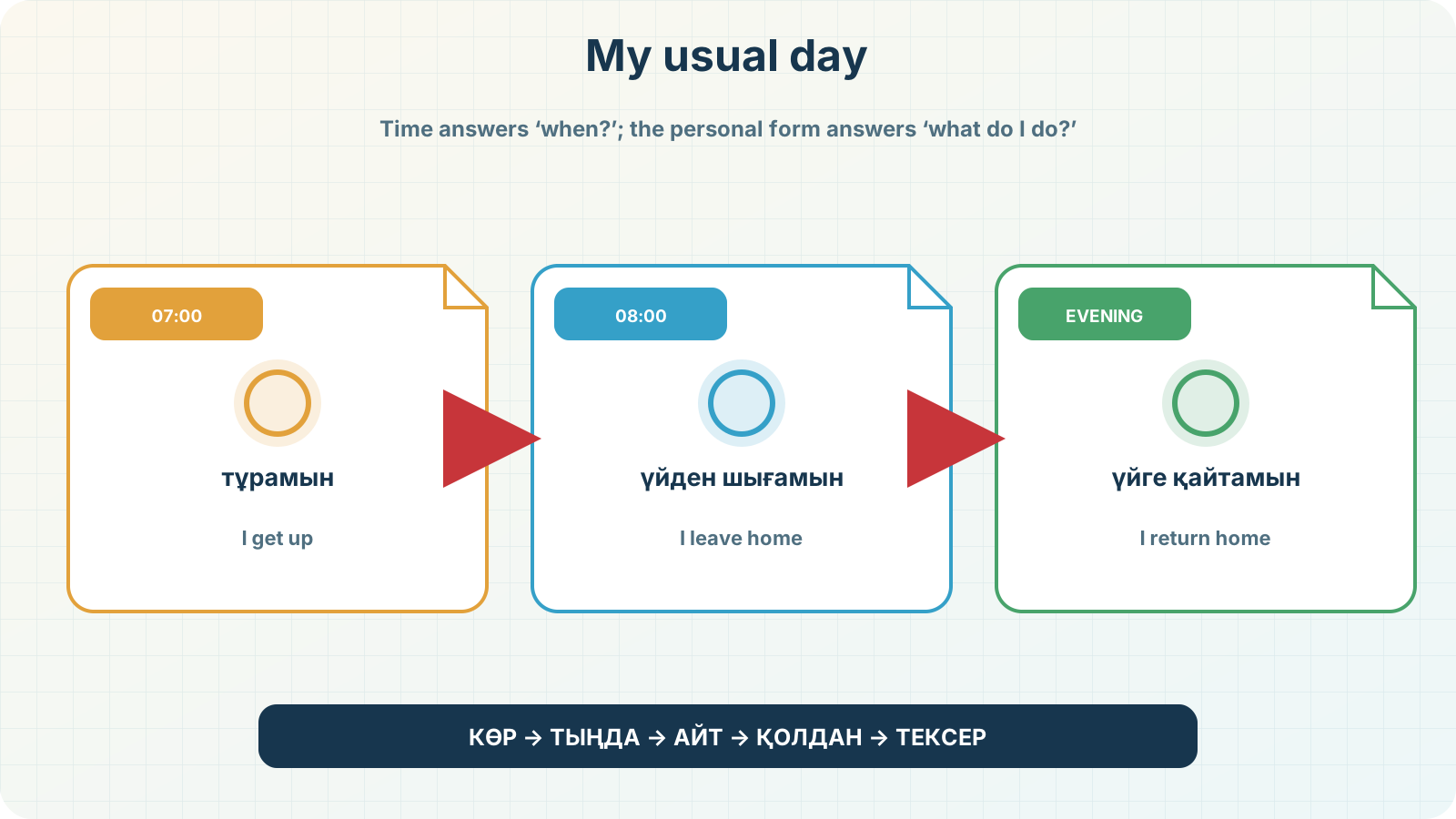
The support map presents an action as a short route: the situation cue, a useful line, the other person’s response, and a result check. Trace the arrows and state the meaning of each node, then hide the map and rebuild it on a blank sheet. Colour helps you find a step, but the response must eventually work without colour.
A real situation
In the morning, family members hurry to different activities. To coordinate who leaves and when, you describe a realistic version of your day instead of memorising someone else’s routine.
Listen and respond
Listen: Мен сағат жетіде тұрамын. — I get up at seven.
Listen: Таңертең бетімді жуамын. — I wash my face in the morning.
Listen: Мен таңғы ас ішемін. — I have breakfast.
Listen: Сағат сегізде үйден шығамын. — I leave home at eight.
Listen: Күндіз оқимын және жұмыс істеймін. — I study and work during the day.
Listen: Кешке үйге қайтамын. — I return home in the evening.
How to practise
On the first listen, hide the text and identify the place and the speaker’s intention. On the second, reveal the Kazakh line, divide it into meaning units, and repeat after the recording without rushing. On the third, remove the model, change the time, product, service, or reason, and produce your own line. The recording models pronunciation; an appropriate response or action proves comprehension.
The precise model
A habitual Kazakh action can be built from a verb stem, the present-future form, and a personal ending: тұр-а-мын, жу-а-мын, іш-е-мін, шық-а-мын, and қайт-а-мын. The final -мын/-мін marks the speaker as ‘I’. Choose the whole form through a living model and notice harmony; do not pronounce the pieces separately.
The support signal
ҚАШАН? → НЕ ІСТЕЙМІН? → таңертең тұрамын → күндіз оқимын → кешке қайтамын
The limit of the rule
This form can describe both a habit and a near intention; time and context resolve the meaning. In a routine, Мен сағат жетіде тұрамын states a habit. Do not present one schedule as correct for every family, and do not place a child’s real address in the project.
Predict before the explanation
Before reading the model, inspect the situation and choose the line that would actually complete the task. Record your prediction. After the explanation, identify the meaning cue rather than an isolated ending: habit, sequence, quantity, request, appointment time, symptom, or detected error.
Rebuild it without the prompt
Hide the page and draw the four main nodes of the support map in sixty seconds. Use the drawing to produce the familiar line, one changed line, and an appropriate reply. If a step disappears, reveal only that area and rebuild the chain once more.
Find and repair the mistake
A learner says мен тұрады: the subject is мен, while the ending belongs with third person. Restore the matching pair мен тұрамын. Then change only the person and compare ол тұрады so that the ending has a visible purpose.
Transfer to a new setting
Change the life task itself: another morning, purchase, dish, time, institution, or problem. A partner supplies one unseen card and checks whether you clarify its meaning instead of reciting the practised dialogue.
Change to the My World project
Add a privacy-safe timeline to My World 1.0: six actions, three parts of the day, and two exact times. You may invent the routine instead of publishing personal information.
Exercise
Required. Mix six daily-action cards and restore their order. Describe four actions in first person. Transfer check. A partner changes two time cards; rebuild the account without a script.
Retrieval after 1, 7, and 30 days
- Tomorrow rebuild the support map and act out two lines without reading.
- After seven days complete a new everyday task and meet at least 7 of 10 criteria.
- After thirty days use the construction in a safe real setting and mark the support you no longer need.
Next lesson: First, then, finally: turning a list into a story
If you have found a mistake or a typo in this article, tell us about it
Comments (0)
Log in to leave a comment →
No comments yet. Be the first.