


Kazakh: start speaking from the first meeting Lesson 58 of 64
Hear a question before the answer: particle and intonation
You will recognise a yes-or-no question in flowing speech and identify what needs confirmation.
This text was translated with AI.
Where we are on the map
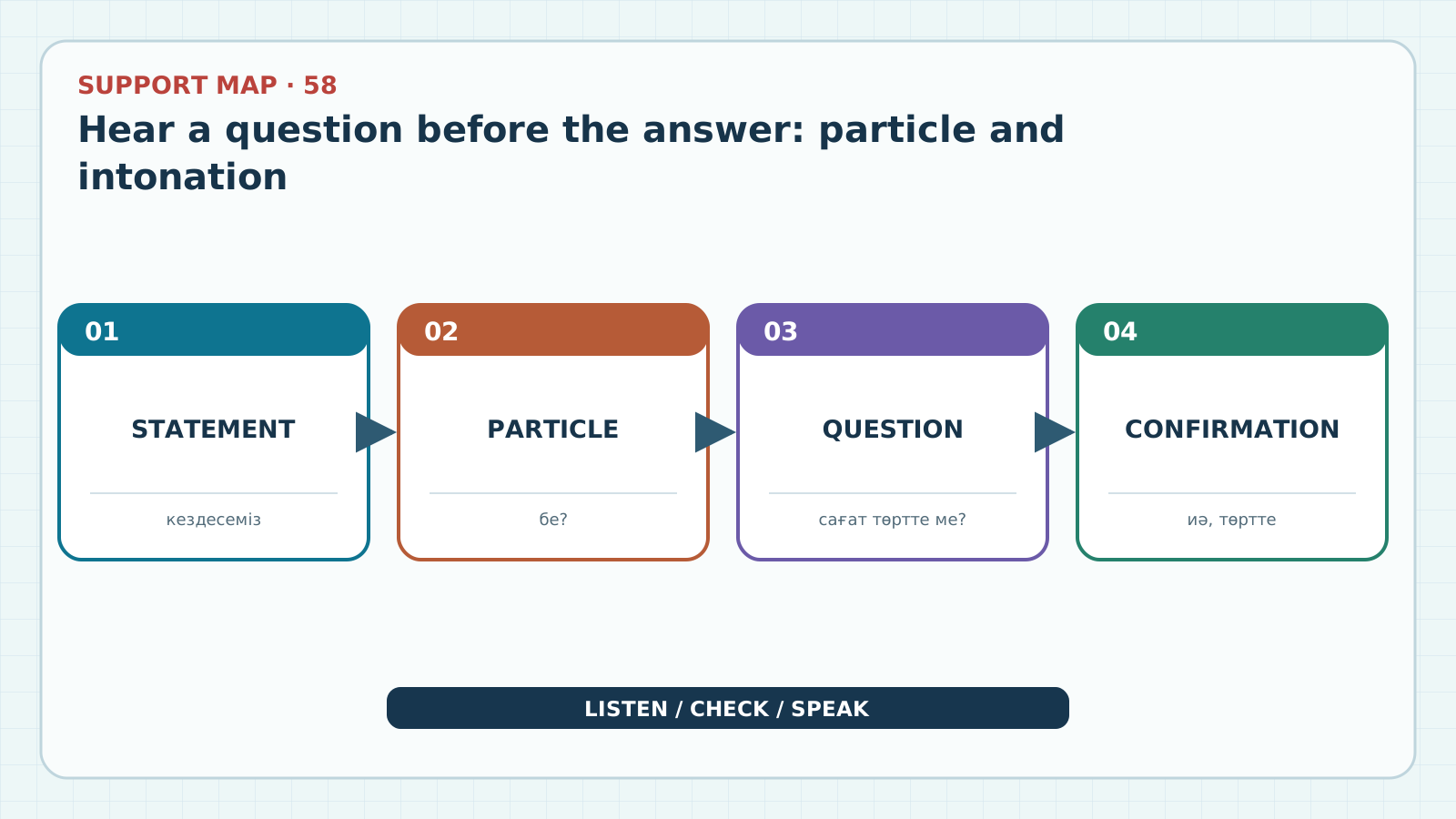
Trace the four nodes with a finger. Hide the diagram and recover only facts you actually heard. The colours mark message roles; they do not imply every sentence contains four special words.
A real situation
In a voice message, the group agrees on a meeting time. One person states a plan and another asks about it. Distinguish a question from a statement without relying only on tone.
Listen and respond
Listen: Бүгін сағат төртте кездесеміз. — We meet at four today.
Listen: Бүгін сағат төртте кездесеміз бе? — Do we meet at four today?
Listen: Иә, сағат төртте кездесеміз. — Yes, we meet at four.
Listen: Сіз бүгін келе аласыз ба? — Can you come today?
Listen: Жоқ, мен ертең келемін. — No, I will come tomorrow.
Listen: Кездесу кітапханада ма? — Is the meeting at the library?
How to practise
First play the recordings with the transcript covered and state only the main meaning. On a second pass note anchor words; on a third, check the written lines. Do not let reading replace listening. Repeat the whole phrase at a natural pace instead of spelling every letter aloud. If the first pass leaves a gap, keep the main point and fill one missing detail on the next pass.
The precise model
In кездесеміз versus кездесеміз бе?, the separate particle бе marks a question. Final pitch can help too, but speakers vary. Find the particle first; then identify the time or place being confirmed.
The support signal
ХАБАР → ШЫЛАУ → СҰРАҚ → РАСТАУ
The limit of the rule
Ма/ме/ба/бе/па/пе are written separately. A rise in pitch alone is not proof of a question; a statement can be expressive.
Predict before the explanation
Before reading the explanation, predict what the message is about and which fact your partner will need. Then compare your prediction with the recording and find one exact sound or word that changed your conclusion.
Rebuild it without the prompt
Hide the text and map. Sketch four support nodes in one minute, say a line from memory, and tell a partner which conclusion follows from it and which would be a guess.
Find and repair the mistake
A learner records Кездесу кітапханада ма? as proof that the meeting is at the library. Mark it as a question and wait for confirmation.
Transfer to a new setting
A partner changes only бе? into a statement. Decide whether the plan is now confirmed; ask for an answer if it is not.
Change to the My World project
Add an audio-message card to My World 2.0: verified fact, unknown detail, follow-up question and confirmed answer. Use fictional names and locations. Save a statement/question pair and mark which question is still unanswered.
Exercise
Shuffle the six lines. With the transcript hidden, mark each ? or ., then say which time and place remain unconfirmed.
Retrieval after 1, 7, and 30 days
- Tomorrow listen once and reconstruct the four nodes without text.
- After seven days use the technique with a new recording containing a different time, place or object.
- After thirty days retell what you heard to someone else and ask them to check its accuracy.
Next lesson: Gist first, details second: listen to an announcement
If you have found a mistake or a typo in this article, tell us about it
Comments (0)
Log in to leave a comment →
No comments yet. Be the first.