

Kazakh: start speaking from the first meeting Lesson 22 of 48
Across the city by bus and on foot
You will ask for the correct bus, mark transport with -мен/-бен/-пен, and understand a short stop and journey-time announcement.
This text was translated with AI.
Where we are on the map
The support is a route rather than a poster to memorise. Find the starting point, trace the arrows, and name the meaning of each step. Then hide the map and rebuild it on a blank sheet.
A real situation
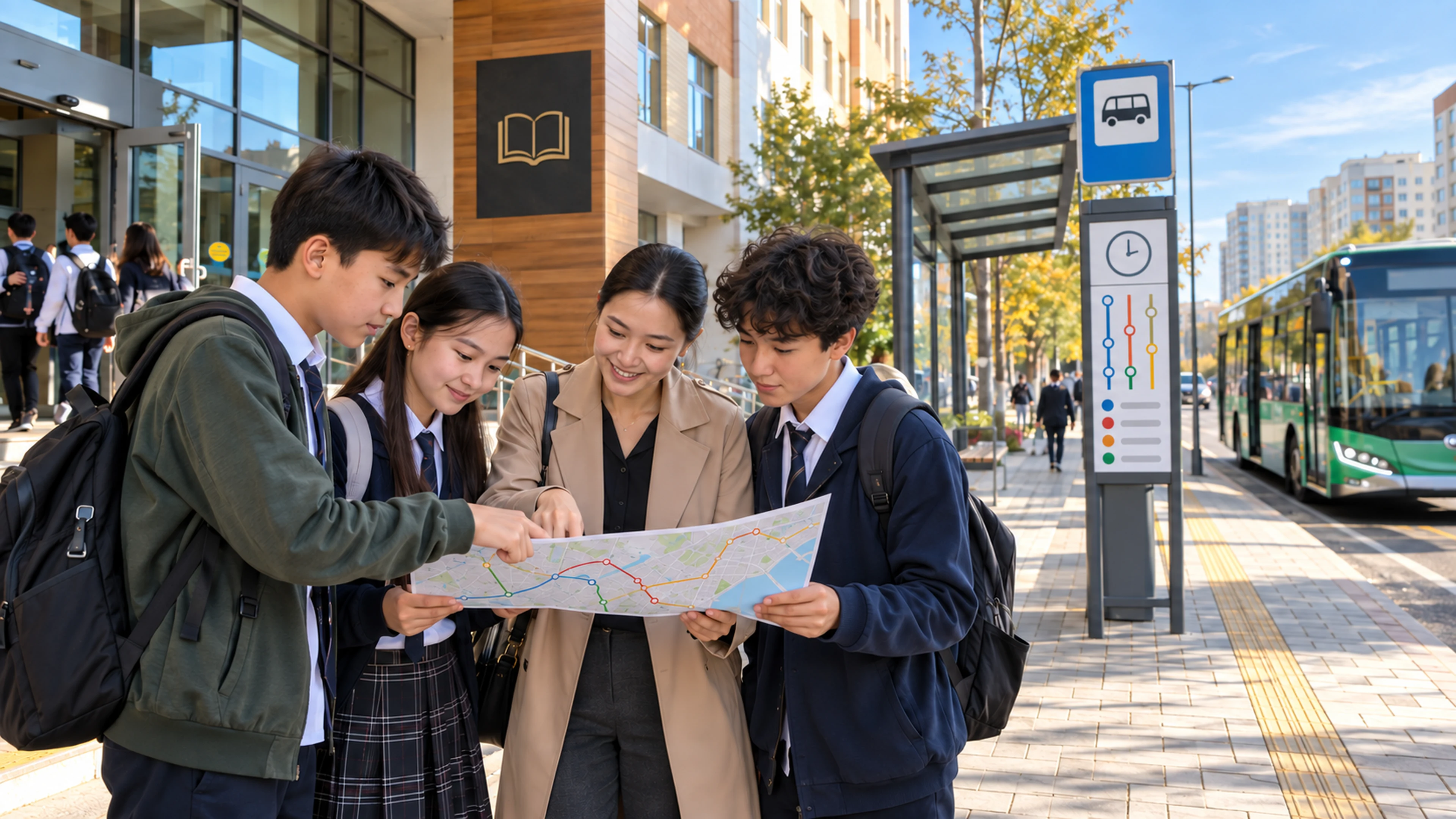
You are at a stop in an unfamiliar part of the city. You need to select a bus to the centre, confirm its direction, and know where to leave without reciting a long address.
Listen and respond
Listen: Мен мектепке автобуспен барамын. — I go to school by bus.
Listen: Қай автобус орталыққа барады? — Which bus goes to the centre?
Listen: Он екінші автобуспен барыңыз. — Take bus number twelve.
Listen: Аялдама қайда? — Where is the stop?
Listen: Келесі аялдама — кітапхана. — The next stop is the library.
Listen: Жол шамамен он бес минут. — The trip is about fifteen minutes.
How to practise
On the first listen, hide the text and identify only the situation. On the second, reveal the Kazakh line, point to its meaning units, and repeat after the recording. On the third, remove the model, change a place, time, or direction card, and produce a new sentence. The recording supplies a pronunciation model; compare your speech with it or ask a live speaker to check it.
The precise model
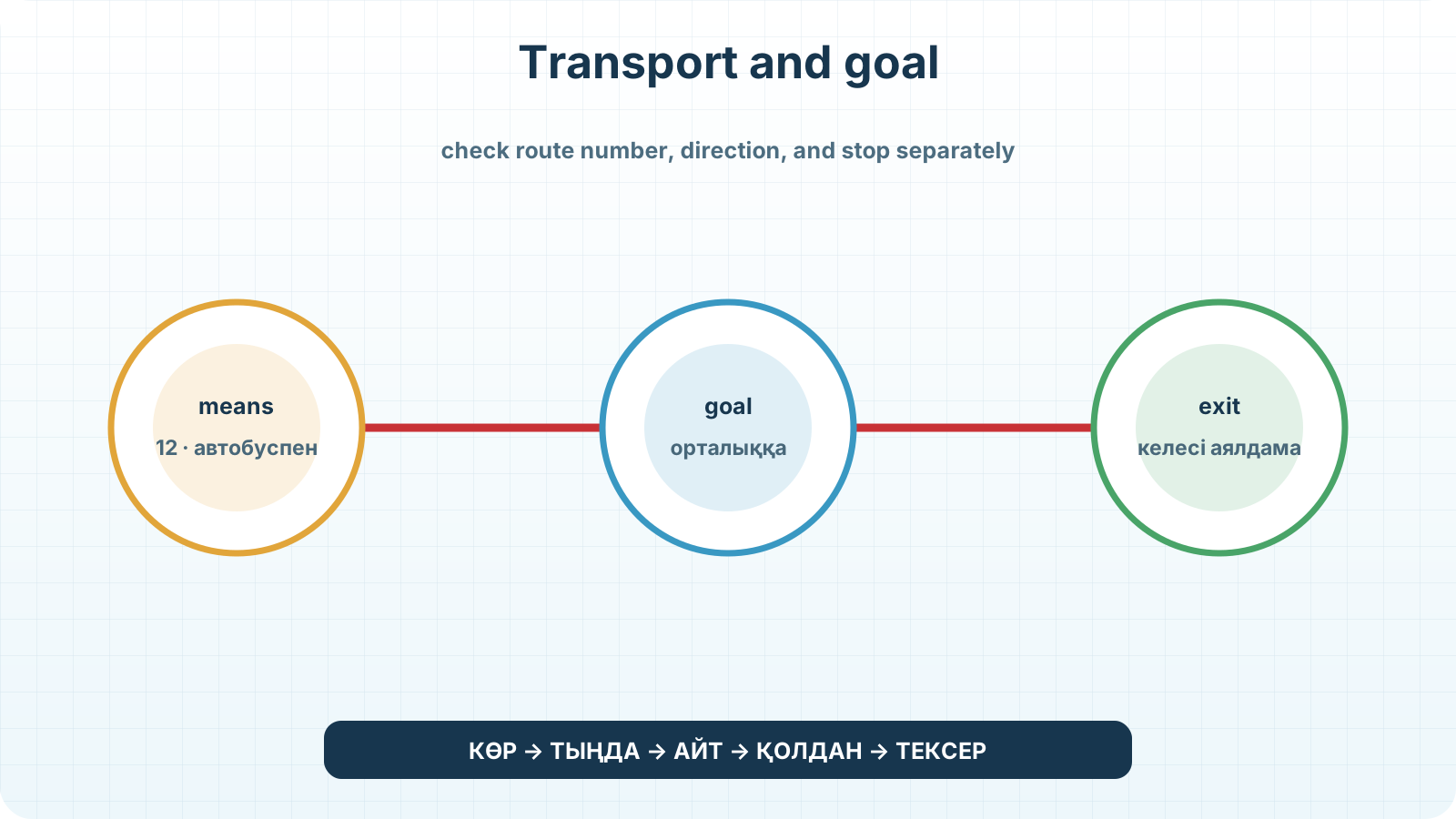
The means of movement answers немен?: автобуспен, таксимен, велосипедпен. The endings -мен/-бен/-пен are sound-conditioned versions of one instrumental function. Walking is normally expressed with the separate word жаяу. A route number uses an ordinal: он екінші автобус.
The support signal
НЕМЕН? → автобуспен / таксимен / велосипедпен | жаяу
The limit of the rule
The transport form identifies a means, not a correct destination. Confirm the goal separately with орталыққа бара ма? On a real journey, verify the number and stop with the operator’s official map; a language exercise cannot replace current transport information.
Predict before the explanation
Before reading the rule, inspect the new cards and choose a form by meaning: where an action happens, where a route starts, where it ends, when an event starts, or which rule applies. Record the prediction, then explain which signal confirmed or changed it.
Rebuild it without the prompt
Hide the page and draw the support from memory in sixty seconds. Use it to say three lines: the familiar model, one changed line, and one entirely your own. If a link is missing, reveal only that link, hide the page again, and rebuild the whole chain.
Find and repair the mistake
A learner boards after hearing a familiar route number but never checks the destination. Add Орталыққа бара ма?, then separate the means автобуспен from the goal орталыққа.
Transfer to a new setting
Change the situation rather than replacing a single word: use another school, day, time, route, or rule. A partner supplies one unseen card and checks whether your ending still matches the intended meaning.
Change to the My World project
Add a fictional transport card to the project: route number, destination, next stop, approximate time, and a backup walking route.
Exercise
Required. Role-play a stop conversation with four questions and answers. Use two kinds of transport and жаяу. Transfer check. A partner changes the goal and number; verify both before choosing the route.
Retrieval after 1, 7, and 30 days
- Tomorrow rebuild the support and say four lines without reading.
- After seven days work with a new route or timetable and meet at least 7 of 10 criteria.
- After thirty days use the construction in a safe real setting and mark the support you no longer need.
Next lesson: May, must not, and need to: understanding rules
If you have found a mistake or a typo in this article, tell us about it
Comments (0)
Log in to leave a comment →
No comments yet. Be the first.