

Kazakh: start speaking from the first meeting Lesson 6 of 16
Questions without fear: open a slot for the unknown
You will build questions with `кім`, `не`, `қайда`, and `қайдан`, then use the separate question particle in verified `ба/бе/па/пе` examples.
This text was translated with AI.
Where we are on the map
The map holds the whole route; we will add its details one at a time.
A real situation
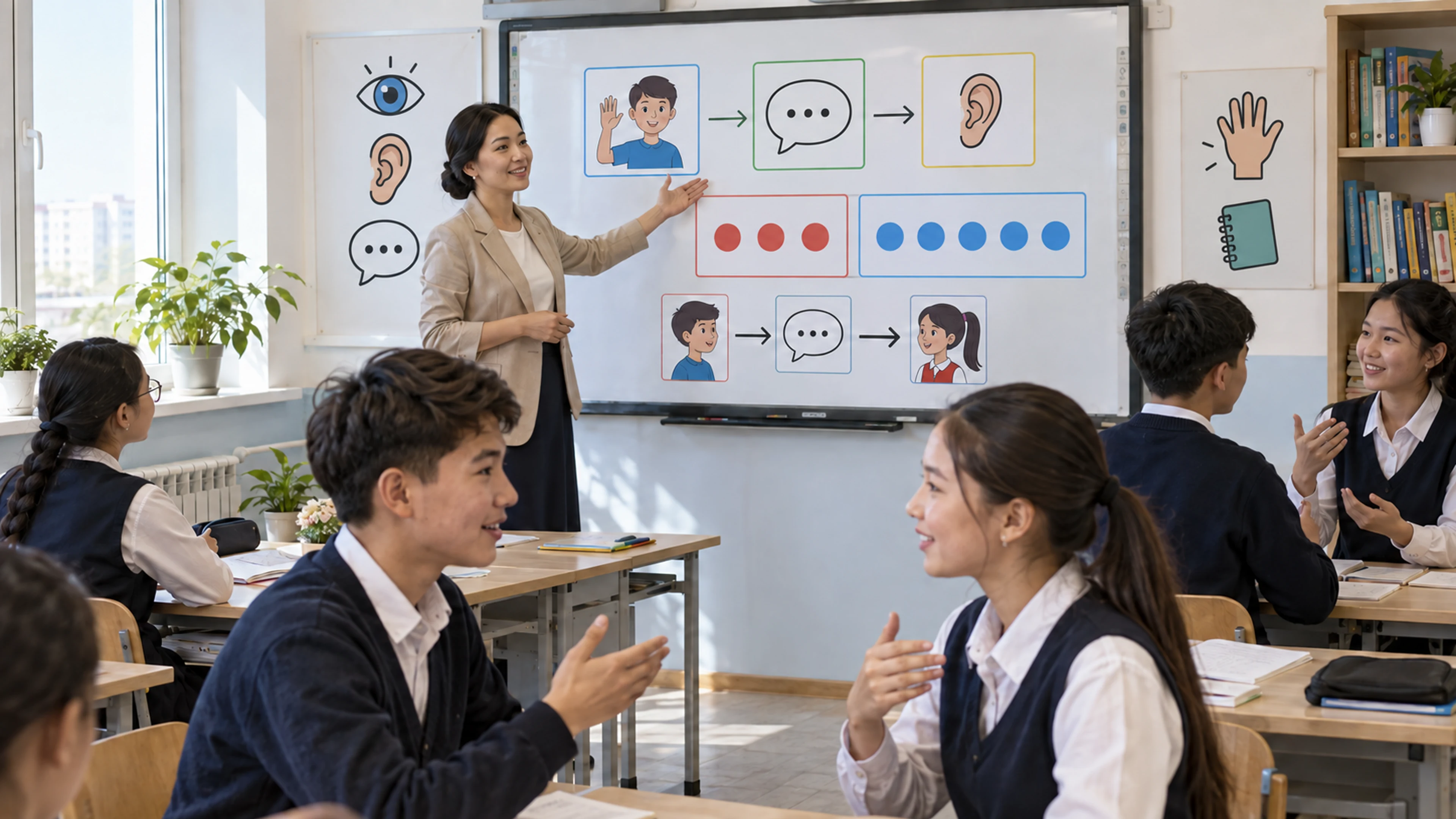
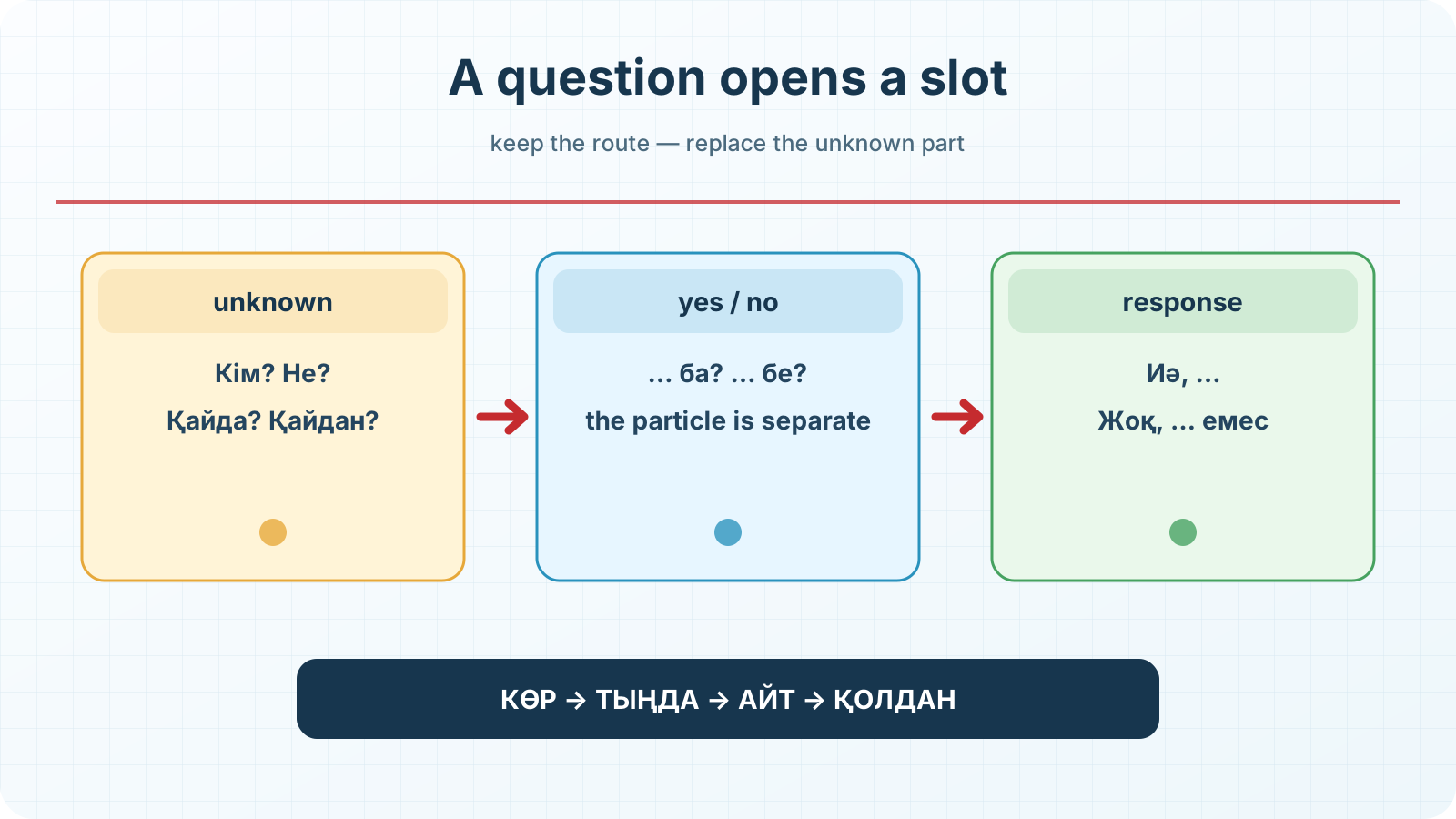
Think of a question as an open slot in a familiar route. A statement contains a person, thing, or place; a question replaces the unknown part with a precise question word. A yes-or-no question has no missing slot, so a separate question particle appears at the end.
Listen and respond
Listen: Сіздің атыңыз кім? — what is your name?
Listen: Бұл не? — what is this?
Listen: Сіз қайда тұрасыз? — where do you live?
Listen: Сіз қайдансыз? — where are you from?
Listen: Сіз оқушысыз ба? — are you a student?
Listen: Бұл мектеп пе? — is this a school?
How to practise
Press the button and look away from the text first: catch the overall meaning and just one new sound or structural choice. On the second pass, follow the phrase and the support map with your finger. Hide the model, rebuild it from two or three signs, and say a version of your own. Finish with a partner or a voice recorder: respond without preparation and note one place where you paused. Return to that link only instead of rereading the whole lesson.
The precise model
Кім? asks about a person, не? about a thing or idea, қайда? about a location, and қайдан? about a point of origin. Put the question word in the slot whose answer is unknown. Use a separate particle for yes or no: Сіз оқушысыз ба?, Бұл мектеп пе?. It follows harmony and the final sound of the preceding word, but it is always written separately.
The support signal
КІМ? · НЕ? · ҚАЙДА? · ҚАЙДАН? | ИӘ/ЖОҚ → … БА/БЕ/ПА/ПЕ?
The limit of the rule
Do not import an English auxiliary verb or rely only on Russian-style intonation. Rising intonation does not complete the written form, and the particle does not attach to the word. A full choice among ма/ме, ба/бе, па/пе requires the final sound. Today we use verified pairs and notice why they differ instead of guessing every variant.
Predict before the explanation
Choose a question word for each answer: Аружан, кітап, мектепте, Қостанайдан. Then inspect оқушысыз and мектеп and predict why the finished questions use different particles, ба and пе.
Rebuild it without the prompt
Hide the page and draw four empty slots labelled person, thing, place, and origin. Rebuild the Kazakh question words. Draw a separate yes/no switch and write two particles from the examples with a visible space before each.
Find and repair the mistake
A learner says Сіз қайда Қостанайдансыз?, mixing location with origin. Choose one unknown meaning and its matching word. In мектеппе, locate the boundary between the main word and particle and restore the space.
Transfer to a new setting
Interview a fictional character. Ask about name, role, location, and origin, followed by one yes-or-no question. A partner may answer from cards. If a question needs a form not yet taught, simplify it to a frame from this lesson.
Change to the My World project
Add five visitor questions to the project card: who the character is, what the place is, where it is, where the character is from, and whether one guess is correct. Leave a blank field under each for another learner’s safe answer.
Exercise
Required. Write four questions with different question words and one with a separate particle. Answer them as a fictional character in short complete lines.
Transfer check. Receive four new answers without their questions and reconstruct the question for each. Explain which unknown slot controlled your choice.
Retrieval after 1, 7, and 30 days
- Tomorrow rebuild the four question words and two questions without the page.
- After seven days, run a one-minute interview from random answer cards.
- After thirty days, inspect the project for a space before every question particle.
If you have found a mistake or a typo in this article, tell us about it
Comments (0)
Log in to leave a comment →
No comments yet. Be the first.