

Kazakh: start speaking from the first meeting Lesson 20 of 48
Straight, right, left: guiding someone politely
You will understand three directions and give a short polite instruction with -ңыз/-ңіз.
This text was translated with AI.
Where we are on the map
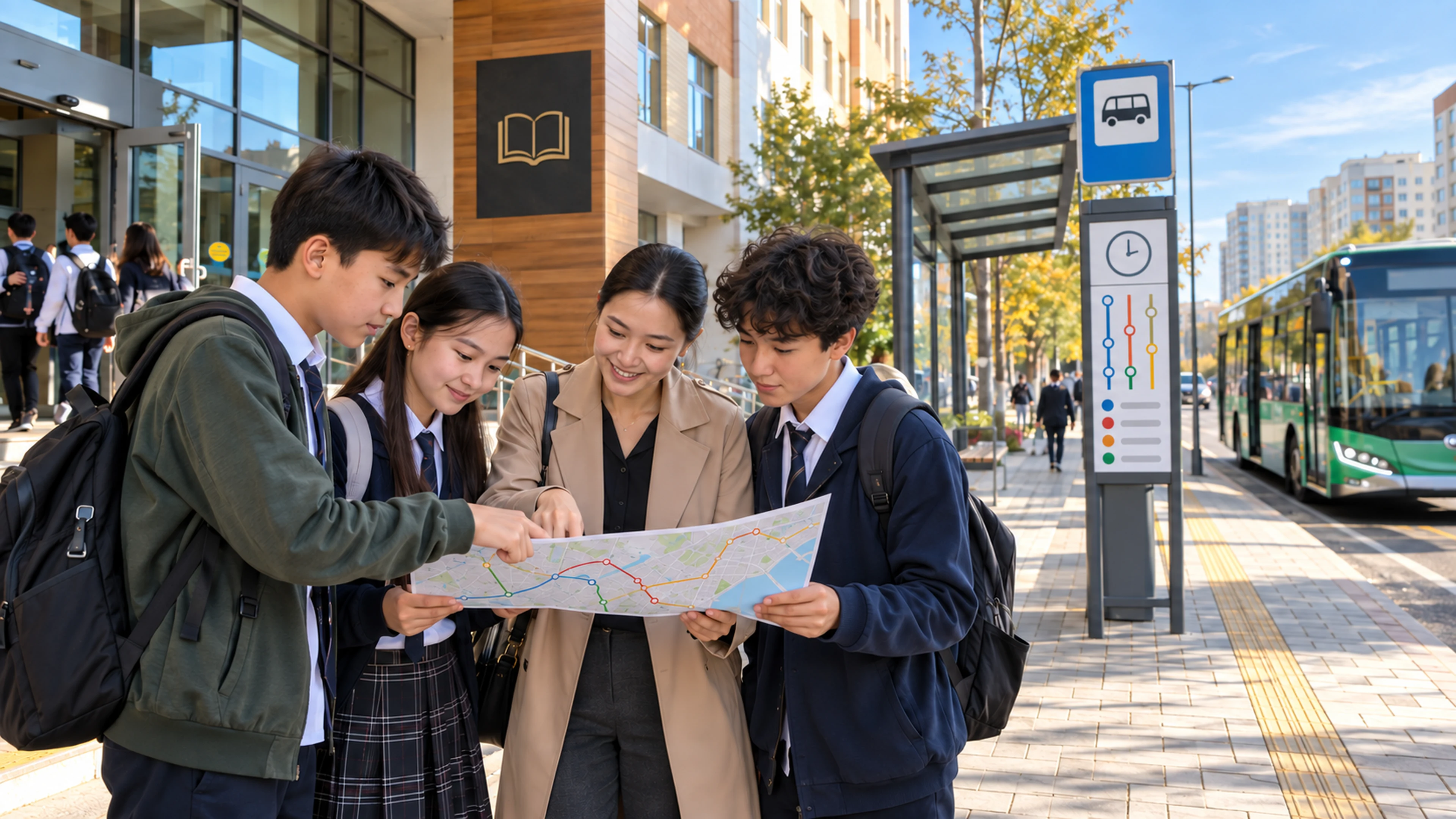
The support is a route rather than a poster to memorise. Find the starting point, trace the arrows, and name the meaning of each step. Then hide the map and rebuild it on a blank sheet.
A real situation
A visitor is at the entrance looking for the library. Their map will not open, so you must guide them by voice through a straight section, a turn, a floor, and a stopping point.
Listen and respond
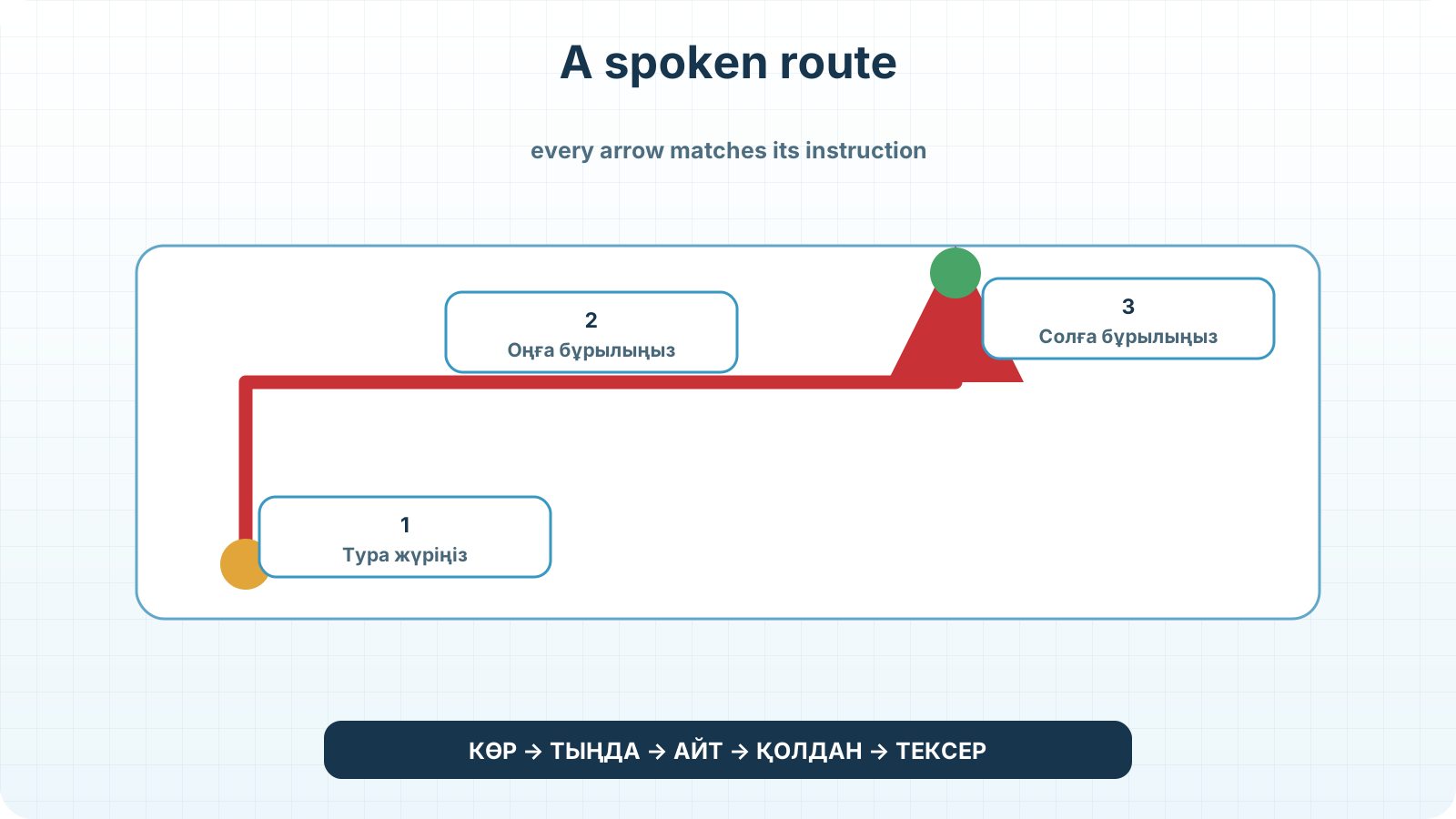
Listen: Тура жүріңіз. — Go straight.
Listen: Оңға бұрылыңыз. — Turn right.
Listen: Солға бұрылыңыз. — Turn left.
Listen: Екінші қабатқа көтеріліңіз. — Go up to the second floor.
Listen: Есіктің жанында тоқтаңыз. — Stop by the door.
Listen: Рақмет, кітапхананы таптым. — Thank you, I found the library.
How to practise
On the first listen, hide the text and identify only the situation. On the second, reveal the Kazakh line, point to its meaning units, and repeat after the recording. On the third, remove the model, change a place, time, or direction card, and produce a new sentence. The recording supplies a pronunciation model; compare your speech with it or ask a live speaker to check it.
The precise model
An instruction combines an orientation with an action. Тура, оңға, and солға set the direction. Жүріңіз, бұрылыңыз, көтеріліңіз, and тоқтаңыз address one person politely or several people. Harmony and the stem affect the visible ending, while the respectful function remains constant.
The support signal
БАҒЫТ → тура / оңға / солға → ӘРЕКЕТ + -ҢЫЗ/-ҢІЗ
The limit of the rule
A short command without the respectful ending can be natural among close people or in an emergency, but the polite form is a safe default for a beginner. Оң жақта locates something on the right; оңға sends movement to the right. The arrow must match the sentence or the support will teach an error.
Predict before the explanation
Before reading the rule, inspect the new cards and choose a form by meaning: where an action happens, where a route starts, where it ends, when an event starts, or which rule applies. Record the prediction, then explain which signal confirmed or changed it.
Rebuild it without the prompt
Hide the page and draw the support from memory in sixty seconds. Use it to say three lines: the familiar model, one changed line, and one entirely your own. If a link is missing, reveal only that link, hide the page again, and rebuild the whole chain.
Find and repair the mistake
A diagram points left while its caption says Оңға бұрылыңыз. Do not memorise conflicting signals. Repair the source so that direction, gesture, and word all agree.
Transfer to a new setting
Change the situation rather than replacing a single word: use another school, day, time, route, or rule. A partner supplies one unseen card and checks whether your ending still matches the intended meaning.
Change to the My World project
Draw a safe route through a fictional school and add four instructions. Another learner should be able to follow it without extra explanation.
Exercise
Required. Give a five-action route containing one straight section, two turns, one floor change, and one stop. Swap two cards and say the repaired route. Listening check. Follow four partner instructions without seeing the text.
Retrieval after 1, 7, and 30 days
- Tomorrow rebuild the support and say four lines without reading.
- After seven days work with a new route or timetable and meet at least 7 of 10 criteria.
- After thirty days use the construction in a safe real setting and mark the support you no longer need.
If you have found a mistake or a typo in this article, tell us about it
Comments (0)
Log in to leave a comment →
No comments yet. Be the first.