

Kazakh: start speaking from the first meeting Lesson 18 of 48
Week and school subjects: reading a timetable by meaning
You will connect a weekday with a subject and read a simple timetable without translating every cell word by word.
This text was translated with AI.
Where we are on the map
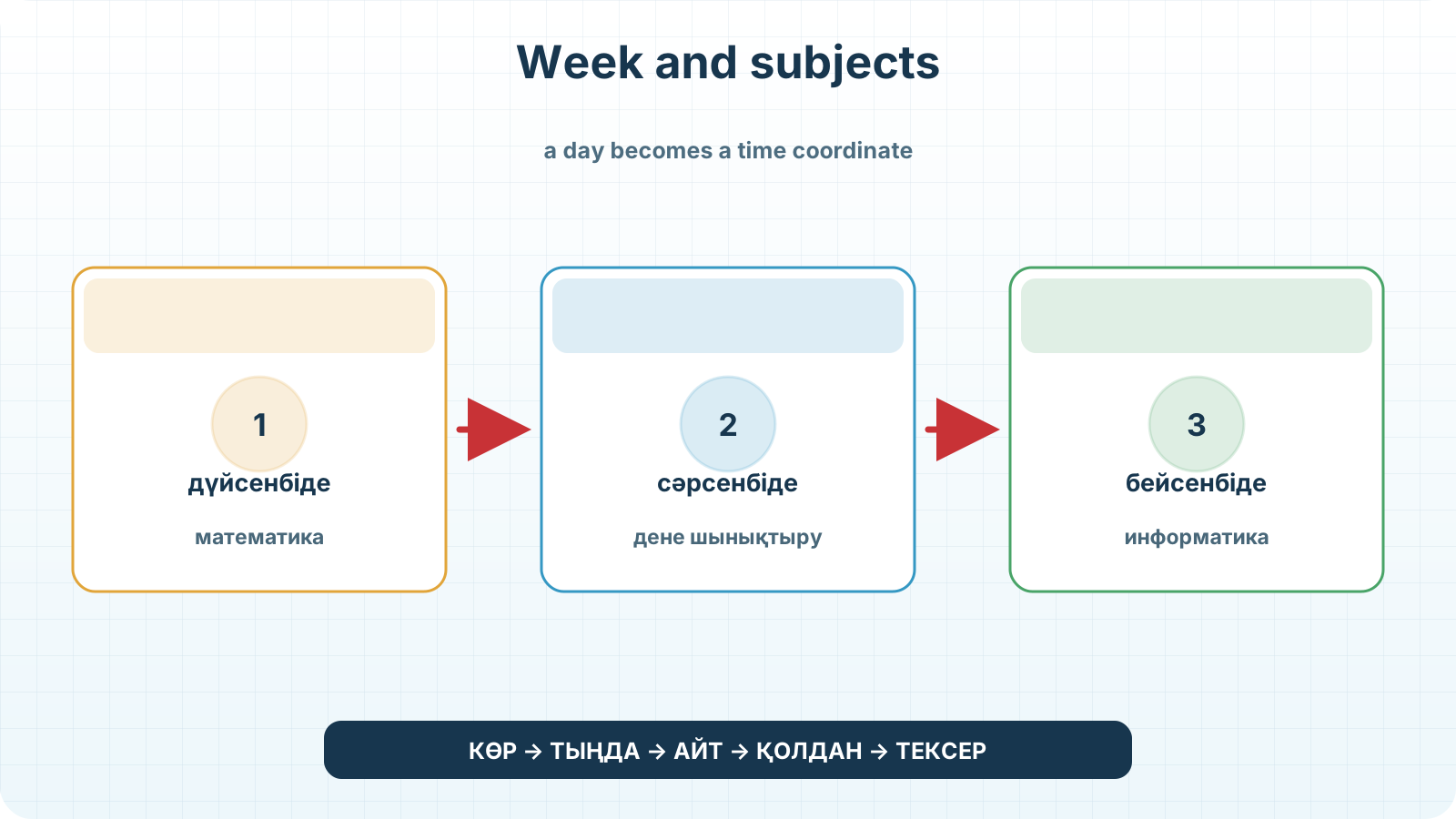
The support is a route rather than a poster to memorise. Find the starting point, trace the arrows, and name the meaning of each step. Then hide the map and rebuild it on a blank sheet.
A real situation
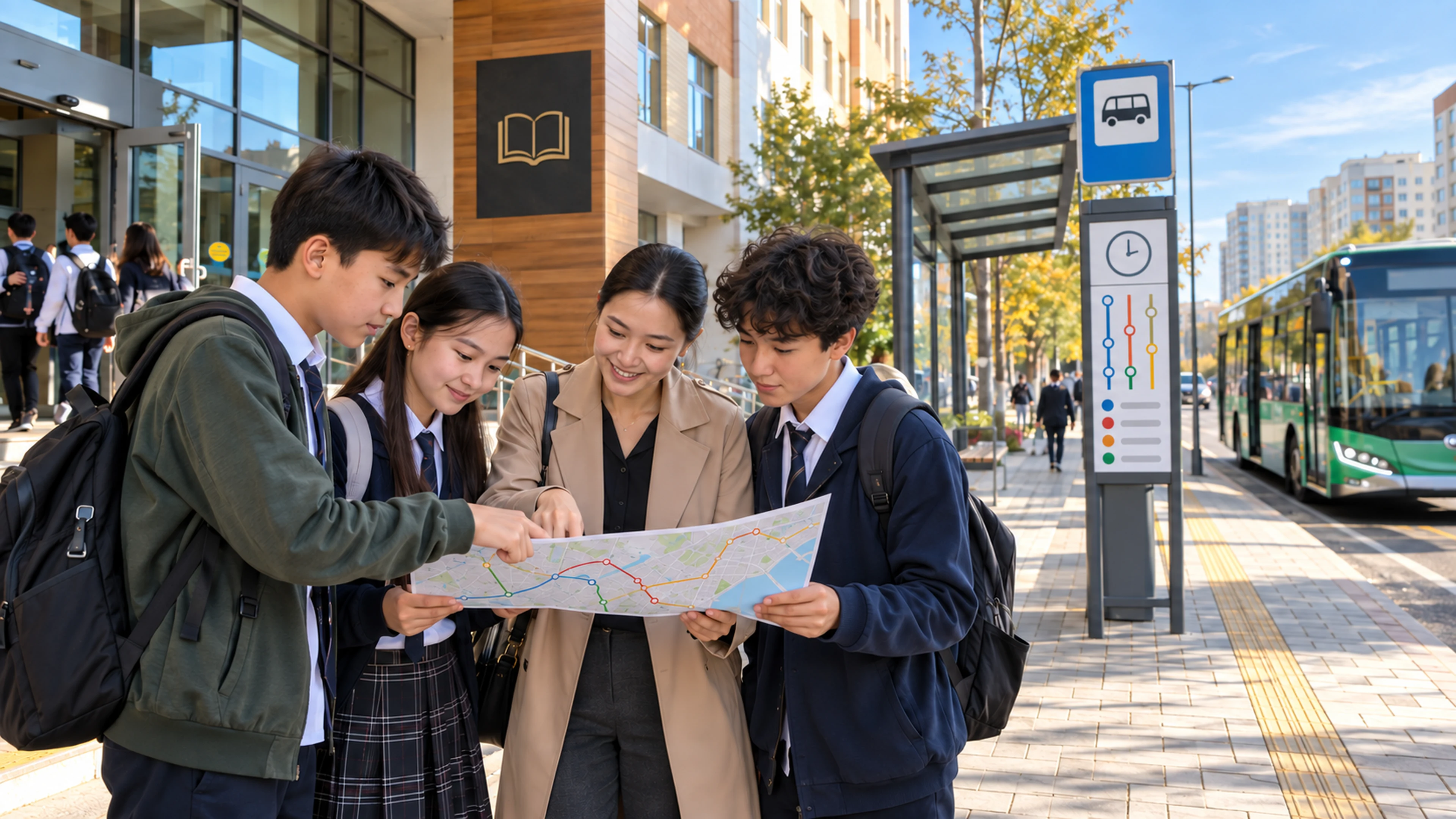
A school chat contains an unexplained timetable. You must identify the days for mathematics, Kazakh, physical education, and computing, then announce one change.
Listen and respond
Listen: Бүгін дүйсенбі. — Today is Monday.
Listen: Бірінші сабақ — математика. — The first lesson is mathematics.
Listen: Қазақ тілі сабағы сейсенбіде. — Kazakh is on Tuesday.
Listen: Сәрсенбіде дене шынықтыру бар. — There is physical education on Wednesday.
Listen: Бейсенбіде информатика бар. — There is computing on Thursday.
Listen: Жұмада сабақ сағат екіде аяқталады. — On Friday lessons finish at two.
How to practise
On the first listen, hide the text and identify only the situation. On the second, reveal the Kazakh line, point to its meaning units, and repeat after the recording. On the third, remove the model, change a place, time, or direction card, and produce a new sentence. The recording supplies a pronunciation model; compare your speech with it or ask a live speaker to check it.
The precise model
A weekday becomes a time cell with the same locative ending: дүйсенбіде, сейсенбіде, сәрсенбіде, бейсенбіде, and жұмада. A subject or event fills that cell: информатика бар, сабақ аяқталады. The ordinal бірінші answers where a lesson stands in a sequence.
The support signal
КҮН + -ДА/-ДЕ → ПӘН / САБАҚ → бар / басталады / аяқталады
The limit of the rule
Kazakh does not need a separate preposition equivalent to ‘on’ before a weekday; the ending makes the day a time coordinate. Жұмада follows the back-vowel lane, while most other weekday examples use -де. A timetable states a plan and does not prove that an event actually occurred.
Predict before the explanation
Before reading the rule, inspect the new cards and choose a form by meaning: where an action happens, where a route starts, where it ends, when an event starts, or which rule applies. Record the prediction, then explain which signal confirmed or changed it.
Rebuild it without the prompt
Hide the page and draw the support from memory in sixty seconds. Use it to say three lines: the familiar model, one changed line, and one entirely your own. If a link is missing, reveal only that link, hide the page again, and rebuild the whole chain.
Find and repair the mistake
A learner writes сейсенбі математика and leaves the relationship implicit. Add the time coordinate: Сейсенбіде математика сабағы бар. A table headed by a weekday can use a short label, but an independent spoken sentence must state the link.
Transfer to a new setting
Change the situation rather than replacing a single word: use another school, day, time, route, or rule. A partner supplies one unseen card and checks whether your ending still matches the intended meaning.
Change to the My World project
Add a privacy-safe fictional five-day timetable and four subject symbols to version 0.3. Never publish a child’s real timetable.
Exercise
Required. Read six timetable cells and produce five weekday sentences. Move one subject to another day and explain the change aloud. Comprehension check. A partner asks three қай күні? questions; answer without looking at the table.
Retrieval after 1, 7, and 30 days
- Tomorrow rebuild the support and say four lines without reading.
- After seven days work with a new route or timetable and meet at least 7 of 10 criteria.
- After thirty days use the construction in a safe real setting and mark the support you no longer need.
If you have found a mistake or a typo in this article, tell us about it
Comments (0)
Log in to leave a comment →
No comments yet. Be the first.